115195
论文已发表
注册即可获取德孚的最新动态
IF 收录期刊
- 3.6 Breast Cancer (Dove Med Press)
- 4.3 Clin Epidemiol
- 2.6 Cancer Manag Res
- 3.2 Infect Drug Resist
- 4.1 Clin Interv Aging
- 6.1 Drug Des Dev Ther
- 4.1 Int J Chronic Obstr
- 8.7 Int J Nanomed
- 2.5 Int J Women's Health
- 3.2 Neuropsych Dis Treat
- 2.4 OncoTargets Ther
- 2.6 Patient Prefer Adher
- 2.6 Ther Clin Risk Manag
- 3.1 J Pain Res
- 3.5 Diabet Metab Synd Ob
- 4.5 Psychol Res Behav Ma
- 3.4 Nat Sci Sleep
- 2.4 Pharmgenomics Pers Med
- 2.6 Risk Manag Healthc Policy
- 4.6 J Inflamm Res
- 2.3 Int J Gen Med
- 3.9 J Hepatocell Carcinoma
- 3.3 J Asthma Allergy
- 2.5 Clin Cosmet Investig Dermatol
- 3.0 J Multidiscip Healthc

长非编码 RNA LINC00662 通过靶向胶质瘤中的 miR-34a-5p/LMAN2L 轴来调控增殖和迁移
Authors Geng Y, Wu Y, Xu C, Li T, Zhang L
Received 21 July 2020
Accepted for publication 4 September 2020
Published 9 October 2020 Volume 2020:13 Pages 10161—10172
DOI https://doi.org/10.2147/OTT.S272616
Checked for plagiarism Yes
Review by Single anonymous peer review
Peer reviewer comments 2
Editor who approved publication: Prof. Dr. Nicola Silvestris
Background: Numerous studies suggest that long non-coding RNAs (lncRNAs) participate in the biological process of diverse malignancies, including glioma. Although many differentially expressed lncRNAs have been identified in glioma, to our best knowledge, the role of LINC00662 and its potential underlying mechanism in glioma progression remains unclear. This study aimed to explore the function and regulatory network of LINC00662 in glioma.
Methods: Expressions of LINC00662, miR-34a-5p and lectin mannose-binding 2-like (LMAN2L) in glioma tissues were analyzed using The Cancer Genome Atlas Program (TCGA) and the Chinese Glioma Genome Atlas (CGGA) databases. Colony formation, Celltiter-Glo and BrdU (5-bromo-2ʹ-deoxyuridine) incorporation assays were used to detect cell proliferation in vitro. Xenograft mouse models were established to determine cell proliferation in vivo. Transwell and wound healing assay was used to detect cell migration. In addition, epithelial–mesenchymal transition (EMT) markers were detected by Western blot. Annexin V and 7-AAD were used to stain apoptotic cells. Interactions between miR-34a-5p and LINC00662 or the 3′-UTR of LMAN2L were predicted and determined by bioinformatics analysis, luciferase reporter assay and RNA immunoprecipitation (RIP) assays.
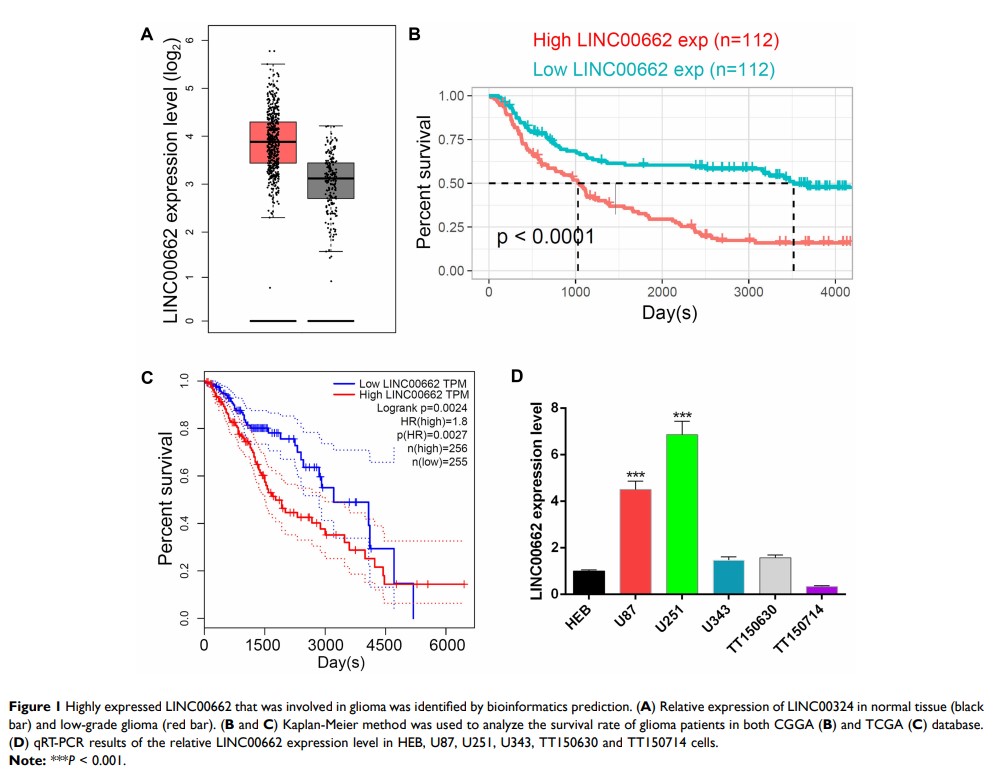
Results: High LINC00662 level predicted poor overall survival of glioma patients. Functional studies revealed that suppression of LINC00662 remarkably inhibited cell proliferation, clonogenicity and EMT pathway. Mechanistically, LINC00662 sponged miR-34a-5p to regulate LMAN2L expression. Furthermore, miR-34a-5p inhibitor reversed the anti-proliferation and anti-migration effect of LINC00662 knockdown, which could be rescued by downregulation of LMAN2L in glioma cells.
Conclusion: Our study was the first to report that LINC00662 acted as a competing endogenous RNA (ceRNA) to regulate glioma progression by targeting miR-34a-5p/LMAN2L axis, providing a new therapeutic target for glioma.
Keywords: long non-coding RNA, LINC00662, miR-34a-5p, LMAN2L, glioma, epithelial–mesenchymal transition