115195
论文已发表
注册即可获取德孚的最新动态
IF 收录期刊
- 3.6 Breast Cancer (Dove Med Press)
- 4.3 Clin Epidemiol
- 2.6 Cancer Manag Res
- 3.2 Infect Drug Resist
- 4.1 Clin Interv Aging
- 6.1 Drug Des Dev Ther
- 4.1 Int J Chronic Obstr
- 8.7 Int J Nanomed
- 2.5 Int J Women's Health
- 3.2 Neuropsych Dis Treat
- 2.4 OncoTargets Ther
- 2.6 Patient Prefer Adher
- 2.6 Ther Clin Risk Manag
- 3.1 J Pain Res
- 3.5 Diabet Metab Synd Ob
- 4.5 Psychol Res Behav Ma
- 3.4 Nat Sci Sleep
- 2.4 Pharmgenomics Pers Med
- 2.6 Risk Manag Healthc Policy
- 4.6 J Inflamm Res
- 2.3 Int J Gen Med
- 3.9 J Hepatocell Carcinoma
- 3.3 J Asthma Allergy
- 2.5 Clin Cosmet Investig Dermatol
- 3.0 J Multidiscip Healthc

CDKL1 促进结肠直肠癌的肿瘤增殖和侵袭
Authors Qin C, Ren L, Ji M, Lv S, Wei Y, Zhu D, Lin Q, Xu P, Chang W, Xu J
Received 23 January 2017
Accepted for publication 23 February 2017
Published 16 March 2017 Volume 2017:10 Pages 1613—1624
DOI https://doi.org/10.2147/OTT.S133014
Checked for plagiarism Yes
Review by Single-blind
Peer reviewers approved by Dr Amy Norman
Peer reviewer comments 2
Editor who approved publication: Dr Yao Dai
Background: CDKL1 is a member of the cell division cycle 2 (CDC2)-related
serine threonine protein kinase family and is overexpressed in malignant tumors
such as melanoma, breast cancer, and gastric cancer.
Objective: This study aimed to evaluate whether CDKL1 can serve
as a potential molecular target for colorectal cancer therapy.
Materials and methods: Expression of CDKL1 in colorectal cancer tissues and
cell lines was measured by immunohistochemistry and Western blot, respectively.
To investigate the role of CDKL1 in colorectal cancer, CDKL1-small hairpin
RNA-expressing lentivirus was constructed and infected into HCT116 and Caco2
cells. The effects of RNA interference (RNAi)-mediated CDKL1 downregulation on
cell proliferation and invasion were assessed by CCK-8, colony formation,
transwell, and tumorigenicity assays in nude mice. The effects of CDKL1
downregulation on cell cycle and apoptosis were analyzed by flow cytometry.
Furthermore, microarray method and data analysis elucidated the molecular
mechanisms underlying the phenomenon.
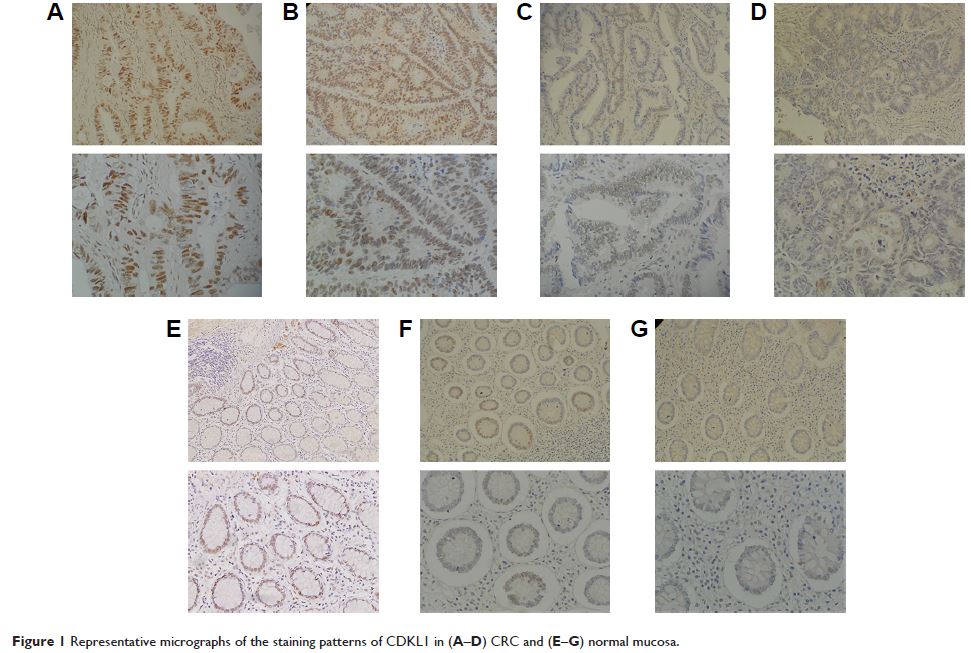
Results: CDKL1 protein was overexpressed in colorectal cancer
tissues compared with paired normal tissues. Knockdown of CDKL1 in HCT116 and
Caco2 significantly inhibited cell growth, colony formation ability, tumor
invasion, and G1–S phase transition of the cell cycle. The knockdown of CDKL1 stimulated
the upregulation of p15 and retinoblastoma protein.
Conclusion: CDKL1 plays a vital role in tumor proliferation and
invasion in colorectal cancer in vitro and in vivo and, thus, may be considered
as a valuable target for therapeutic intervention.
Keywords: CDKL1, cell cycle, protein kinases,
colorectal cancer