117333
论文已发表
注册即可获取德孚的最新动态
IF 收录期刊
- 3.6 Breast Cancer (Dove Med Press)
- 4.3 Clin Epidemiol
- 2.6 Cancer Manag Res
- 3.2 Infect Drug Resist
- 4.1 Clin Interv Aging
- 6.1 Drug Des Dev Ther
- 4.1 Int J Chronic Obstr
- 8.7 Int J Nanomed
- 2.5 Int J Women's Health
- 3.2 Neuropsych Dis Treat
- 2.4 OncoTargets Ther
- 2.6 Patient Prefer Adher
- 2.6 Ther Clin Risk Manag
- 3.1 J Pain Res
- 3.5 Diabet Metab Synd Ob
- 4.5 Psychol Res Behav Ma
- 3.4 Nat Sci Sleep
- 2.4 Pharmgenomics Pers Med
- 2.6 Risk Manag Healthc Policy
- 4.6 J Inflamm Res
- 2.3 Int J Gen Med
- 3.9 J Hepatocell Carcinoma
- 3.3 J Asthma Allergy
- 2.5 Clin Cosmet Investig Dermatol
- 3.0 J Multidiscip Healthc

NVP-AUY922,一种新型的 HSP90 抑制剂,可在体外和体内抑制恶性嗜铬细胞瘤的进展
Authors Lian JP, Lin D, Xie X, Xu Y, Xu L, Meng L, Zhu Y
Received 14 December 2016
Accepted for publication 13 March 2017
Published 19 April 2017 Volume 2017:10 Pages 2219—2226
DOI https://doi.org/10.2147/OTT.S130236
Checked for plagiarism Yes
Review by Single-blind
Peer reviewers approved by Dr Akshita Wason
Peer reviewer comments 2
Editor who approved publication: Dr Faris Farassati
Purpose: Malignant pheochromocytoma (PCC) is a rare tumor with a very
poor prognosis and no effective treatments. The aim of this study was to assess
the efficacy of a novel second-generation synthetic heat-shock protein 90
(HSP90) inhibitor, NVP-AUY922, to treat malignant PCC in vitro and in vivo.
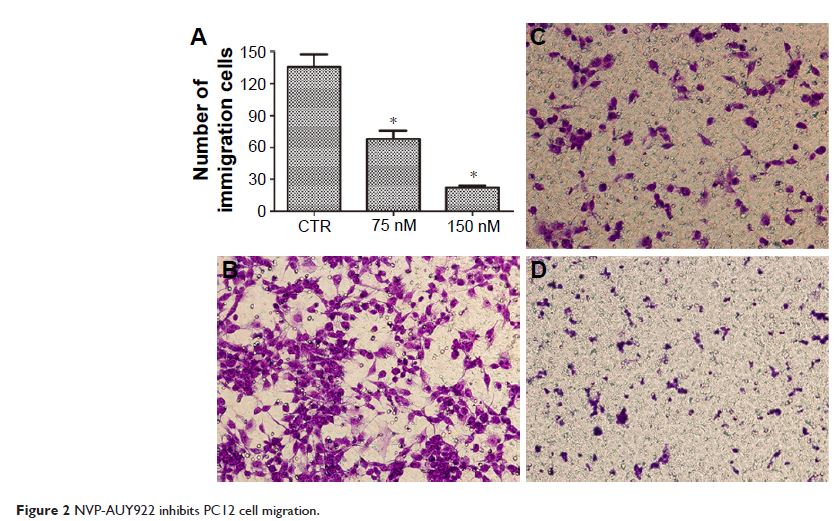
Materials and methods: Cell Counting Kit-8 (CCK-8) and Transwell assays were
used to assess the effects of NVP-AUY922 on the proliferation and migration of
the PCC cell line PC12. Flow cytometry was used to determine the effects of
NVP-AUY922 on apoptosis and cell-cycle progression. Activation of
phosphatidylinositol-3-kinase (PI3K)/protein kinase B (PKB/AKT) and
mitogen-activated protein kinase (MAPK)/extracellular signal-regulated kinase
(ERK) signaling was measured using a Western blot analysis. In vivo, a mouse
xenograft model was used to test the effects of intraperitoneal injection of
NVP-AUY922 on tumor growth.
Results: NVP-AUY922 was found to be cytotoxic in PC12 cells at
lower concentrations compared with 17-allylamino-17-demethoxygeldanamcyin
(17-AAG). NVP-AUY922 inhibited the proliferation of PC12 cells in a time- and
concentration-dependent manner and decreased the rate of migration of PC12
cells. Furthermore, we found that HSP90 inhibition induced cell-cycle arrest
and apoptosis. In vivo, administration of NVP-AUY922 reduced PCC tumor growth
without significant weight loss. Finally, we observed the modulation of MEK/ERK
and PI3K/AKT signaling in response to NVP-AUY922 exposure.
Conclusion: NVP-AUY922 exhibits potent anti-PCC activities in
vitro and in vivo and represents a promising therapeutic small molecule for
treating malignant PCC.
Keywords: pheochromocytoma, HSP90, NVP-AUY922,
xenograft model, therapy