117207
论文已发表
注册即可获取德孚的最新动态
IF 收录期刊
- 3.6 Breast Cancer (Dove Med Press)
- 4.3 Clin Epidemiol
- 2.6 Cancer Manag Res
- 3.2 Infect Drug Resist
- 4.1 Clin Interv Aging
- 6.1 Drug Des Dev Ther
- 4.1 Int J Chronic Obstr
- 8.7 Int J Nanomed
- 2.5 Int J Women's Health
- 3.2 Neuropsych Dis Treat
- 2.4 OncoTargets Ther
- 2.6 Patient Prefer Adher
- 2.6 Ther Clin Risk Manag
- 3.1 J Pain Res
- 3.5 Diabet Metab Synd Ob
- 4.5 Psychol Res Behav Ma
- 3.4 Nat Sci Sleep
- 2.4 Pharmgenomics Pers Med
- 2.6 Risk Manag Healthc Policy
- 4.6 J Inflamm Res
- 2.3 Int J Gen Med
- 3.9 J Hepatocell Carcinoma
- 3.3 J Asthma Allergy
- 2.5 Clin Cosmet Investig Dermatol
- 3.0 J Multidiscip Healthc

COPD 患者血清 IL-1β and IL-17 水平:与临床参数相关
Authors Zou Y, Chen X, Liu J, Zhou DB, Kuang X, Xiao J, Yu Q, Lu XX, Li W, Xie B, Chen Q
Received 7 January 2017
Accepted for publication 3 April 2017
Published 24 April 2017 Volume 2017:12 Pages 1247—1254
DOI https://doi.org/10.2147/COPD.S131877
Checked for plagiarism Yes
Review by Single-blind
Peer reviewers approved by Dr Lucy Goodman
Peer reviewer comments 3
Editor who approved publication: Dr Richard Russell
Abstract: COPD is a chronic airway inflammatory disease characterized mainly by
neutrophil airway infiltrations. Interleukin (IL)-1β and IL-17 are the key
mediators of neutrophilic airway inflammation in COPD. This study was
undertaken to evaluate the serum IL-1β and IL-17 levels and associations
between these two key mediators with clinical parameters in COPD patients.
Serum samples were collected from 60 COPD subjects during the acute
exacerbation of COPD, 60 subjects with stable COPD and 40 healthy control
subjects. Commercial enzyme-linked immunosorbent assay kits were used to
measure the serum IL-1β and IL-17 concentrations. The association between serum
IL-1β and IL-17 with FEV1% predicted,
C-reactive protein, neutrophil percentage and smoking status (pack-years) was
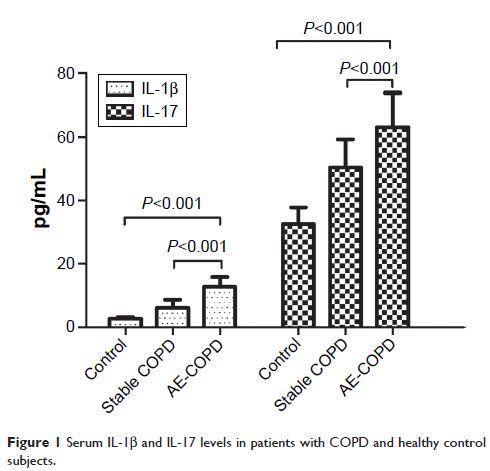
assessed in the COPD patients. We found that serum IL-1β and IL-17 levels in
acute exacerbation of COPD subjects were significantly higher than that in
stable COPD or control subjects and were positively correlated to serum
C-reactive protein levels, neutrophil % and smoking status (pack-years) but
negatively correlated with FEV1% predicted in
COPD patients. More importantly, serum IL-1β levels were markedly positively
associated with serum IL-17 levels in patients with COPD (P =0.741, P <0.001). In conclusion,
elevated serum IL-1β and IL-17 levels may be used as a biomarker for indicating
persistent neutrophilic airway inflammation and potential ongoing exacerbation
of COPD.
Keywords: neutrophilic
airway inflammation, cigarette smoking, exacerbation