117207
论文已发表
注册即可获取德孚的最新动态
IF 收录期刊
- 3.6 Breast Cancer (Dove Med Press)
- 4.3 Clin Epidemiol
- 2.6 Cancer Manag Res
- 3.2 Infect Drug Resist
- 4.1 Clin Interv Aging
- 6.1 Drug Des Dev Ther
- 4.1 Int J Chronic Obstr
- 8.7 Int J Nanomed
- 2.5 Int J Women's Health
- 3.2 Neuropsych Dis Treat
- 2.4 OncoTargets Ther
- 2.6 Patient Prefer Adher
- 2.6 Ther Clin Risk Manag
- 3.1 J Pain Res
- 3.5 Diabet Metab Synd Ob
- 4.5 Psychol Res Behav Ma
- 3.4 Nat Sci Sleep
- 2.4 Pharmgenomics Pers Med
- 2.6 Risk Manag Healthc Policy
- 4.6 J Inflamm Res
- 2.3 Int J Gen Med
- 3.9 J Hepatocell Carcinoma
- 3.3 J Asthma Allergy
- 2.5 Clin Cosmet Investig Dermatol
- 3.0 J Multidiscip Healthc

Mn2+- 协同 PDA @ DOX / PLGA 纳米粒子作为化学-光热肿瘤协同治疗的智能治疗剂
Authors Xi J, Da L, Yang C, Chen R, Gao L, Fan L, Han J
Received 12 January 2017
Accepted for publication 3 April 2017
Published 24 April 2017 Volume 2017:12 Pages 3331—3345
DOI https://doi.org/10.2147/IJN.S132270
Checked for plagiarism Yes
Review by Single-blind
Peer reviewers approved by Dr Alexander Kharlamov
Peer reviewer comments 3
Editor who approved publication: Dr Lei Yang
Abstract: Nanoparticle drug delivery carriers, which can implement high
performances of multi-functions, are of great interest, especially for
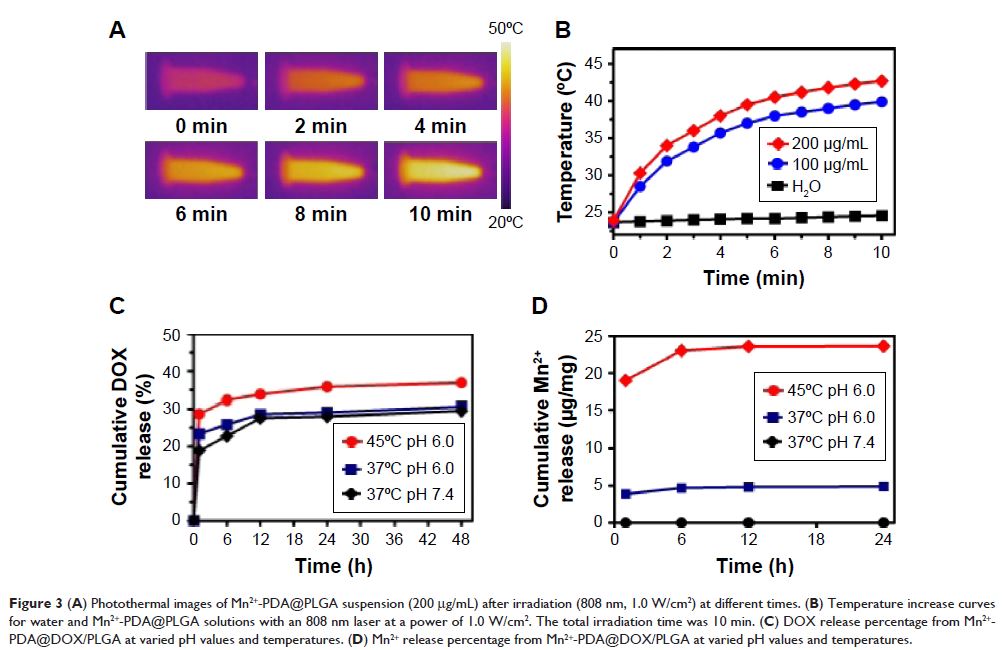
improving cancer therapy. Herein, we reported a new approach to construct Mn2+-coordinated doxorubicin (DOX)-loaded poly(lactic-co -glycolic acid) (PLGA)
nanoparticles as a platform for synergistic chemo-photothermal tumor therapy.
DOX-loaded PLGA (DOX/PLGA) nanoparticles were first synthesized through a
double emulsion-solvent evaporation method, and then modified with polydopamine
(PDA) through self-polymerization of dopamine, leading to the formation of
PDA@DOX/PLGA nanoparticles. Mn2+ ions were then coordinated on the
surfaces of PDA@DOX/PLGA to obtain Mn2+-PDA@DOX/PLGA
nanoparticles. In our system, Mn2+-PDA@DOX/PLGA
nanoparticles could destroy tumors in a mouse model directly, by thermal energy
deposition, and could also simulate the chemotherapy by thermal-responsive
delivery of DOX to enhance tumor therapy. Furthermore, the coordination of Mn2+ could
afford the high magnetic resonance (MR) imaging capability with sensitivity to
temperature and pH. The results demonstrated that Mn2+-PDA@DOX/PLGA nanoparticles had a great potential
as a smart theranostic agent due to their imaging and tumor-growth-inhibition
properties.
Keywords: PLGA nanoparticles, polydopamine,
chemo-photothermal therapy, smart theranostic agent