117207
论文已发表
注册即可获取德孚的最新动态
IF 收录期刊
- 3.6 Breast Cancer (Dove Med Press)
- 4.3 Clin Epidemiol
- 2.6 Cancer Manag Res
- 3.2 Infect Drug Resist
- 4.1 Clin Interv Aging
- 6.1 Drug Des Dev Ther
- 4.1 Int J Chronic Obstr
- 8.7 Int J Nanomed
- 2.5 Int J Women's Health
- 3.2 Neuropsych Dis Treat
- 2.4 OncoTargets Ther
- 2.6 Patient Prefer Adher
- 2.6 Ther Clin Risk Manag
- 3.1 J Pain Res
- 3.5 Diabet Metab Synd Ob
- 4.5 Psychol Res Behav Ma
- 3.4 Nat Sci Sleep
- 2.4 Pharmgenomics Pers Med
- 2.6 Risk Manag Healthc Policy
- 4.6 J Inflamm Res
- 2.3 Int J Gen Med
- 3.9 J Hepatocell Carcinoma
- 3.3 J Asthma Allergy
- 2.5 Clin Cosmet Investig Dermatol
- 3.0 J Multidiscip Healthc

已发表论文
通过使用 21 种氨基酸保护对尼莫地平 (Nimodipine) 乳液中杂质含量的降低进行方法学评估
Authors Xie YQ, Zhuang ZQ, Zhang S, Xia ZH, Chen D, Fan KY, Ren JL, Lin CC, Chen YZ, Yang F
Received 15 December 2016
Accepted for publication 16 March 2017
Published 27 April 2017 Volume 2017:12 Pages 3407—3419
DOI https://doi.org/10.2147/IJN.S130348
Checked for plagiarism Yes
Review by Single-blind
Peer reviewers approved by Dr Thiruganesh Ramasamy
Peer reviewer comments 3
Editor who approved publication: Dr Linlin Sun
Purpose: The present study
examined the factors affecting the content of impurities of nimodipine (NMP)
emulsion and the associated methods of compound protection.
Methods: Destructive testing of NMP emulsion and its active pharmaceutical ingredient (API) were conducted, and ultracentrifugation was used to study the content of impurities in two phases. The impurity of NMP was measured under different potential of hydrogen (pH) conditions, antioxidants and pH-adjusting agents.
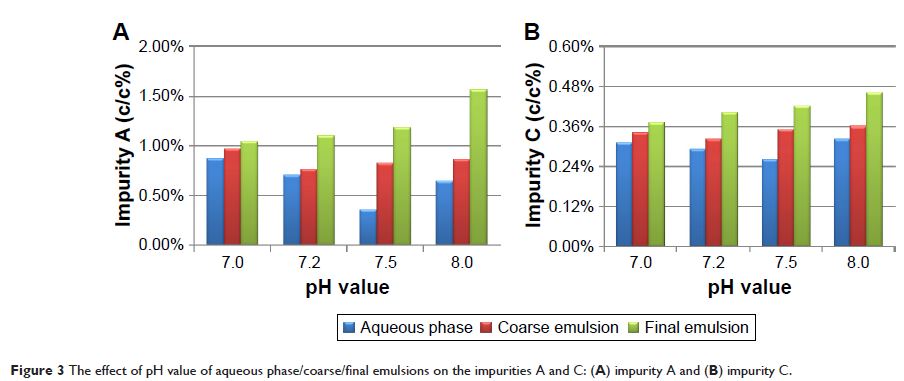
Results: Following destruction, the degradation of NMP notably occurred in the basic environment. The consumption of the pH-adjusting agent NaOH was proportional to the production of impurities since the inorganic base and/or acid promoted the degradation of NMP. The organic antioxidants, notably amino acids with an appropriate length of intermediate chain and electron-donating side group, exhibited improved antioxidant effects compared with inorganic antioxidants. The minimal amount of impurities was produced following addition of 0.04% lysine and 0.06% leucine in the aqueous phase and adjustment of the pH to a range of 7.5–8.0 in the presence of acetic acid solution.
Conclusion: NMP was more prone to degradation in an oxidative environment, in an aqueous phase and/or in the presence of inorganic pH-adjusting agents and antioxidants. The appropriate antioxidant and pH-adjusting agent should be selected according to the chemical structure, while destructive testing of the drug is considered to play the optimal protective effect.
Keywords: nimodipine emulsion, impurity, destructive testing, ultracentrifugation, antioxidation, pH
Methods: Destructive testing of NMP emulsion and its active pharmaceutical ingredient (API) were conducted, and ultracentrifugation was used to study the content of impurities in two phases. The impurity of NMP was measured under different potential of hydrogen (pH) conditions, antioxidants and pH-adjusting agents.
Results: Following destruction, the degradation of NMP notably occurred in the basic environment. The consumption of the pH-adjusting agent NaOH was proportional to the production of impurities since the inorganic base and/or acid promoted the degradation of NMP. The organic antioxidants, notably amino acids with an appropriate length of intermediate chain and electron-donating side group, exhibited improved antioxidant effects compared with inorganic antioxidants. The minimal amount of impurities was produced following addition of 0.04% lysine and 0.06% leucine in the aqueous phase and adjustment of the pH to a range of 7.5–8.0 in the presence of acetic acid solution.
Conclusion: NMP was more prone to degradation in an oxidative environment, in an aqueous phase and/or in the presence of inorganic pH-adjusting agents and antioxidants. The appropriate antioxidant and pH-adjusting agent should be selected according to the chemical structure, while destructive testing of the drug is considered to play the optimal protective effect.
Keywords: nimodipine emulsion, impurity, destructive testing, ultracentrifugation, antioxidation, pH