117207
论文已发表
注册即可获取德孚的最新动态
IF 收录期刊
- 3.6 Breast Cancer (Dove Med Press)
- 4.3 Clin Epidemiol
- 2.6 Cancer Manag Res
- 3.2 Infect Drug Resist
- 4.1 Clin Interv Aging
- 6.1 Drug Des Dev Ther
- 4.1 Int J Chronic Obstr
- 8.7 Int J Nanomed
- 2.5 Int J Women's Health
- 3.2 Neuropsych Dis Treat
- 2.4 OncoTargets Ther
- 2.6 Patient Prefer Adher
- 2.6 Ther Clin Risk Manag
- 3.1 J Pain Res
- 3.5 Diabet Metab Synd Ob
- 4.5 Psychol Res Behav Ma
- 3.4 Nat Sci Sleep
- 2.4 Pharmgenomics Pers Med
- 2.6 Risk Manag Healthc Policy
- 4.6 J Inflamm Res
- 2.3 Int J Gen Med
- 3.9 J Hepatocell Carcinoma
- 3.3 J Asthma Allergy
- 2.5 Clin Cosmet Investig Dermatol
- 3.0 J Multidiscip Healthc

Update on the treatment of narcolepsy: clinical efficacy of pitolisant
Authors Calik MW
Received 14 January 2017
Accepted for publication 11 April 2017
Published 26 April 2017 Volume 2017:9 Pages 127—133
DOI https://doi.org/10.2147/NSS.S103462
Checked for plagiarism Yes
Review by Single-blind
Peer reviewers approved by Prof. Dr. Roumen Kirov
Peer reviewer comments 4
Editor who approved publication: Professor Steven Shea
Abstract: Narcolepsy is a neurological disease that affects 1 in 2,000 individuals
and is characterized by excessive daytime sleepiness (EDS). In 60–70% of
individuals with narcolepsy, it is also characterized by cataplexy or a sudden
loss of muscle tone that is triggered by positive or negative emotions.
Narcolepsy decreases the quality of life of the afflicted individuals.
Currently used drugs treat EDS alone (modafinil/armodafinil, methylphenidate,
and amphetamine), cataplexy alone (“off-label” use of antidepressants), or both
EDS and cataplexy (sodium oxybate). These drugs have abuse, tolerability, and
adherence issues. A greater diversity of drug options is needed to treat
narcolepsy. The small molecule drug, pitolisant, acts as an inverse
agonist/antagonist at the H3 receptor, thus increasing
histaminergic tone in the wake promoting system of the brain. Pitolisant has
been studied in animal models of narcolepsy and used in clinical trials as a
treatment for narcolepsy. A comprehensive search of online databases (eg,
Medline, PubMed, EMBASE, the Cochrane Library Database, Ovid MEDLINE, Europe
PubMed Central, EBSCOhost CINAHL, ProQuest Research Library, Google Scholar,
and ClinicalTrials.gov) was performed. Nonrandomized and randomized studies
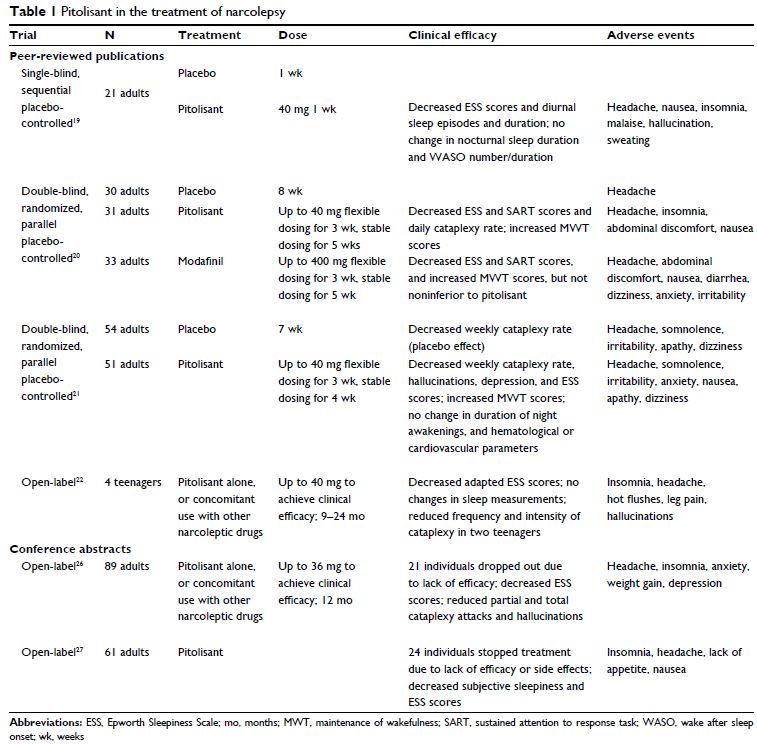
were included. This review focuses on the outcomes of four clinical trials of
pitolisant to treat narcolepsy. These four trials show that pitolisant is an
effective drug to treat EDS and cataplexy in narcolepsy.
Keywords: narcolepsy, pitolisant, histamine