117333
论文已发表
注册即可获取德孚的最新动态
IF 收录期刊
- 3.6 Breast Cancer (Dove Med Press)
- 4.3 Clin Epidemiol
- 2.6 Cancer Manag Res
- 3.2 Infect Drug Resist
- 4.1 Clin Interv Aging
- 6.1 Drug Des Dev Ther
- 4.1 Int J Chronic Obstr
- 8.7 Int J Nanomed
- 2.5 Int J Women's Health
- 3.2 Neuropsych Dis Treat
- 2.4 OncoTargets Ther
- 2.6 Patient Prefer Adher
- 2.6 Ther Clin Risk Manag
- 3.1 J Pain Res
- 3.5 Diabet Metab Synd Ob
- 4.5 Psychol Res Behav Ma
- 3.4 Nat Sci Sleep
- 2.4 Pharmgenomics Pers Med
- 2.6 Risk Manag Healthc Policy
- 4.6 J Inflamm Res
- 2.3 Int J Gen Med
- 3.9 J Hepatocell Carcinoma
- 3.3 J Asthma Allergy
- 2.5 Clin Cosmet Investig Dermatol
- 3.0 J Multidiscip Healthc

将眼镜蛇神经毒素 (Cobra neurotoxin) 封装于光响应纳米胶囊中可增强其在红光下的中枢镇痛作用
Authors Yang Q, Zhao C, Zhao J, Ye Y
Received 16 January 2017
Accepted for publication 5 April 2017
Published 2 May 2017 Volume 2017:12 Pages 3463—3470
DOI https://doi.org/10.2147/IJN.S132510
Checked for plagiarism Yes
Review by Single-blind
Peer reviewers approved by Dr Colin Mak
Peer reviewer comments 3
Editor who approved publication: Dr Lei Yang
Abstract: Cobra neurotoxin (CNT), a peptide isolated from snake venom of Naja naja atra,
shows central analgesic effects in our previous research. In order to help CNT
pass through blood–brain barrier (BBB) and improve its central analgesic
effects, a new kind of CNT nanocapsules were prepared by double emulsification
with soybean lecithin and cholesterol as the shell, and pheophorbide as the
photosensitizer added to make it photoresponsive. The analgesic effects were
evaluated by hot plate test and acetic acid-induced writhing in mice. The CNT
nanocapsules had an average particle size of 229.55 nm, zeta potential of -53.00
mV, encapsulation efficiency of 84.81% and drug loading of 2.98%, when the
pheophorbide content was 1% of lecithin weight. Pheophorbide was mainly
distributed in outer layer of the CNT nanocapsules and increased the release of
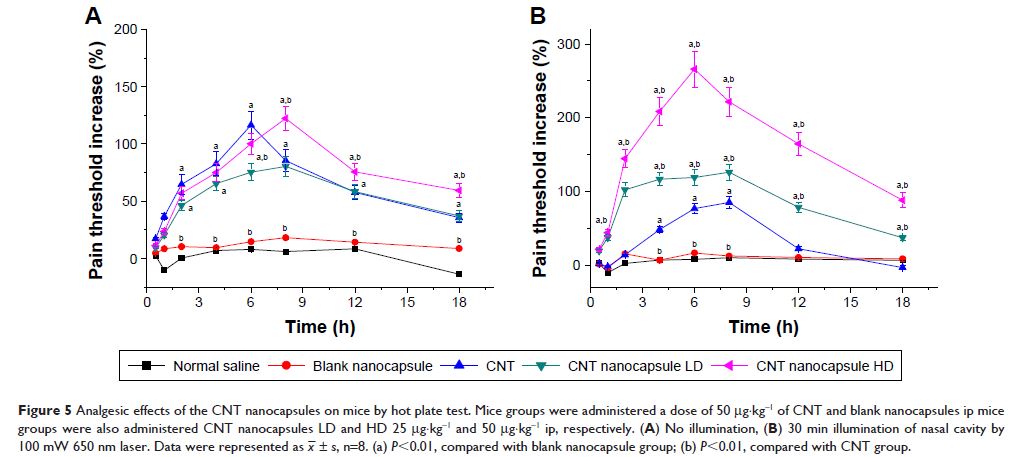
the CNT nanocapsules after 650 nm illumination. The central analgesic effects
were improved after intraperitoneal injection of CNT at 25 and 50 µg·kg-1 under
650 nm irradiation for 30 min in the nasal cavity. Activation of
pheophorbide by red light generated reactive oxygen species which opened the
nanocapsules and BBB and helped the CNT enter the brain. This research provides
a new drug delivery for treatment of central pain.
Keywords: cobra
neurotoxin, nanocapsules, photoresponsive, central analgesic effects, red
light, drug delivery, photosensitizer