117207
论文已发表
注册即可获取德孚的最新动态
IF 收录期刊
- 3.6 Breast Cancer (Dove Med Press)
- 4.3 Clin Epidemiol
- 2.6 Cancer Manag Res
- 3.2 Infect Drug Resist
- 4.1 Clin Interv Aging
- 6.1 Drug Des Dev Ther
- 4.1 Int J Chronic Obstr
- 8.7 Int J Nanomed
- 2.5 Int J Women's Health
- 3.2 Neuropsych Dis Treat
- 2.4 OncoTargets Ther
- 2.6 Patient Prefer Adher
- 2.6 Ther Clin Risk Manag
- 3.1 J Pain Res
- 3.5 Diabet Metab Synd Ob
- 4.5 Psychol Res Behav Ma
- 3.4 Nat Sci Sleep
- 2.4 Pharmgenomics Pers Med
- 2.6 Risk Manag Healthc Policy
- 4.6 J Inflamm Res
- 2.3 Int J Gen Med
- 3.9 J Hepatocell Carcinoma
- 3.3 J Asthma Allergy
- 2.5 Clin Cosmet Investig Dermatol
- 3.0 J Multidiscip Healthc

对 T1a 期声门型喉癌激光手术与放射治疗后的声音质量的比较: 一个系统评价和综合分析
Authors Huang GJ, Luo MS, Zhang JX, Liu HB
Received 16 March 2017
Accepted for publication 11 April 2017
Published 3 May 2017 Volume 2017:10 Pages 2403—2410
DOI https://doi.org/10.2147/OTT.S137210
Checked for plagiarism Yes
Review by Single-blind
Peer reviewers approved by Dr Akshita Wason
Peer reviewer comments 2
Editor who approved publication: Dr William Cho
Background and
objectives: The voice quality assessment of laser surgery (LS) in comparison with
radiotherapy (RT) remains uncertain in T1a glottic carcinoma treatment. This
systematic review and meta-analysis were conducted to compare the voice quality
of the two treatments.
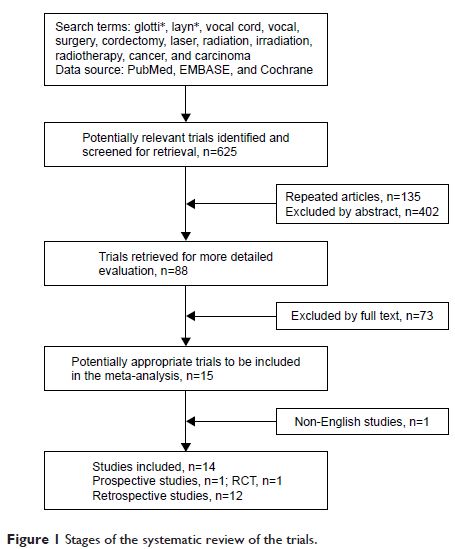
Methods: Searches were conducted in PubMed, EMBASE, and
Cochrane with the following index words: glotti*, layn*, vocal cord, vocal,
surgery, cordectomy, laser, radiation, irradiation, radiotherapy, cancer, and
carcinoma for relative studies that compared the voice quality between LS and
RT. Random-effect models were used, and heterogeneity was assessed.
Results: A total of 14 studies were included in the analysis,
consisting of 1 randomized controlled trial, 1 prospective study, and 12
retrospective studies. RT has increased the maximum phonation time (MPT; mean
difference [MD] =-1.89, 95% confidence interval [CI] =-3.66 to -0.11, P =0.04) and
decreased the fundamental frequency (MD =14.06, 95% CI =10.30–17.83, P <0.00001) in
comparison with LS. No statistical difference was observed between the two groups
in terms of Voice Handicap Index, Jitter, Shimmer, and airflow rate.
Conclusion: RT may be a better choice for T1a glottic carcinoma
treatment compared with LS because patients undergoing RT may have the
advantage of increased MPT and decreased fundamental frequency. However, more
multicenter, randomized, controlled trials are urgently needed to verify these
differences.
Keywords: laser therapy, radiotherapy, meta-analysis, glottis,
laryngeal neoplasms