117207
论文已发表
注册即可获取德孚的最新动态
IF 收录期刊
- 3.6 Breast Cancer (Dove Med Press)
- 4.3 Clin Epidemiol
- 2.6 Cancer Manag Res
- 3.2 Infect Drug Resist
- 4.1 Clin Interv Aging
- 6.1 Drug Des Dev Ther
- 4.1 Int J Chronic Obstr
- 8.7 Int J Nanomed
- 2.5 Int J Women's Health
- 3.2 Neuropsych Dis Treat
- 2.4 OncoTargets Ther
- 2.6 Patient Prefer Adher
- 2.6 Ther Clin Risk Manag
- 3.1 J Pain Res
- 3.5 Diabet Metab Synd Ob
- 4.5 Psychol Res Behav Ma
- 3.4 Nat Sci Sleep
- 2.4 Pharmgenomics Pers Med
- 2.6 Risk Manag Healthc Policy
- 4.6 J Inflamm Res
- 2.3 Int J Gen Med
- 3.9 J Hepatocell Carcinoma
- 3.3 J Asthma Allergy
- 2.5 Clin Cosmet Investig Dermatol
- 3.0 J Multidiscip Healthc

通过肿瘤血管系统正常化和抑制上皮 — 间质转化,金纳米颗粒可削弱肿瘤的转移
Authors Li W, Li X, Liu S, Yang W, Pan F, Yang XY, Du B, Qin L, Pan Y
Received 26 November 2016
Accepted for publication 23 March 2017
Published 4 May 2017 Volume 2017:12 Pages 3509—3520
DOI https://doi.org/10.2147/IJN.S128802
Checked for plagiarism Yes
Review by Single-blind
Peer reviewers approved by Dr Ashutosh Singhal
Peer reviewer comments 2
Editor who approved publication: Dr Linlin Sun
Abstract: Angiogenesis is a process by which vessels are formed through
preexisting ones, and this plays a key role in the progression of solid tumors.
However, tumor vessels are influenced by excessive pro-angiogenic factors,
resulting in deformed structures that facilitate the intravasation of tumor
cells into the circulation and subsequent metastasis. Moreover, abnormal tumor
vessels have low blood perfusion and thereby decreased oxygen infusion into
tumors. This results in a hostile microenvironment that promotes
epithelial–mesenchymal transition (EMT), a process in which epithelial cells
lose their polarity and gain increased motility, which is associated with
metastasis and invasion. Here, we demonstrate that gold nanoparticles (AuNPs)
facilitate tumor vasculature normalization, increase blood perfusion and
alleviate hypoxia in melanoma tumors. Additionally, AuNPs were observed to
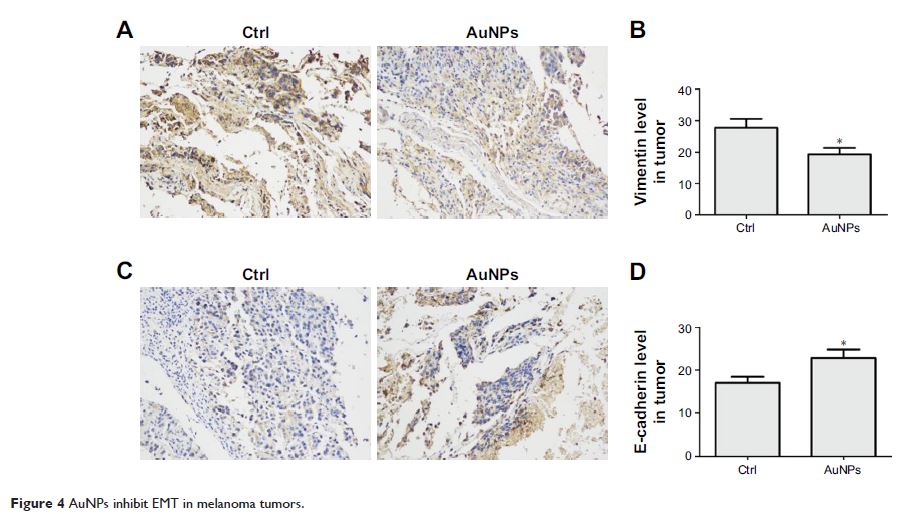
reverse EMT in tumors, accompanied by the alleviation of lung metastasis. These
AuNPs inhibited the migration of B16F10 cells and reversed EMT in B16F10 cells,
indicating that AuNPs could directly regulate EMT independent of improvements
in hypoxia. Taken together, our data demonstrated that AuNPs could induce tumor
vasculature normalization and reverse EMT, resulting in decreased melanoma
tumor metastasis.
Keywords: gold nanoparticles, tumor vasculature
normalization, tumor metastasis, epithelial–mesenchymal transition