117207
论文已发表
注册即可获取德孚的最新动态
IF 收录期刊
- 3.6 Breast Cancer (Dove Med Press)
- 4.3 Clin Epidemiol
- 2.6 Cancer Manag Res
- 3.2 Infect Drug Resist
- 4.1 Clin Interv Aging
- 6.1 Drug Des Dev Ther
- 4.1 Int J Chronic Obstr
- 8.7 Int J Nanomed
- 2.5 Int J Women's Health
- 3.2 Neuropsych Dis Treat
- 2.4 OncoTargets Ther
- 2.6 Patient Prefer Adher
- 2.6 Ther Clin Risk Manag
- 3.1 J Pain Res
- 3.5 Diabet Metab Synd Ob
- 4.5 Psychol Res Behav Ma
- 3.4 Nat Sci Sleep
- 2.4 Pharmgenomics Pers Med
- 2.6 Risk Manag Healthc Policy
- 4.6 J Inflamm Res
- 2.3 Int J Gen Med
- 3.9 J Hepatocell Carcinoma
- 3.3 J Asthma Allergy
- 2.5 Clin Cosmet Investig Dermatol
- 3.0 J Multidiscip Healthc

与中国肿瘤护理人员对临终关怀的态度有关联的因素
Authors Yang F, Ye Z, Tang L, Xiang W, Yan L, Xiang M
Received 10 January 2017
Accepted for publication 18 March 2017
Published 5 May 2017 Volume 2017:11 Pages 853—860
DOI https://doi.org/10.2147/PPA.S132093
Checked for plagiarism Yes
Review by Single-blind
Peer reviewers approved by Dr Colin Mak
Peer reviewer comments 3
Editor who approved publication: Dr Naifeng Liu
Objective: To examine factors that are associated with the apprehension levels of
oncology nurses toward hospice care. Factors examined in this study included
demographics, nursing experience, education levels, title and post, personal
experiences, and attitudes toward end-of-life care.
Methods: Questionnaires were provided to nurses (n=201) from
three first-tier hospitals in China. A quantitative scale, Professional
End-of-life Care Attitude Scale (PEAS), was used to assess personal and
professional apprehension levels toward hospice care. The PEAS was translated
to Chinese with terms adapted to the cultural environment in China. Statistical
analyses were performed to examine the relationships between the apprehension
levels and various factors.
Results: The total PEAS scores exhibited internal consistency
and reliability, with a Cronbach α =0.897 and Pearson’s r =0.9030. Of the
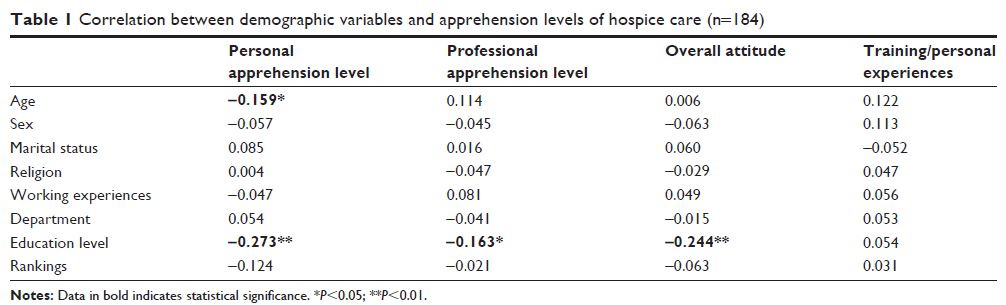
201 nurses, 184 provided a valid response (91.5%). Education level was
significantly correlated with personal (P <0.01) and
professional apprehension levels (P <0.05). Higher
apprehension level was found in nurses with less education.
Conclusion: The PEAS quantitative survey is useful for evaluating
apprehension levels of nurses toward hospice care. Nurses with more education
experienced less anxiety when providing care for terminally ill patients. The
findings suggested that education programs on hospice care could be
strengthened to help nurses cope with negative attitudes toward end-of-life
care.
Keywords: end of
life, nurses’ perspective, communication, palliative care, cancer patients,
terminally ill