115195
论文已发表
注册即可获取德孚的最新动态
IF 收录期刊
- 3.6 Breast Cancer (Dove Med Press)
- 4.3 Clin Epidemiol
- 2.6 Cancer Manag Res
- 3.2 Infect Drug Resist
- 4.1 Clin Interv Aging
- 6.1 Drug Des Dev Ther
- 4.1 Int J Chronic Obstr
- 8.7 Int J Nanomed
- 2.5 Int J Women's Health
- 3.2 Neuropsych Dis Treat
- 2.4 OncoTargets Ther
- 2.6 Patient Prefer Adher
- 2.6 Ther Clin Risk Manag
- 3.1 J Pain Res
- 3.5 Diabet Metab Synd Ob
- 4.5 Psychol Res Behav Ma
- 3.4 Nat Sci Sleep
- 2.4 Pharmgenomics Pers Med
- 2.6 Risk Manag Healthc Policy
- 4.6 J Inflamm Res
- 2.3 Int J Gen Med
- 3.9 J Hepatocell Carcinoma
- 3.3 J Asthma Allergy
- 2.5 Clin Cosmet Investig Dermatol
- 3.0 J Multidiscip Healthc

对原发性食管小细胞癌患者术前嗜中性粒细胞/淋巴细胞比例的预后价值的回顾研究
Authors Wang Y, Liu JF
Received 23 June 2016
Accepted for publication 14 January 2017
Published 5 May 2017 Volume 2017:10 Pages 2453—2459
DOI https://doi.org/10.2147/OTT.S115637
Checked for plagiarism Yes
Review by Single-blind
Peer reviewers approved by Dr Ru Chen
Peer reviewer comments 2
Editor who approved publication: Dr Samir Farghaly
Introduction: There is increasing evidence that systemic inflammation influences the
prognosis in patients with malignant tumors. The aim of this research was to
investigate the prognostic value of neutrophil/lymphocyte ratio (NLR) in
patients with primary small-cell carcinoma of the esophagus.
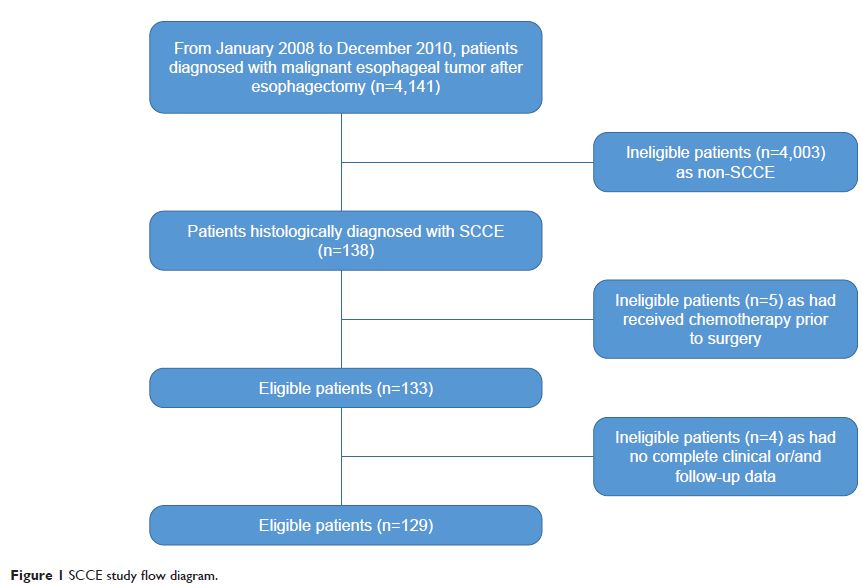
Methods: This study retrospectively analyzed 129 patients with
primary small-cell carcinoma of the esophagus who underwent esophagectomy in
The Fourth Hospital of Hebei Medical University between January 2008 and
December 2010. NLRs were calculated by using the following formula: peripheral
neutrophil count/lymphocyte count (109/L). Correlations
of NLR with other clinicopathologic data and prognosis were analyzed. The
survival rate was calculated by Kaplan–Meier analysis. The differences between
groups were compared by using the log-rank test. Cox regression was used to
analyze the factors that may affect the survival of the patients.
Results: The survival rate was found to be related to tumor
stage, tumor location, nodal metastasis, TNM stage, histology, adjuvant
therapy, and NLR (all P <0.05). High-NLR group had
significantly poorer survival than low-NLR group (1-, 3-, and 5-year survival
rates: 46.6% vs 57.1%, 21.9% vs 50.0%, and 5.5% vs 23.2%, respectively, P =0.002). NLR was
identified as an independent prognostic factor for patients with primary
small-cell carcinoma of the esophagus.
Conclusion: NLR is a valuable clinical marker in preoperative
estimation as well as prognosis prediction for patients with primary small-cell
carcinoma of the esophagus.
Keywords: neutrophil/lymphocyte ratio, primary
small-cell carcinoma of the esophagus, surgery, prognosis