117207
论文已发表
注册即可获取德孚的最新动态
IF 收录期刊
- 3.6 Breast Cancer (Dove Med Press)
- 4.3 Clin Epidemiol
- 2.6 Cancer Manag Res
- 3.2 Infect Drug Resist
- 4.1 Clin Interv Aging
- 6.1 Drug Des Dev Ther
- 4.1 Int J Chronic Obstr
- 8.7 Int J Nanomed
- 2.5 Int J Women's Health
- 3.2 Neuropsych Dis Treat
- 2.4 OncoTargets Ther
- 2.6 Patient Prefer Adher
- 2.6 Ther Clin Risk Manag
- 3.1 J Pain Res
- 3.5 Diabet Metab Synd Ob
- 4.5 Psychol Res Behav Ma
- 3.4 Nat Sci Sleep
- 2.4 Pharmgenomics Pers Med
- 2.6 Risk Manag Healthc Policy
- 4.6 J Inflamm Res
- 2.3 Int J Gen Med
- 3.9 J Hepatocell Carcinoma
- 3.3 J Asthma Allergy
- 2.5 Clin Cosmet Investig Dermatol
- 3.0 J Multidiscip Healthc

普萘洛尔 (Propranolol) 治疗婴幼儿血管瘤: 作者们的经验
Authors Zhang L, Wu HW, Yuan W, Zheng J
Received 15 February 2017
Accepted for publication 30 March 2017
Published 8 May 2017 Volume 2017:11 Pages 1401—1408
DOI https://doi.org/10.2147/DDDT.S134808
Checked for plagiarism Yes
Review by Single-blind
Peer reviewers approved by Dr Colin Mak
Peer reviewer comments 2
Editor who approved publication: Dr Qiongyu Guo
Objective: Hemangiomas are the most common benign vascular tumors of infancy.
Although most infantile hemangiomas (IHs) have the ability to involute
spontaneously after initial proliferation and resolve without consequence,
intervention is required in a subset of IHs, which develop complications
resulting in ulceration, bleeding, or aesthetic deformity. The primary
treatment for this subset of IHs is pharmacological intervention, and
propranolol has become the new first-line treatment for complicated
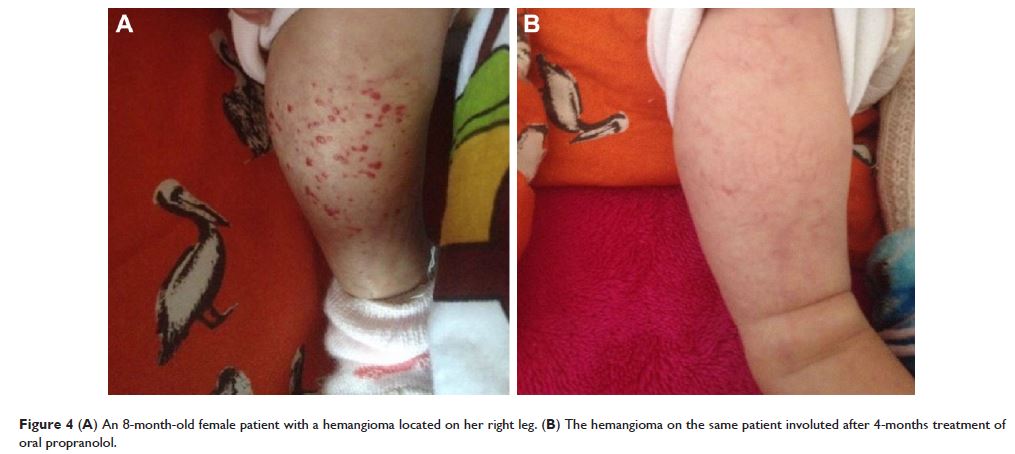
hemangiomas. Here, we evaluated the efficacy of propranolol on proliferation IH
in a clinical cohort including 578 patients.
Methods: We retrospectively reviewed a total of 578 IH patients who were treated
with oral propranolol from January 2010 to December 2012. Responses to the
propranolol treatment were graded as: excellent, good, poor, or no response.
Based on the response to propranolol treatment (once daily at a dose of 1.0
mg/kg for patients younger than 2 months; twice daily at daily total dose of 2
mg/kg for patients older than 2 months), additional pharmacotherapies or
surgery were used for IH patients for satisfactory clinical outcome.
Results: Five hundred and sixty (96.9%) of 578 IH patients in our study responded
to oral propranolol treatment, and the response rate was significantly
different for different ages of patients (P<0.05), with
the youngest patients having the highest response rate. The mean time of
treatment was 6 months (range, 3–12 months). For example, response rate to
propranolol was 98.1% in patients younger than 2 months, compared with 93.3% in
patients older than 2 months and younger than 8 months, and 73.7% in
patients older than 8 months. One hundred and thirty one patients who exhibited
incompletely involuted hemangiomas were further treated with timolol maleate
(n=89) or pulsed dye laser (n=42). One hundred and seventeen (89.3%) of 131
patients showed a positive response. There were no instances of
life-threatening complications after propranolol. However, minor side effects
were observed including 10 (1.73%) cases of sleep disturbance, 7 (1.21%) cases
of diarrhea, and 5 (0.86%) cases of bronchospasm.
Conclusion: IH requires early intervention. During the involution phase, tapering
propranolol dosage can be done to minimize side effects before discontinuing
treatment. For patients exhibiting telangiectasia and chromatosis after
propranolol treatment, administration of a 0.5% solution of timolol maleate or
pulse dye laser is an effective therapeutic approach for complete involution.
Keywords: propranolol, infantile hemangioma, β-blockers, oral propranolol,
intervention studies