117333
论文已发表
注册即可获取德孚的最新动态
IF 收录期刊
- 3.6 Breast Cancer (Dove Med Press)
- 4.3 Clin Epidemiol
- 2.6 Cancer Manag Res
- 3.2 Infect Drug Resist
- 4.1 Clin Interv Aging
- 6.1 Drug Des Dev Ther
- 4.1 Int J Chronic Obstr
- 8.7 Int J Nanomed
- 2.5 Int J Women's Health
- 3.2 Neuropsych Dis Treat
- 2.4 OncoTargets Ther
- 2.6 Patient Prefer Adher
- 2.6 Ther Clin Risk Manag
- 3.1 J Pain Res
- 3.5 Diabet Metab Synd Ob
- 4.5 Psychol Res Behav Ma
- 3.4 Nat Sci Sleep
- 2.4 Pharmgenomics Pers Med
- 2.6 Risk Manag Healthc Policy
- 4.6 J Inflamm Res
- 2.3 Int J Gen Med
- 3.9 J Hepatocell Carcinoma
- 3.3 J Asthma Allergy
- 2.5 Clin Cosmet Investig Dermatol
- 3.0 J Multidiscip Healthc

Perirenal fat stranding is not a powerful diagnostic tool for acute pyelonephritis
Authors Fukami H, Takeuchi Y, Kagaya S, Ojima Y, Saito A, Sato H, Matsuda K, Nagasawa T
Received 2 February 2017
Accepted for publication 29 March 2017
Published 8 May 2017 Volume 2017:10 Pages 137—144
DOI https://doi.org/10.2147/IJGM.S133685
Checked for plagiarism Yes
Review by Single-blind
Peer reviewers approved by Dr Amy Norman
Peer reviewer comments 2
Editor who approved publication: Dr Scott Fraser
Purpose: Pyelonephritis, an upper urinary tract infection, is a
serious infection that often requires hospitalization. However, the accurate
diagnosis of acute pyelonephritis can be difficult, especially among older
individuals who can present with unusual symptoms. Imaging with computed
tomography (CT) is not unusual in the diagnosis of pyelonephritis, with some
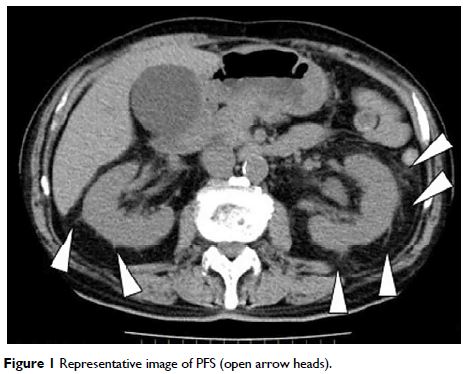
clinicians regarding perirenal fat stranding (PFS) as a characteristic finding.
However, the sensitivity and specificity of PFS in diagnosing pyelonephritis
are currently unknown. We therefore sought to clarify the relevance of PFS in
diagnosing acute pyelonephritis.
Patients and methods: We conducted a case-controlled retrospective analysis
of medical records. The pyelonephritis group included 89 patients who had been
diagnosed with acute pyelonephritis, while the control group included 319
patients who had undergone percutaneous renal biopsy. CT findings were
available for both groups. The frequency of PFS and its sensitivity and
specificity for the diagnosis of acute pyelonephritis were investigated.
Results: The mean ages of the pyelonephritis and control groups
were 74±15 years and 63±16 years, respectively. A total of 28% of men
were in the pyelonephritis group vs 61% of men in the control group. The
frequency of PFS was 72% in the pyelonephritis group vs 39% in the control
group. Age and renal dysfunction were associated with an increased frequency of
PFS. After adjusting for age, sex, and renal function using a propensity score
analysis, the sensitivity, specificity, and positive likelihood ratio of PFS
for diagnosing acute pyelonephritis were 72%, 58%, and 1.7, respectively.
Conclusion: The presence of PFS was not useful in diagnosing acute
pyelonephritis.
Keywords: acute
pyelonephritis, perirenal fat stranding, sensitivity, specificity, urinary
tract infection, CT