115195
论文已发表
注册即可获取德孚的最新动态
IF 收录期刊
- 3.6 Breast Cancer (Dove Med Press)
- 4.3 Clin Epidemiol
- 2.6 Cancer Manag Res
- 3.2 Infect Drug Resist
- 4.1 Clin Interv Aging
- 6.1 Drug Des Dev Ther
- 4.1 Int J Chronic Obstr
- 8.7 Int J Nanomed
- 2.5 Int J Women's Health
- 3.2 Neuropsych Dis Treat
- 2.4 OncoTargets Ther
- 2.6 Patient Prefer Adher
- 2.6 Ther Clin Risk Manag
- 3.1 J Pain Res
- 3.5 Diabet Metab Synd Ob
- 4.5 Psychol Res Behav Ma
- 3.4 Nat Sci Sleep
- 2.4 Pharmgenomics Pers Med
- 2.6 Risk Manag Healthc Policy
- 4.6 J Inflamm Res
- 2.3 Int J Gen Med
- 3.9 J Hepatocell Carcinoma
- 3.3 J Asthma Allergy
- 2.5 Clin Cosmet Investig Dermatol
- 3.0 J Multidiscip Healthc

用于诊断产后抑郁症的新型尿代谢标记
Authors Lin L, Chen X, Liu R
Received 20 February 2017
Accepted for publication 18 April 2017
Published 10 May 2017 Volume 2017:13 Pages 1263—1270
DOI https://doi.org/10.2147/NDT.S135190
Checked for plagiarism Yes
Review by Single-blind
Peer reviewers approved by Prof. Dr. Roumen Kirov
Peer reviewer comments 2
Editor who approved publication: Professor Wai Kwong Tang
Background: Postpartum depression (PPD) could affect ~10% of women and
impair the quality of mother–infant interactions. Currently, there are no
objective methods to diagnose PPD. Therefore, this study was conducted to
identify potential biomarkers for diagnosing PPD.
Materials and methods: Morning urine samples of PPD subjects, postpartum
women without depression (PPWD) and healthy controls (HCs) were collected. The
gas chromatography-mass spectroscopy (GC-MS)-based urinary metabolomic approach
was performed to characterize the urinary metabolic profiling. The orthogonal
partial least-squares-discriminant analysis (OPLS-DA) was used to identify the
differential metabolites. The logistic regression analysis and Bayesian
information criterion rule were further used to identify the potential
biomarker panel. The receiver operating characteristic curve analysis was
conducted to evaluate the diagnostic performance of the identified potential
biomarker panel.
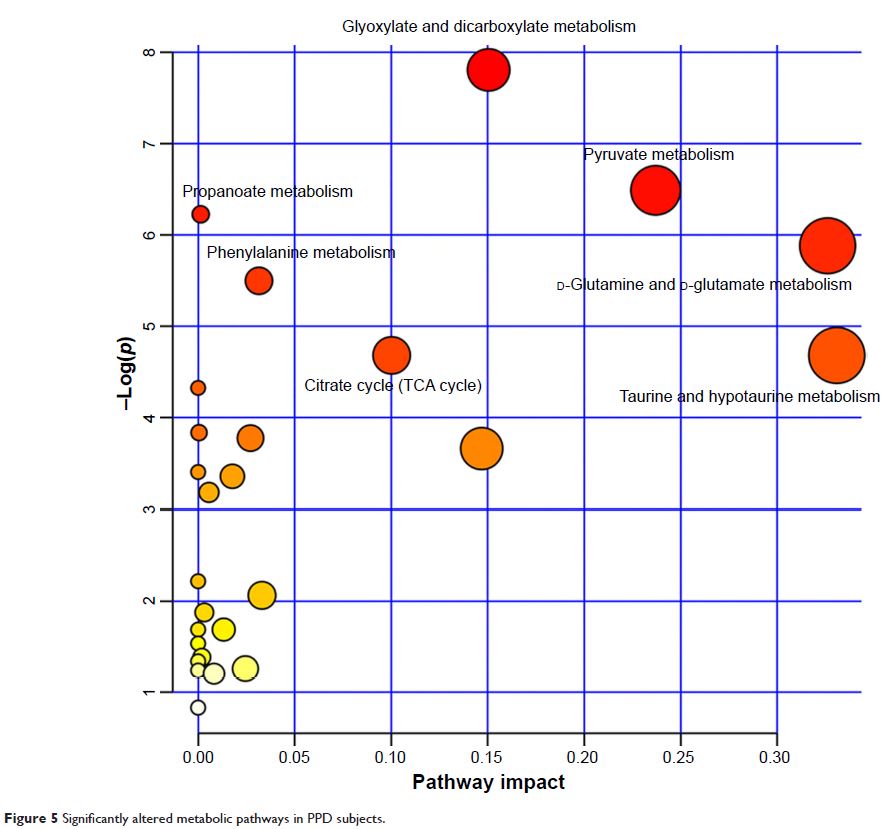
Results: Totally, 73 PPD subjects, 73 PPWD and 74 HCs were
included, and 68 metabolites were identified using GC-MS. The OPLS-DA model
showed that there were 22 differential metabolites (14 upregulated and 8
downregulated) responsible for separating PPD subjects from HCs and PPWD.
Meanwhile, a panel of five potential biomarkers – formate, succinate,
1-methylhistidine, a-glucose and dimethylamine – was identified. This panel could
effectively distinguish PPD subjects from HCs and PPWD with an area under the
curve (AUC) curve of 0.948 in the training set and 0.944 in the testing set.
Conclusion: These results demonstrated that the potential
biomarker panel could aid in the future development of an objective diagnostic
method for PPD.
Keywords: postpartum depression, gas
chromatography-mass spectroscopy, biomarker, metabolomics