117207
论文已发表
注册即可获取德孚的最新动态
IF 收录期刊
- 3.6 Breast Cancer (Dove Med Press)
- 4.3 Clin Epidemiol
- 2.6 Cancer Manag Res
- 3.2 Infect Drug Resist
- 4.1 Clin Interv Aging
- 6.1 Drug Des Dev Ther
- 4.1 Int J Chronic Obstr
- 8.7 Int J Nanomed
- 2.5 Int J Women's Health
- 3.2 Neuropsych Dis Treat
- 2.4 OncoTargets Ther
- 2.6 Patient Prefer Adher
- 2.6 Ther Clin Risk Manag
- 3.1 J Pain Res
- 3.5 Diabet Metab Synd Ob
- 4.5 Psychol Res Behav Ma
- 3.4 Nat Sci Sleep
- 2.4 Pharmgenomics Pers Med
- 2.6 Risk Manag Healthc Policy
- 4.6 J Inflamm Res
- 2.3 Int J Gen Med
- 3.9 J Hepatocell Carcinoma
- 3.3 J Asthma Allergy
- 2.5 Clin Cosmet Investig Dermatol
- 3.0 J Multidiscip Healthc

与硅酸镁 (Magnesium silicate) 相比,含有纳米多孔硅酸镁的聚 (丁二酸丁二醇酯) 基复合支架之纳米孔隙改善了吸水率、体外降解性、矿化、成骨细胞反应和药物释放
Authors Wu Z, Li Q, Pan Y, Yao Y, Tang S, Su J, Shin JW, Wei J, Zhao J
Received 19 January 2017
Accepted for publication 23 March 2017
Published 11 May 2017 Volume 2017:12 Pages 3637—3651
DOI https://doi.org/10.2147/IJN.S132778
Checked for plagiarism Yes
Review by Single-blind
Peer reviewers approved by Dr Bhavesh Kevadiya
Peer reviewer comments 3
Editor who approved publication: Dr Linlin Sun
Abstract: Bioactive composite macroporous scaffold containing nanoporosity was
prepared by incorporation of nanoporous magnesium silicate (NMS) into poly(butylene
succinate) (PBSu) using solvent casting–particulate leaching method. The
results showed that the water absorption and in vitro degradability of NMS/PBSu
composite (NMPC) scaffold significantly improved compared with magnesium
silicate (MS)/PBSu composite (MPC) scaffold. In addition, the NMPC scaffold
showed improved apatite mineralization ability, indicating better bioactivity,
as the NMPC containing nanoporosity could induce more apatite and homogeneous
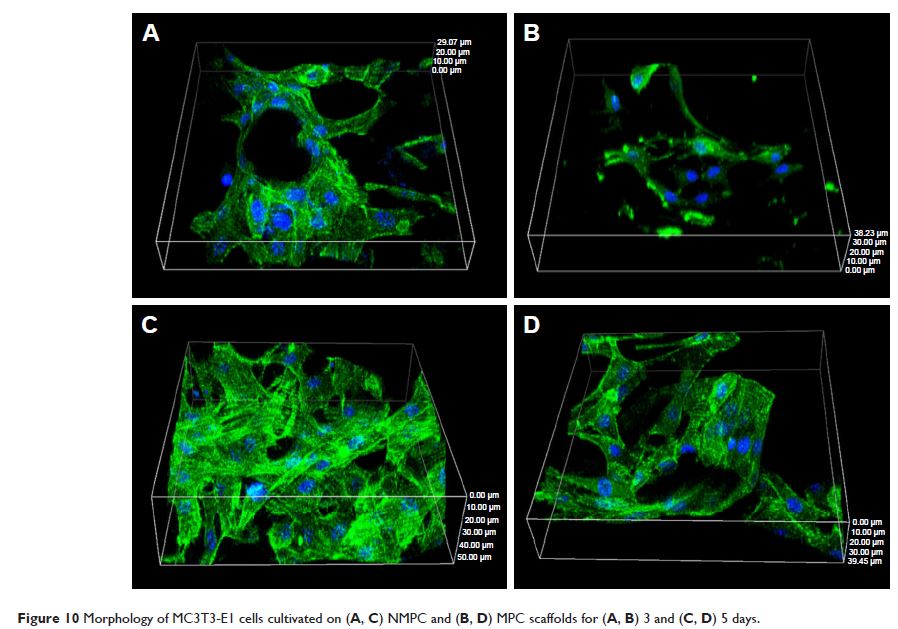
apatite layer on the surfaces than MPC scaffold. The attachment and
proliferation of MC3T3-E1 cells on NMPC scaffold increased significantly
compared with MPC scaffold, and the alkaline phosphatase (ALP) activity of the
cells on NMPC scaffold was expressed at considerably higher levels compared
with MPC scaffold. Moreover, NMPC scaffold with nanoporosity not only had large
drug loading (vancomycin) but also exhibited drug sustained release. The
results suggested that the incorporation of NMS into PBSu could produce
bioactive composite scaffold with nanoporosity, which could enhance water
absorption, degradability, apatite mineralization and drug sustained release
and promote cell responses.
Keywords: nanocomposite, degradability, apatite
mineralization, cell behaviors, drug release