117207
论文已发表
注册即可获取德孚的最新动态
IF 收录期刊
- 3.6 Breast Cancer (Dove Med Press)
- 4.3 Clin Epidemiol
- 2.6 Cancer Manag Res
- 3.2 Infect Drug Resist
- 4.1 Clin Interv Aging
- 6.1 Drug Des Dev Ther
- 4.1 Int J Chronic Obstr
- 8.7 Int J Nanomed
- 2.5 Int J Women's Health
- 3.2 Neuropsych Dis Treat
- 2.4 OncoTargets Ther
- 2.6 Patient Prefer Adher
- 2.6 Ther Clin Risk Manag
- 3.1 J Pain Res
- 3.5 Diabet Metab Synd Ob
- 4.5 Psychol Res Behav Ma
- 3.4 Nat Sci Sleep
- 2.4 Pharmgenomics Pers Med
- 2.6 Risk Manag Healthc Policy
- 4.6 J Inflamm Res
- 2.3 Int J Gen Med
- 3.9 J Hepatocell Carcinoma
- 3.3 J Asthma Allergy
- 2.5 Clin Cosmet Investig Dermatol
- 3.0 J Multidiscip Healthc

通过先臂后核 (arm-first) 串联 ATRP 法制备双核肝细胞特有的星形聚糖纳米凝胶
Authors Lou S, Zhang X, Zhang M, Ji S, Wang W, Zhang J, Li C, Kong D
Received 9 February 2017
Accepted for publication 23 March 2017
Published 11 May 2017 Volume 2017:12 Pages 3653—3664
DOI https://doi.org/10.2147/IJN.S134367
Checked for plagiarism Yes
Review by Single-blind
Peer reviewers approved by Dr Alexander Kharlamov
Peer reviewer comments 2
Editor who approved publication: Dr Linlin Sun
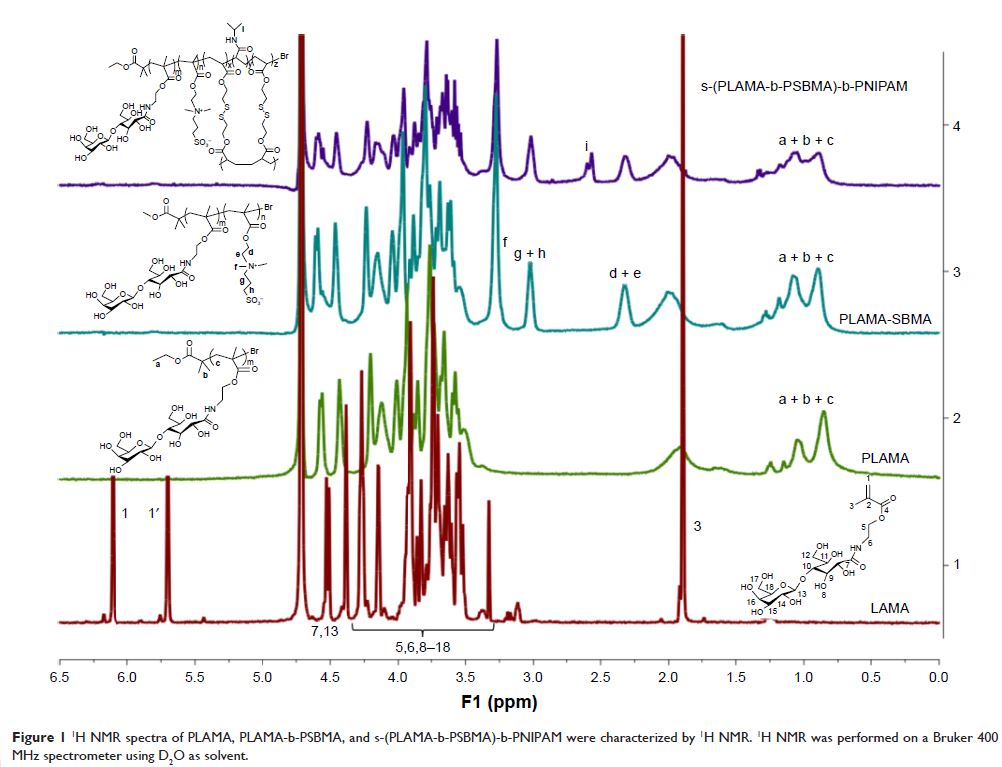
Abstract: A reductase-cleavable and thermo-responsive star-shaped polymer nanogel
was prepared via an “arm-first” atom transfer radical polymerization approach.
The nanogel consists of a thermo- and redox-sensitive core and a zwitterionic
copolymer block. The dual sensitive core is composed of
poly(N-isopropylacrylamide) that is formed by disulfide crosslinking of
N-isopropylacrylamide. The zwitterionic copolymer block contains a
poly(sulfobetaine methacrylate) component, a known anti-adsorptive moiety that
extends blood circulation time, and a lactose motif of
poly(2-lactobionamidoethyl methacrylamide) that specifically targets the
asialoglycoprotein receptors (ASGP-Rs) of hepatoma. Doxorubicin (DOX) was
encapsulated into the cross-linked nanogels via solvent extraction/evaporation
method and dialysis; average diameter of both blank and DOX-loaded nanogels was
~120 nm. The multi-responsiveness of nanogel drug release in different
temperatures and redox conditions was assessed. After 24 h, DOX release was
only ~20% at 30°C with 0 mM glutathione (GSH), whereas over 90% DOX release was
observed at 40°C and 10 mM GSH, evidence of dual responsiveness to temperature
and reductase GSH. The IC50 value of DOX-loaded nanogels was much
lower in human hepatoma (HepG2) cells compared to non-hepatic HeLa cells.
Remarkably, DOX uptake of HepG2 cells differed substantially in the presence
and absence of galactose (0.31 vs 1.42 µg/mL after 48 h of incubation). The
difference was non-detectable in HeLa cells (1.21 vs 1.57 µg/mL after 48 h of
incubation), indicating that the overexpression of ASGP-Rs leads to the
DOX-loaded lactosylated nanogels actively targeting hepatoma. Our data indicate
that the lactose-decorated star-shaped nanogels are dual responsive and
hepatoma targeted, and could be employed as hepatoma-specific anti-cancer drug
delivery vehicle for cancer chemotherapy.
Keywords: glycopolymer,
multi-responsive nanogel, hepatoma targeting, drug delivery, arm-first ATRP