117207
论文已发表
注册即可获取德孚的最新动态
IF 收录期刊
- 3.6 Breast Cancer (Dove Med Press)
- 4.3 Clin Epidemiol
- 2.6 Cancer Manag Res
- 3.2 Infect Drug Resist
- 4.1 Clin Interv Aging
- 6.1 Drug Des Dev Ther
- 4.1 Int J Chronic Obstr
- 8.7 Int J Nanomed
- 2.5 Int J Women's Health
- 3.2 Neuropsych Dis Treat
- 2.4 OncoTargets Ther
- 2.6 Patient Prefer Adher
- 2.6 Ther Clin Risk Manag
- 3.1 J Pain Res
- 3.5 Diabet Metab Synd Ob
- 4.5 Psychol Res Behav Ma
- 3.4 Nat Sci Sleep
- 2.4 Pharmgenomics Pers Med
- 2.6 Risk Manag Healthc Policy
- 4.6 J Inflamm Res
- 2.3 Int J Gen Med
- 3.9 J Hepatocell Carcinoma
- 3.3 J Asthma Allergy
- 2.5 Clin Cosmet Investig Dermatol
- 3.0 J Multidiscip Healthc

A multicenter prospective study of patients undergoing open ventral hernia repair with intraperitoneal positioning using the monofilament polyester composite ventral patch: interim results of the PANACEA study
Authors Berrevoet F, Doerhoff C, Muysoms F, Hopson S, Muzi MG, Nienhuijs S, Kullman E, Tollens T, Schwartz MR, LeBlanc K, Velanovich V, Jørgensen LN
Received 19 January 2017
Accepted for publication 8 March 2017
Published 12 May 2017 Volume 2017:10 Pages 81—88
DOI https://doi.org/10.2147/MDER.S132755
Checked for plagiarism Yes
Review by Single-blind
Peer reviewers approved by Dr Akshita Wason
Peer reviewer comments 2
Editor who approved publication: Dr Scott Fraser
Purpose: This study assessed the
recurrence rate and other safety and efficacy parameters following ventral
hernia repair with a polyester composite prosthesis (Parietex™ Composite
Ventral Patch [PCO-VP]).
Patients and
methods: A
single-arm, multicenter prospective study of 126 patients undergoing open
ventral hernia repair with the PCO-VP was performed. Patient outcomes were
assessed at discharge and at 10 days, 1, 6, 12, and 24 months
postoperative.
Results: All patients had hernioplasty for
umbilical (n = 110, 87.3%) or epigastric hernia (n = 16, 12.7%). Mean hernia
diameter was 1.8 ± 0.8 cm. Mean operative time was 36.2
±15.6 minutes, with a mean mesh positioning time of 8.1 ±
3.4 minutes. Surgeons reported satisfaction with mesh ease of use in 95%
of surgeries. The cumulative hernia recurrence rate at 1 year was 2.8%
(3/106). Numeric Rating Scale (NRS) pain scores showed improvement from 2.1 ±
2.0 at preoperative baseline to 0.5 ± 0.7 at 1 month postoperative (P <
0.001), and this low pain level was maintained at 12 months postsurgery (P < 0.001). The mean global
Carolina’s Comfort Scale® (CCS) score improved postoperatively from 3.8 ±
6.2 at 1 month to 1.6 ± 3.5 at 6 months (P <
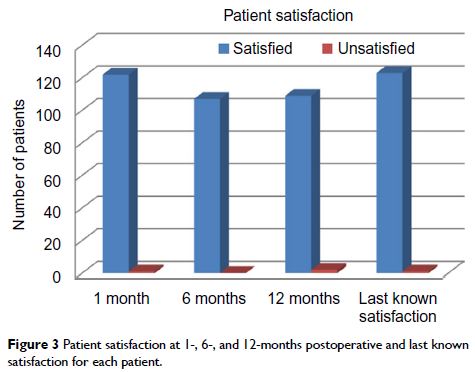
0.001). One patient was unsatisfied with the procedure.
Conclusion: This 1-year interim analysis
using PCO-VP for primary umbilical and epigastric defects shows promising
results in terms of mesh ease of use, postoperative pain, and patient
satisfaction. Recurrence rate is low, but, as laparoscopic evaluation shows a
need for patch repositioning in some cases, an accurate surgical technique
remains of utmost importance.
Keywords: intraperitoneal mesh, epigastric
hernia, umbilical hernia, pain