115195
论文已发表
注册即可获取德孚的最新动态
IF 收录期刊
- 3.6 Breast Cancer (Dove Med Press)
- 4.3 Clin Epidemiol
- 2.6 Cancer Manag Res
- 3.2 Infect Drug Resist
- 4.1 Clin Interv Aging
- 6.1 Drug Des Dev Ther
- 4.1 Int J Chronic Obstr
- 8.7 Int J Nanomed
- 2.5 Int J Women's Health
- 3.2 Neuropsych Dis Treat
- 2.4 OncoTargets Ther
- 2.6 Patient Prefer Adher
- 2.6 Ther Clin Risk Manag
- 3.1 J Pain Res
- 3.5 Diabet Metab Synd Ob
- 4.5 Psychol Res Behav Ma
- 3.4 Nat Sci Sleep
- 2.4 Pharmgenomics Pers Med
- 2.6 Risk Manag Healthc Policy
- 4.6 J Inflamm Res
- 2.3 Int J Gen Med
- 3.9 J Hepatocell Carcinoma
- 3.3 J Asthma Allergy
- 2.5 Clin Cosmet Investig Dermatol
- 3.0 J Multidiscip Healthc

miR-375 水平的上调通过抑制 JAK2/STAT3 通路改善小鼠背根神经节中的吗啡 (morphine) 镇痛耐受
Authors Li HQ, Tao R, Wang J, Xia LJ
Received 20 October 2016
Accepted for publication 22 December 2016
Published 26 May 2017 Volume 2017:10 Pages 1279—1287
DOI https://doi.org/10.2147/JPR.S125264
Checked for plagiarism Yes
Review by Single-blind
Peer reviewers approved by Dr Lucy Goodman
Peer reviewer comments 3
Editor who approved publication: Dr Michael Schatman
Abstract: Several lines of evidence indicate that microRNAs (miRNAs) modulate
tolerance to the analgesic effects of morphine via regulation of pain-related
genes, making dysregulation of miRNA levels a clinical target for controlling
opioid tolerance. However, the precise mechanisms by which miRNAs regulate
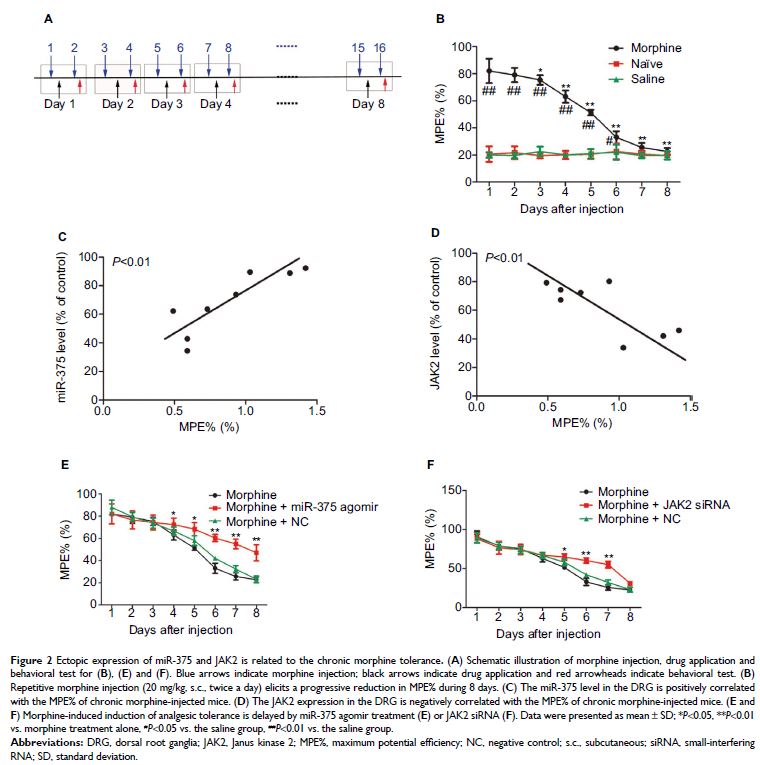
opioid tolerance are unclear. In the present study, we noted that the miR-375
level was downregulated but the expression of Janus kinase 2 (JAK2) was
upregulated in mouse dorsal root ganglia (DRG) following chronic morphine
treatment. The miR-375 levels and JAK2 expression were correlated with the
progression of morphine tolerance, and upregulation of miR-375 level could
significantly hinder morphine tolerance. This was ameliorated by JAK2 knockdown.
Prolonged morphine exposure induced the expression of brain-derived
neurotrophic factor (BDNF) in a time-dependent manner in the DRG. This was
regulated by the miR-375 and JAK2–signal transducer and activator of
transcription 3 (STAT3) pathway, and inhibition of this pathway decreased BDNF
production, and thus, attenuated morphine tolerance. More importantly, we found
that miR-375 could target JAK2 and increase BDNF expression in a JAK2/STAT3
pathway-dependent manner.
Keywords: morphine tolerance,
miR-375, JAK2, BDNF