115195
论文已发表
注册即可获取德孚的最新动态
IF 收录期刊
- 3.6 Breast Cancer (Dove Med Press)
- 4.3 Clin Epidemiol
- 2.6 Cancer Manag Res
- 3.2 Infect Drug Resist
- 4.1 Clin Interv Aging
- 6.1 Drug Des Dev Ther
- 4.1 Int J Chronic Obstr
- 8.7 Int J Nanomed
- 2.5 Int J Women's Health
- 3.2 Neuropsych Dis Treat
- 2.4 OncoTargets Ther
- 2.6 Patient Prefer Adher
- 2.6 Ther Clin Risk Manag
- 3.1 J Pain Res
- 3.5 Diabet Metab Synd Ob
- 4.5 Psychol Res Behav Ma
- 3.4 Nat Sci Sleep
- 2.4 Pharmgenomics Pers Med
- 2.6 Risk Manag Healthc Policy
- 4.6 J Inflamm Res
- 2.3 Int J Gen Med
- 3.9 J Hepatocell Carcinoma
- 3.3 J Asthma Allergy
- 2.5 Clin Cosmet Investig Dermatol
- 3.0 J Multidiscip Healthc

Myopia onset and role of peripheral refraction
Authors Rotolo M, Montani G, Martin R
Received 25 February 2017
Accepted for publication 28 April 2017
Published 16 June 2017 Volume 2017:9 Pages 105—111
DOI https://doi.org/10.2147/OPTO.S134985
Checked for plagiarism Yes
Review by Single-blind
Peer reviewers approved by Dr Amy Norman
Peer reviewer comments 2
Editor who approved publication: Mr Simon Berry
Background: To determine the peripheral refraction characteristics related to
18-month changes in refraction in Caucasian (Mediterranean) children.
Methods: Non-cycloplegic peripheral refraction at 10° intervals
over the central ±30° of horizontal visual field over 18 months (baseline, 12
months, and 18 months of follow-up) was conducted in 50 healthy children who
were 8 years old. Axial length (AL) was also recorded. Relative peripheral
refraction (RPR) was calculated and eyes were divided into three study groups:
non-myopic eyes, myopic eyes, and eyes that develop myopia.
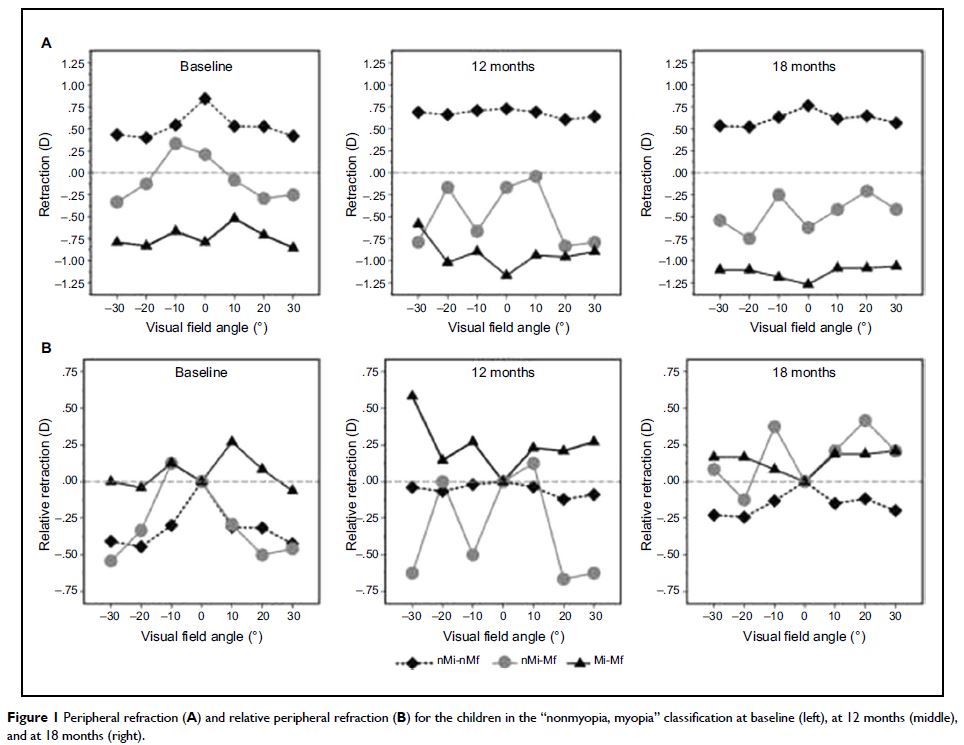
Results: Myopic eyes showed hyperopic RPR and emetropic and
hyperopic eyes showed myopic RPR. Univariate analysis of variance did not find
any statistically significant effect of peripheral refraction (F 36=0.13; P =1.00) and RPR (F 36=0.79; P =0.80) on myopia
onset (eyes that developed myopia along the study). All the studied groups
showed an increase of AL, without statistically significant differences between
the studied groups (F 6=0.09; P =0.99).
Conclusion: Hyperopic relative peripheral shift change in eyes
that develop myopia has been found with differences in RPR between myopic
(hyperopic RPR) and hyperopic or emmetropic eyes (with myopic RPR). The results
suggest that RPR cannot predict development or progression of myopia in
Caucasian (Mediterranean) children and the efficacy in slowing myopia
progression obtained with treatments that manipulate the peripheral refraction
is not just driven with RPR.
Keywords: myopia, refractive errors, myopia
onset, peripheral refraction, relative peripheral hyperopia