115195
论文已发表
注册即可获取德孚的最新动态
IF 收录期刊
- 3.6 Breast Cancer (Dove Med Press)
- 4.3 Clin Epidemiol
- 2.6 Cancer Manag Res
- 3.2 Infect Drug Resist
- 4.1 Clin Interv Aging
- 6.1 Drug Des Dev Ther
- 4.1 Int J Chronic Obstr
- 8.7 Int J Nanomed
- 2.5 Int J Women's Health
- 3.2 Neuropsych Dis Treat
- 2.4 OncoTargets Ther
- 2.6 Patient Prefer Adher
- 2.6 Ther Clin Risk Manag
- 3.1 J Pain Res
- 3.5 Diabet Metab Synd Ob
- 4.5 Psychol Res Behav Ma
- 3.4 Nat Sci Sleep
- 2.4 Pharmgenomics Pers Med
- 2.6 Risk Manag Healthc Policy
- 4.6 J Inflamm Res
- 2.3 Int J Gen Med
- 3.9 J Hepatocell Carcinoma
- 3.3 J Asthma Allergy
- 2.5 Clin Cosmet Investig Dermatol
- 3.0 J Multidiscip Healthc

AQP3 沉默通过下调甘油 (glycerol) 的摄入及对脂肪生成和自噬的下游抑制而诱导胃癌细胞凋亡
Authors Chen L, Li Z, Zhang Q, Wei S, Li B, Zhang X, Zhang L, Li Q, Xu H, Xu Z
Received 6 February 2017
Accepted for publication 5 May 2017
Published 1 June 2017 Volume 2017:10 Pages 2791—2804
DOI https://doi.org/10.2147/OTT.S134016
Checked for plagiarism Yes
Review by Single-blind
Peer reviewers approved by Dr Akshita Wason
Peer reviewer comments 3
Editor who approved publication: Dr Yao Dai
Abstract: Gastric cancer (GC) has a poor prognosis and is a leading cause of
cancer-related death. Optimal therapeutic targets have not been identified.
AQP3 is capable of transporting glycerol across the cytomembrane. Previous
studies have shown that AQP3 is involved in proliferation, invasion and
migration by regulating glycerol and lipid metabolism in diverse cancer cell
types. However, the potential roles of glycerol and lipid metabolism in
AQP3-related cell apoptosis in GC remain unclear. In this study, we observed
that AQP3 expression was upregulated in tumor tissues, and positively
correlated with tumor size, lymph node metastasis and glycerol concentration in
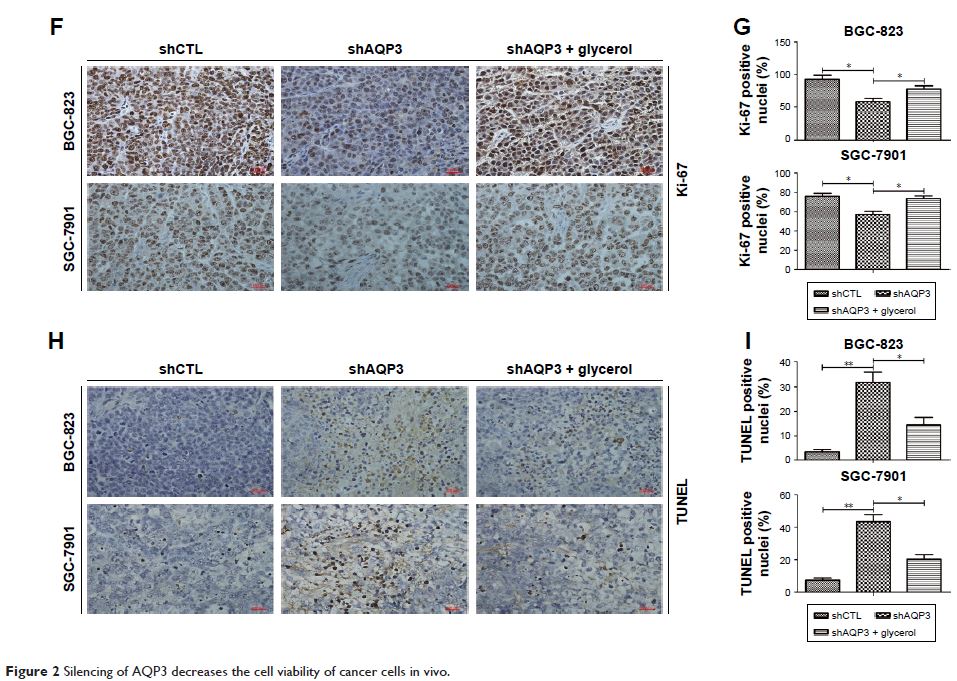
human GC samples. Silencing of AQP3 resulted in decreased glycerol intake and
impaired lipid synthesis, which contributed to increased cell apoptosis. Furthermore,
inhibition of autophagy induced by AQP3 knockdown promoted cell apoptosis.
Administration of either glycerol or rapamycin restored cell viability, and
overexpression of AQP3 increased cell viability by upregulating cellular
glycerol metabolism and autophagy. Our study demonstrates that the increase in
cell apoptosis of AQP3-deficient GC cells is a consequence of reduced glycerol
uptake and lipogenesis and is associated with autophagy inhibition induced by
AQP3 deficiency.
Keywords: AQP3,
glycerol uptake, lipid metabolism, autophagy, apoptosis