115195
论文已发表
注册即可获取德孚的最新动态
IF 收录期刊
- 3.6 Breast Cancer (Dove Med Press)
- 4.3 Clin Epidemiol
- 2.6 Cancer Manag Res
- 3.2 Infect Drug Resist
- 4.1 Clin Interv Aging
- 6.1 Drug Des Dev Ther
- 4.1 Int J Chronic Obstr
- 8.7 Int J Nanomed
- 2.5 Int J Women's Health
- 3.2 Neuropsych Dis Treat
- 2.4 OncoTargets Ther
- 2.6 Patient Prefer Adher
- 2.6 Ther Clin Risk Manag
- 3.1 J Pain Res
- 3.5 Diabet Metab Synd Ob
- 4.5 Psychol Res Behav Ma
- 3.4 Nat Sci Sleep
- 2.4 Pharmgenomics Pers Med
- 2.6 Risk Manag Healthc Policy
- 4.6 J Inflamm Res
- 2.3 Int J Gen Med
- 3.9 J Hepatocell Carcinoma
- 3.3 J Asthma Allergy
- 2.5 Clin Cosmet Investig Dermatol
- 3.0 J Multidiscip Healthc

单壁碳纳米角与极性上皮的相互作用
Authors Shi YJ, Shi ZJ, Li SX, Zhang Y, He B, Peng D, Tian J, Zhao M, Wang XQ, Zhang Q
Received 26 January 2017
Accepted for publication 3 April 2017
Published 1 June 2017 Volume 2017:12 Pages 4177—4194
DOI https://doi.org/10.2147/IJN.S133295
Checked for plagiarism Yes
Review by Single-blind
Peer reviewers approved by Dr Alexander Kharlamov
Peer reviewer comments 3
Editor who approved publication: Dr Linlin Sun
Abstract: Single-wall carbon nanohorns (SWCNHs), which have multitudes of horn
interstices, an extensive surface area, and a spherical aggregate structure,
offer many advantages over other carbon nanomaterials being used as a drug
nanovector. The previous studies on the interaction between SWCNHs and cells
have mostly emphasized on cellular uptake and intracellular trafficking, but
seldom on epithelial cells. Polar epithelium as a typical biological barrier
constitutes the prime obstacle for the transport of therapeutic agents to
target site. This work tried to explore the permeability of SWCNHs through
polar epithelium and their abilities to modulate transcellular transport, and
evaluate the potential of SWCNHs in drug delivery. Madin-Darby canine kidney
(MDCK) cell monolayer was used as a polar epithelial cell model, and as-grown
SWCNHs, together with oxidized and fluorescein isothiocyanate-conjugated bovine
serum albumin-labeled forms, were constructed and comprehensively investigated
in vitro and in vivo. Various methods such as transmission electron microscopy
and confocal imaging were used to visualize their intracellular uptake and
localization, as well as to investigate the potential transcytotic process. The
related mechanism was explored by specific inhibitors. Additionally, fast
multispectral optoacoustic tomography imaging was used for monitoring the
distribution and transport process of SWCNHs in vivo after oral administration
in nude mice, as an evidence for their interaction with the intestinal
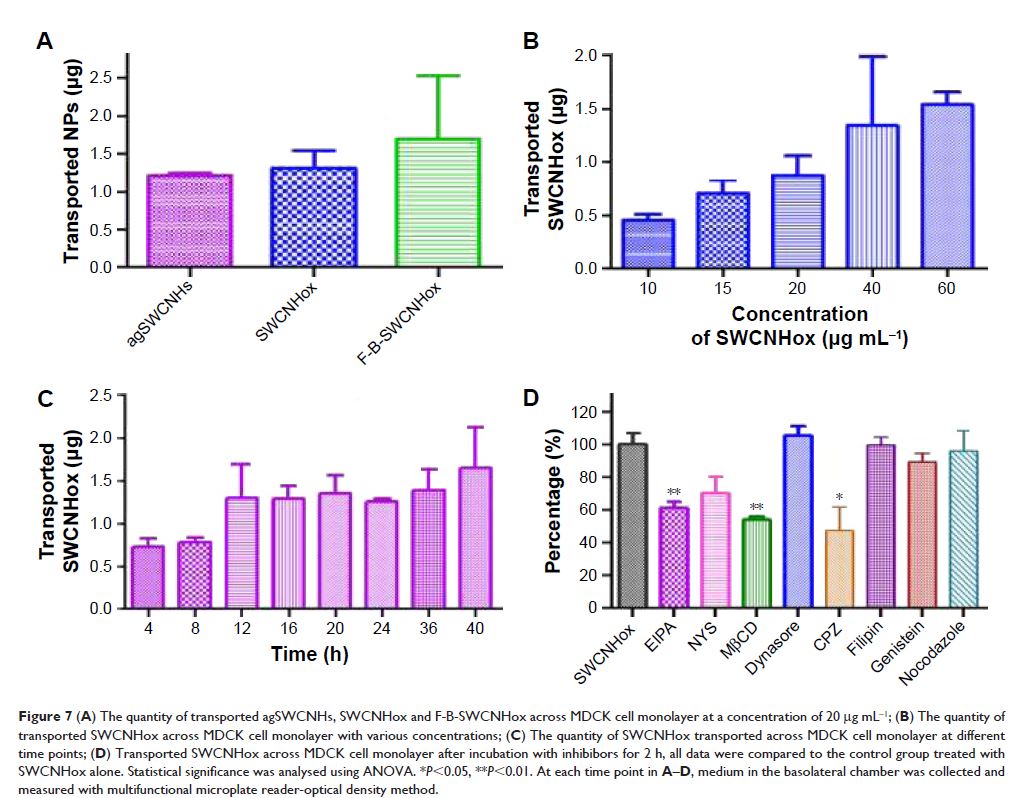
epithelium. The results showed that SWCNHs had a strong bioadhesion property,
and parts of them could be uptaken and transcytosed across the MDCK monolayer.
Multiple mechanisms were involved in the uptake and transcytosis of SWCNHs with
varying degrees. After oral administration, oxidized SWCNHs were distributed in
the gastrointestinal tract and retained in the intestine for up to 36 h
probably due to their surface adhesion and endocytosis into the intestinal
epithelium. Overall, this comprehensive investigation demonstrated that SWCNHs
can serve as a promising nanovector that can cross the barrier of polar
epithelial cells and deliver drugs effectively.
Keywords: carbon nanohorns, epithelial cells,
transport mechanisms, nanocarriers, MSOT imaging