115195
论文已发表
注册即可获取德孚的最新动态
IF 收录期刊
- 3.6 Breast Cancer (Dove Med Press)
- 4.3 Clin Epidemiol
- 2.6 Cancer Manag Res
- 3.2 Infect Drug Resist
- 4.1 Clin Interv Aging
- 6.1 Drug Des Dev Ther
- 4.1 Int J Chronic Obstr
- 8.7 Int J Nanomed
- 2.5 Int J Women's Health
- 3.2 Neuropsych Dis Treat
- 2.4 OncoTargets Ther
- 2.6 Patient Prefer Adher
- 2.6 Ther Clin Risk Manag
- 3.1 J Pain Res
- 3.5 Diabet Metab Synd Ob
- 4.5 Psychol Res Behav Ma
- 3.4 Nat Sci Sleep
- 2.4 Pharmgenomics Pers Med
- 2.6 Risk Manag Healthc Policy
- 4.6 J Inflamm Res
- 2.3 Int J Gen Med
- 3.9 J Hepatocell Carcinoma
- 3.3 J Asthma Allergy
- 2.5 Clin Cosmet Investig Dermatol
- 3.0 J Multidiscip Healthc

PI3K/AKT/mTOR 通路通过抑制自噬来促进子宫内膜癌细胞的孕激素耐药性
Authors Liu H, Zhang L, Zhang X, Cui Z
Received 27 August 2015
Accepted for publication 5 February 2016
Published 6 June 2017 Volume 2017:10 Pages 2865—2871
DOI https://doi.org/10.2147/OTT.S95267
Checked for plagiarism Yes
Review by Single-blind
Peer reviewers approved by Dr Ram Prasad
Peer reviewer comments 4
Editor who approved publication: Dr Jianmin Xu
Abstract: Endometrial cancer (EC) is now one of the most common malignant tumors
in young women. In all, 90% of young patients with EC have a high expression of
progesterone receptor, can be treated with progestin, and have very good
prognosis. However, some of the young EC patients are resistant to progestin,
the mechanism of which is unclear. To illuminate the mechanism by which
endometrial cells acquire progestin resistance, we treated Ishikawa cells by
slowly increasing dosage of progestin and established a progestin-resistant
cell subline. We show here that progesterone resistant cells acquire increased
proliferation rate and interestingly decreased autophagy. To uncover the
mechanism by which cells increase proliferation and bypass autophagy, we found
higher activation of phosphatidylinositol 3-kinase/AKT/mTOR signaling pathway
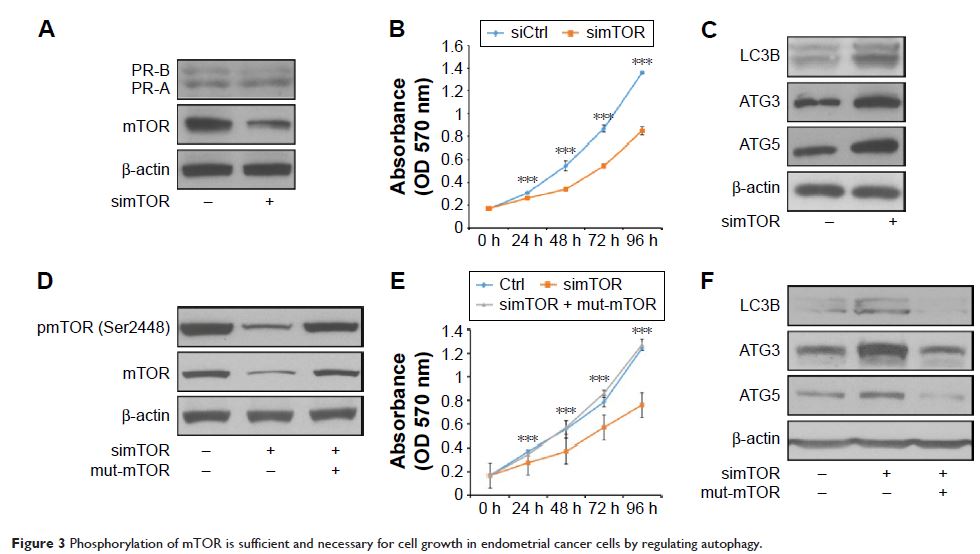
was necessary to this malignant acquirement by RNAi technique. Further, we
elucidated that activation of mTOR was sufficient and necessary for progestin
resistance. RAD001, an inhibitor of mTOR, decreased phosphorylation of mTOR and
inhibited proliferation of progestin-resistant cancer cells by promoting
autophagy. Thus, our results indicated that mTOR can be a target to treat the
progestin-resistant EC.
Keywords: progesterone receptor, RAD001, proliferation,
Ishikawa, phosphorylation