115195
论文已发表
注册即可获取德孚的最新动态
IF 收录期刊
- 3.6 Breast Cancer (Dove Med Press)
- 4.3 Clin Epidemiol
- 2.6 Cancer Manag Res
- 3.2 Infect Drug Resist
- 4.1 Clin Interv Aging
- 6.1 Drug Des Dev Ther
- 4.1 Int J Chronic Obstr
- 8.7 Int J Nanomed
- 2.5 Int J Women's Health
- 3.2 Neuropsych Dis Treat
- 2.4 OncoTargets Ther
- 2.6 Patient Prefer Adher
- 2.6 Ther Clin Risk Manag
- 3.1 J Pain Res
- 3.5 Diabet Metab Synd Ob
- 4.5 Psychol Res Behav Ma
- 3.4 Nat Sci Sleep
- 2.4 Pharmgenomics Pers Med
- 2.6 Risk Manag Healthc Policy
- 4.6 J Inflamm Res
- 2.3 Int J Gen Med
- 3.9 J Hepatocell Carcinoma
- 3.3 J Asthma Allergy
- 2.5 Clin Cosmet Investig Dermatol
- 3.0 J Multidiscip Healthc

已发表论文
优化电穿孔受控释放可增强盐酸青藤碱 (Sinomenine hydrochloride) 在体外和临床上治疗关节炎的透皮效能
Authors Feng S, Zhu L, Huang Z, Wang H, Li H, Zhou H, Lu L, Wang Y, Liu Z, Liu L
Received 7 March 2017
Accepted for publication 1 May 2017
Published 15 June 2017 Volume 2017:11 Pages 1737—1752
DOI https://doi.org/10.2147/DDDT.S136313
Checked for plagiarism Yes
Review by Single-blind
Peer reviewers approved by Dr Rajendra Narayan Mitra
Peer reviewer comments 2
Editor who approved publication: Dr Qiongyu Guo
Abstract: Sinomenine
hydrochloride (SH) is an ideal drug for the treatment of rheumatoid arthritis
and osteoarthritis. However, high plasma concentration of systemically
administered SH can release histamine, which can cause rash and
gastrointestinal side effects. Topical delivery can increase SH concentration
in the synovial fluid without high plasma level, thus minimizing systemic side
effects. However, passive diffusion of SH was found to be inefficient because
of the presence of the stratum corneum layer. Therefore, an effective method is
required to compensate for the low efficiency of SH passive diffusion. In this
study, transdermal experiments in vitro and clinical tests were utilized to
explore the optimized parameters for electroporation of topical delivery for
SH. Fluorescence experiment and hematoxylin and eosin staining analysis were
performed to reveal the mechanism by which electroporation promoted permeation.
In vitro, optimized electroporation parameters were 3 KHz, exponential
waveform, and intensity 10. Using these parameters, transdermal permeation of
SH was increased by 1.9–10.1 fold in mice skin and by 1.6–47.1 fold in
miniature pig skin compared with passive diffusion. After the electroporation
stimulation, the intercellular intervals and epidermal cracks in the skin
increased. In clinical tests, SH concentration in synovial fluid was 20.84
ng/mL after treatment with electroporation. Therefore, electroporation with
optimized parameters could significantly enhance transdermal permeation of SH.
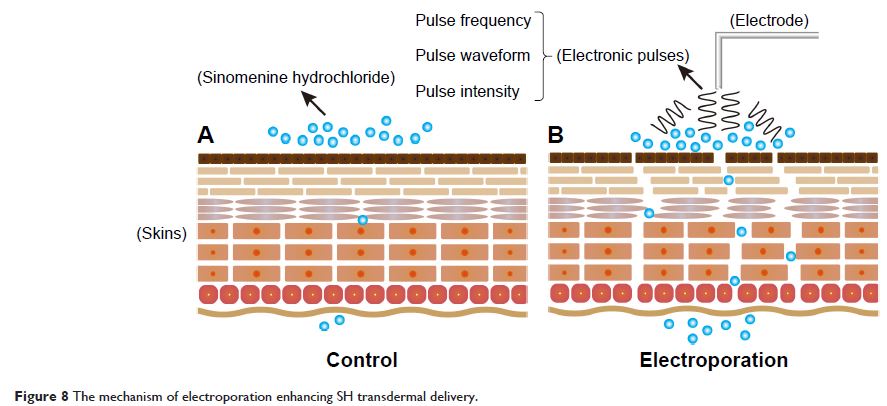
The mechanism by which electroporation promoted permeation was that the
electronic pulses made the skin structure looser. To summarize, electroporation
may be an effective complementary method for transdermal permeation of SH. The
controlled release of electroporation may be a promising clinical method for
transdermal drug administration.
Keywords: electroporation, sinomenine hydrochloride, transdermal drug delivery, arthritis
Keywords: electroporation, sinomenine hydrochloride, transdermal drug delivery, arthritis