115195
论文已发表
注册即可获取德孚的最新动态
IF 收录期刊
- 3.6 Breast Cancer (Dove Med Press)
- 4.3 Clin Epidemiol
- 2.6 Cancer Manag Res
- 3.2 Infect Drug Resist
- 4.1 Clin Interv Aging
- 6.1 Drug Des Dev Ther
- 4.1 Int J Chronic Obstr
- 8.7 Int J Nanomed
- 2.5 Int J Women's Health
- 3.2 Neuropsych Dis Treat
- 2.4 OncoTargets Ther
- 2.6 Patient Prefer Adher
- 2.6 Ther Clin Risk Manag
- 3.1 J Pain Res
- 3.5 Diabet Metab Synd Ob
- 4.5 Psychol Res Behav Ma
- 3.4 Nat Sci Sleep
- 2.4 Pharmgenomics Pers Med
- 2.6 Risk Manag Healthc Policy
- 4.6 J Inflamm Res
- 2.3 Int J Gen Med
- 3.9 J Hepatocell Carcinoma
- 3.3 J Asthma Allergy
- 2.5 Clin Cosmet Investig Dermatol
- 3.0 J Multidiscip Healthc

月经前综合征的压力反应和情绪
Authors Liu Q, Wang Y, van Heck CH, Qiao W
Received 9 January 2017
Accepted for publication 4 May 2017
Published 16 June 2017 Volume 2017:13 Pages 1597—1602
DOI https://doi.org/10.2147/NDT.S132001
Checked for plagiarism Yes
Review by Single-blind
Peer reviewers approved by Prof. Dr. Roumen Kirov
Peer reviewer comments 3
Editor who approved publication: Professor Wai Kwong Tang
Background: Hormone level fluctuation across the menstrual cycle causes women to
experience negative emotions and also affects their mood regulation and stress
sensitivity. However, the stress reactivity and emotional variations in women
with premenstrual syndrome (PMS), who are especially sensitive to the
variations in hormone cycles, have not been explained.
Methods: The present study used an electroencephalogram (EEG)
stress evaluation test, a physiology stress evaluation test, and the positive
affect and negative affect scale (PANAS) to evaluate the stress reactivity
pattern and emotional state of women with PMS.
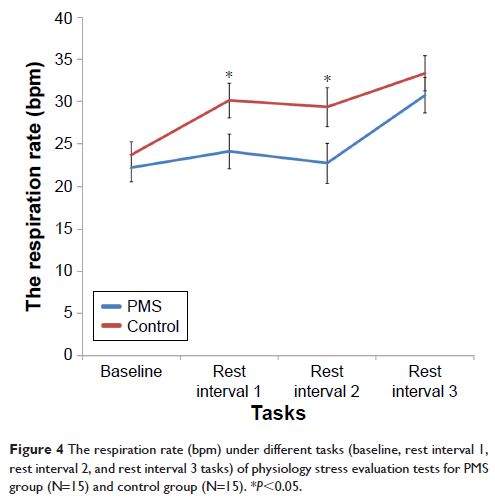
Results: The results showed that women with PMS had higher
negative affect and lower positive affect compared with controls. Moreover,
under stressful conditions, the women with PMS had a higher alpha activity and
a lower respiration rate than the controls. The differences in stress
reactivity and emotional states between women with PMS and controls were based
on a covariant analysis with menstrual cycle (luteal and follicular phases) as
the covariate.
Conclusion: The results demonstrated that, compared with controls,
women suffering from PMS have a continuous abnormality in emotional state and
stress reactivity, which was independent of the menstrual cycle.
Keywords: premenstrual syndrome, stress
reactivity, emotion, EEG stress evaluation test, physiology stress evaluation
test