115195
论文已发表
注册即可获取德孚的最新动态
IF 收录期刊
- 3.6 Breast Cancer (Dove Med Press)
- 4.3 Clin Epidemiol
- 2.6 Cancer Manag Res
- 3.2 Infect Drug Resist
- 4.1 Clin Interv Aging
- 6.1 Drug Des Dev Ther
- 4.1 Int J Chronic Obstr
- 8.7 Int J Nanomed
- 2.5 Int J Women's Health
- 3.2 Neuropsych Dis Treat
- 2.4 OncoTargets Ther
- 2.6 Patient Prefer Adher
- 2.6 Ther Clin Risk Manag
- 3.1 J Pain Res
- 3.5 Diabet Metab Synd Ob
- 4.5 Psychol Res Behav Ma
- 3.4 Nat Sci Sleep
- 2.4 Pharmgenomics Pers Med
- 2.6 Risk Manag Healthc Policy
- 4.6 J Inflamm Res
- 2.3 Int J Gen Med
- 3.9 J Hepatocell Carcinoma
- 3.3 J Asthma Allergy
- 2.5 Clin Cosmet Investig Dermatol
- 3.0 J Multidiscip Healthc

FHIT 表达和 FHIT 基因超甲基化与肝癌风险的关联:一项 PRISMA 兼容的综合分析
Authors Zhang Y, Xu X, Chen Z, Zhao Z
Received 26 March 2017
Accepted for publication 17 May 2017
Published 20 June 2017 Volume 2017:10 Pages 3083—3093
DOI https://doi.org/10.2147/OTT.S138036
Checked for plagiarism Yes
Review by Single-blind
Peer reviewers approved by Dr Colin Mak
Peer reviewer comments 2
Editor who approved publication: Dr Faris Farassati
Background: There have been suggestions that fragile histidine triad protein (FHIT)
expression and FHIT gene
hypermethylation were crucial to the pathogenesis of liver cancer. However, the
conclusions remained unclear because of small sample size, disease subtype, and
different detection techniques. Therefore, we performed a meta-analysis to
estimate the associations of FHIT expression and FHIT gene hypermethylation with liver
cancer pathogenesis.
Methods: Studies that were published in electronic databases,
such as PubMed, Web of Knowledge, China National Knowledge Infrastructure
(CNKI), VIP, and WanFang, were retrieved and selected for the meta-analysis.
Relative risk (RR) and 95% confidence interval (CI) were calculated to
determine the correlations of FHIT expression and FHIT gene hypermethylation with liver
cancer pathogenesis with Stata 12.0 software.
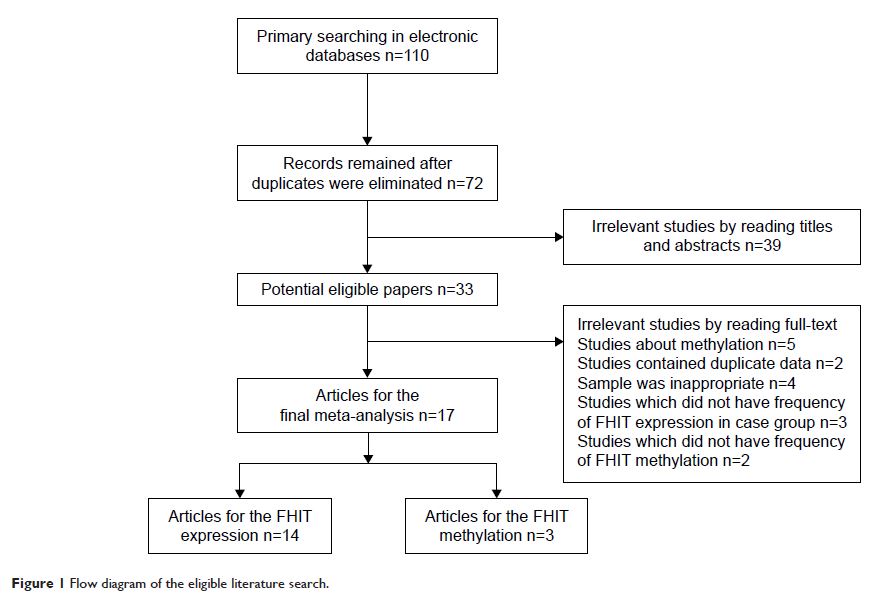
Results: A total of 17 papers that evaluated the associations
of FHIT expression (14 articles) and FHIT gene methylation (3 articles) with
liver cancer pathogenesis were included in this meta-analysis. In the overall
analysis, the pooled relative risk was 1.93 (95% CI =1.72–2.17), which
indicated a significant association between FHIT low expression and liver
cancer risk. According to the results of clinical information, there were
significant associations of FHIT expression with TNM-stage (RR =2.13, 95% CI
=1.72–2.64), tumor size (RR =1.67, 95% CI =1.36–2.05), and merger of cirrhosis
(RR =1.34, 95% CI =1.06–1.69) of liver cancer in the Chinese population. In
addition, the FHIT gene hypermethylation was
significantly associated with the risk of liver cancer (RR =1.45, 95% CI
=1.08–1.93).
Conclusion: The FHIT expression and hypermethylation of FHIT gene were significantly associated
with the risk of liver cancer, especially in the Chinese population.
Furthermore, the results indicated significant associations between FHIT low
expression and TNM-stage, tumor size, and merging of cirrhosis of liver cancer
in the Chinese population.
Keywords: FHIT, expression, hypermethylation,
liver neoplasms, meta-analysis