115195
论文已发表
注册即可获取德孚的最新动态
IF 收录期刊
- 3.6 Breast Cancer (Dove Med Press)
- 4.3 Clin Epidemiol
- 2.6 Cancer Manag Res
- 3.2 Infect Drug Resist
- 4.1 Clin Interv Aging
- 6.1 Drug Des Dev Ther
- 4.1 Int J Chronic Obstr
- 8.7 Int J Nanomed
- 2.5 Int J Women's Health
- 3.2 Neuropsych Dis Treat
- 2.4 OncoTargets Ther
- 2.6 Patient Prefer Adher
- 2.6 Ther Clin Risk Manag
- 3.1 J Pain Res
- 3.5 Diabet Metab Synd Ob
- 4.5 Psychol Res Behav Ma
- 3.4 Nat Sci Sleep
- 2.4 Pharmgenomics Pers Med
- 2.6 Risk Manag Healthc Policy
- 4.6 J Inflamm Res
- 2.3 Int J Gen Med
- 3.9 J Hepatocell Carcinoma
- 3.3 J Asthma Allergy
- 2.5 Clin Cosmet Investig Dermatol
- 3.0 J Multidiscip Healthc

姜黄素 (Curcumin) 可降低 Aβ 诱导的阿尔茨海默病 (Alzheimer's disease) 模型大鼠海马神经元凋亡和 JNK-3 磷酸化:保护空间学习与记忆
Authors Wang YL, Li JF, Wang YT, Xu CY, Hua LL, Yang XP, Geng S, Wang SS, Wang Z, Yin HL
Received 24 October 2016
Accepted for publication 10 February 2017
Published 21 June 2017 Volume 2017:5 Pages 117—123
DOI https://doi.org/10.2147/JN.S125567
Checked for plagiarism Yes
Review by Single-blind
Peer reviewers approved by Dr Colin Mak
Peer reviewer comments 2
Editor who approved publication: Prof. Dr. Hongyun Huang
Abstract: Amyloid-β peptide (Aβ) toxicity in Alzheimer’s disease (AD)
is associated with the c-Jun N-terminal kinase (JNK) signaling pathway.
Curcumin may prevent Aβ fiber formation, slowing AD progression. A model of AD
was established in 32 Sprague Dawley rats by injection of 10 μg Aβ1–40 into the right hippocampus. Saline was used in
sham control (n=16). Sixteen AD model rats received 300 mg/kg curcumin and
another 16 received saline daily for 7 days. Spatial learning and memory were
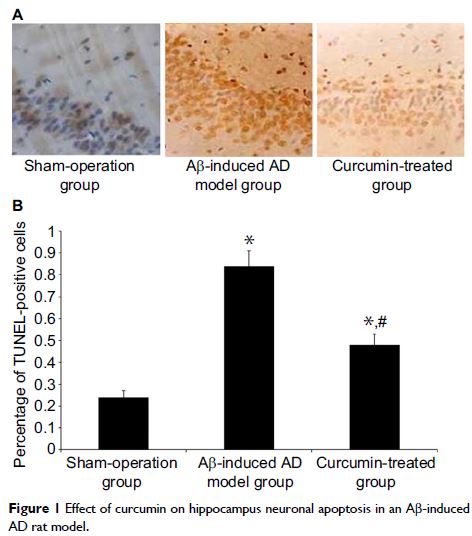
assessed using a Morris water maze. Hippocampus neuron apoptosis and
hippocampal levels of JNK-3 and p-JNK-3 were assessed by terminal
deoxynucleotidyl transferase dUTP nick end labeling, reverse
transcription-polymerase chain reaction and Western blotting. Aβ1–40 injection
induced slower spatial learning, memory deficit, neuronal apoptosis and
increased JNK-3 expression and phosphorylation (all P <0.05).
Curcumin relieved spatial learning and memory deficits, hippocampus neuronal
apoptosis, and reduced JNK-3 and p-JNK-3 levels (all P <0.05). In
conclusion, curcumin may inhibit JNK-3 phosphorylation to protect against
hippocampal neuron apoptosis after Aβ injection.
Keywords: Alzheimer’s
disease, curcumin, apoptosis, JNK-3, phosphorylation