115195
论文已发表
注册即可获取德孚的最新动态
IF 收录期刊
- 3.6 Breast Cancer (Dove Med Press)
- 4.3 Clin Epidemiol
- 2.6 Cancer Manag Res
- 3.2 Infect Drug Resist
- 4.1 Clin Interv Aging
- 6.1 Drug Des Dev Ther
- 4.1 Int J Chronic Obstr
- 8.7 Int J Nanomed
- 2.5 Int J Women's Health
- 3.2 Neuropsych Dis Treat
- 2.4 OncoTargets Ther
- 2.6 Patient Prefer Adher
- 2.6 Ther Clin Risk Manag
- 3.1 J Pain Res
- 3.5 Diabet Metab Synd Ob
- 4.5 Psychol Res Behav Ma
- 3.4 Nat Sci Sleep
- 2.4 Pharmgenomics Pers Med
- 2.6 Risk Manag Healthc Policy
- 4.6 J Inflamm Res
- 2.3 Int J Gen Med
- 3.9 J Hepatocell Carcinoma
- 3.3 J Asthma Allergy
- 2.5 Clin Cosmet Investig Dermatol
- 3.0 J Multidiscip Healthc

血浆纤维蛋白原和血清白蛋白水平 (FA 评分) 可充当良好的非小细胞肺癌 (NSCLC) 预后指标
Authors Chen P, Wang C, Cheng B, Nesa EU, Liu Y, Jia Y, Qu Y, Jiang Z, Han J, Cheng Y
Received 5 April 2017
Accepted for publication 22 May 2017
Published 21 June 2017 Volume 2017:10 Pages 3107—3118
DOI https://doi.org/10.2147/OTT.S138854
Checked for plagiarism Yes
Review by Single-blind
Peer reviewers approved by Dr Ru Chen
Peer reviewer comments 2
Editor who approved publication: Prof. Dr. Geoffrey Pietersz
Background: Evidence implies that preoperative plasma fibrinogen and serum albumin
are associated with cancer prognosis. We aimed to explore the prognostic values
of the score based on plasma fibrinogen and serum albumin levels (FA score) in
non-small cell lung cancer (NSCLC), and to compare that with prognostic
nutritional index (PNI).
Patients and methods: In all, 182 patients pathologically diagnosed with
NSCLC were included in this study. Kaplan–Meier survival analysis and
multivariate analysis were used in the prognostic analyses.
Results: High FA score was related to smoking (P =0.005), poor differential grade
(P =0.002), and advanced T stage (P <0.001) and tumor, node, and
metastases stage (P =0.011). Low PNI showed
association with advanced T stage (P =0.030).
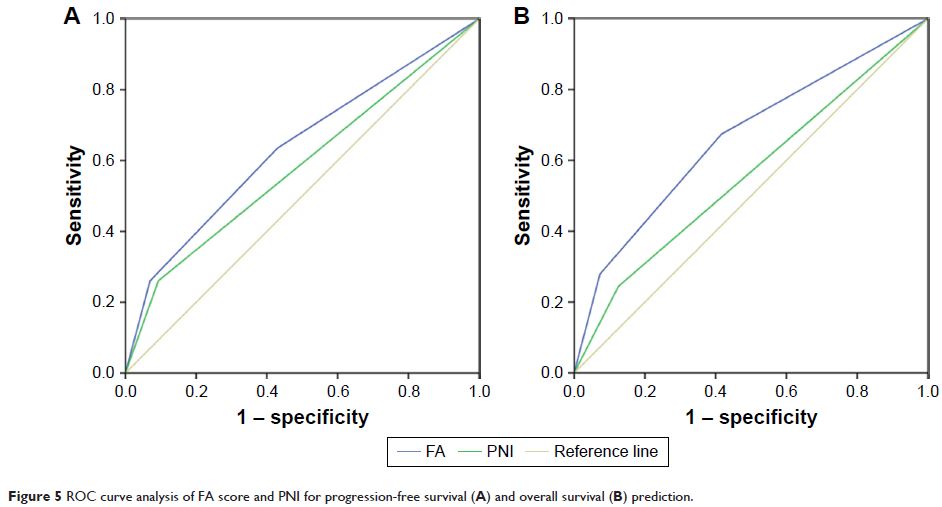
Kaplan–Meier survival analysis indicated that high FA score and low PNI were
associated with poor progression-free survival (PFS; for the FA score, P <0.001; for PNI, P =0.001) and
overall survival (OS; for the FA score, P <0.001; for PNI, P =0.013),
respectively. Multivariate analysis revealed that FA score was an independent
predictor for PFS (P =0.003) and OS (P =0.001) in NSCLC patients.
Conclusion: The FA score could act as a more promising prognostic
predictor than PNI in NSCLC patients who underwent pneumonectomy.
Keywords: non-small cell lung cancer, surgical
treatment, serum albumin, plasma fibrinogen, prognostic nutritional index,
prognosis