115195
论文已发表
注册即可获取德孚的最新动态
IF 收录期刊
- 3.6 Breast Cancer (Dove Med Press)
- 4.3 Clin Epidemiol
- 2.6 Cancer Manag Res
- 3.2 Infect Drug Resist
- 4.1 Clin Interv Aging
- 6.1 Drug Des Dev Ther
- 4.1 Int J Chronic Obstr
- 8.7 Int J Nanomed
- 2.5 Int J Women's Health
- 3.2 Neuropsych Dis Treat
- 2.4 OncoTargets Ther
- 2.6 Patient Prefer Adher
- 2.6 Ther Clin Risk Manag
- 3.1 J Pain Res
- 3.5 Diabet Metab Synd Ob
- 4.5 Psychol Res Behav Ma
- 3.4 Nat Sci Sleep
- 2.4 Pharmgenomics Pers Med
- 2.6 Risk Manag Healthc Policy
- 4.6 J Inflamm Res
- 2.3 Int J Gen Med
- 3.9 J Hepatocell Carcinoma
- 3.3 J Asthma Allergy
- 2.5 Clin Cosmet Investig Dermatol
- 3.0 J Multidiscip Healthc

酪氨酸激酶 (Tyrosine kinase) 抑制剂对具有 EGFR 敏感突变的非小细胞肺癌 (NSCLC) 患者的临床疗效评价
Authors Song X, Wang Z
Received 12 February 2017
Accepted for publication 31 March 2017
Published 22 June 2017 Volume 2017:10 Pages 3119—3122
DOI https://doi.org/10.2147/OTT.S134523
Checked for plagiarism Yes
Review by Single-blind
Peer reviewers approved by Dr Akshita Wason
Peer reviewer comments 2
Editor who approved publication: Dr Ingrid Espinoza
Abstract: Epidermal growth factor receptor (EGFR) tyrosine kinase inhibitors
(TKIs) as a standard therapy have been used in EGFR-mutated adenocarcinoma of
non-small-cell lung cancer (NSCLC) patients in recent years. But in current
randomized prospective clinical trials, due to few cases of non-adenocarcinoma
patients having been found, the efficacy of TKIs for EGFR-mutated
non-adenocarcinoma and the relationship with clinicopathological
characteristics remained debatable. The results of retrospective studies showed
that the frequency of EGFR mutation was significantly associated with
nationality, gender, smoking history, and histology type. Being female,
never-smoker and adenocarcinoma had a higher mutation rate. Furthermore, the
EGFR mutation rate and efficacies of TKIs in adenocarcinoma were higher than
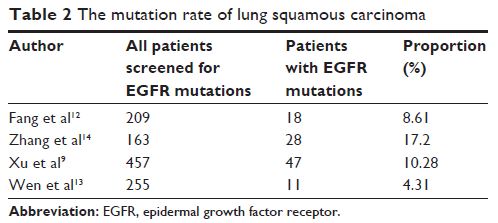
those in non-adenocarcinoma. And in non-adenocarcinoma, the EGFR mutation rate
and efficacies of TKIs in adenosquamous cell carcinoma were higher than those
in squamous cell carcinoma or in large-cell lung carcinoma. In conclusion,
it may be necessary to conduct a large sample prospective study to understand
the clinicopathological characteristics of non-adenocarcinomas and to evaluate
the efficacy of EGFR TKI and/or chemotherapy for EGFR-mutated
non-adenocarcinoma NSCLC. So we searched relevant articles between the year
2010 and 2016 through the major indexed literature database PubMed by searching
the keywords such as EGFR mutation, Tyrosine kinase inhibitors, and
Non-adenocarcinoma.
Keywords: EGFR mutation, tyrosine kinase
inhibitors, non-adenocarcinoma