115195
论文已发表
注册即可获取德孚的最新动态
IF 收录期刊
- 3.6 Breast Cancer (Dove Med Press)
- 4.3 Clin Epidemiol
- 2.6 Cancer Manag Res
- 3.2 Infect Drug Resist
- 4.1 Clin Interv Aging
- 6.1 Drug Des Dev Ther
- 4.1 Int J Chronic Obstr
- 8.7 Int J Nanomed
- 2.5 Int J Women's Health
- 3.2 Neuropsych Dis Treat
- 2.4 OncoTargets Ther
- 2.6 Patient Prefer Adher
- 2.6 Ther Clin Risk Manag
- 3.1 J Pain Res
- 3.5 Diabet Metab Synd Ob
- 4.5 Psychol Res Behav Ma
- 3.4 Nat Sci Sleep
- 2.4 Pharmgenomics Pers Med
- 2.6 Risk Manag Healthc Policy
- 4.6 J Inflamm Res
- 2.3 Int J Gen Med
- 3.9 J Hepatocell Carcinoma
- 3.3 J Asthma Allergy
- 2.5 Clin Cosmet Investig Dermatol
- 3.0 J Multidiscip Healthc

用于癌胚抗原检测的硅纳米线场效应晶体管 (Si-NR FET) 的自顶向下的纳米制造方法
Authors Bao Z, Sun J, Zhao X, Li Z, Cui S, Meng Q, Zhang Y, Wang T, Jiang Y
Received 2 March 2017
Accepted for publication 10 May 2017
Published 27 June 2017 Volume 2017:12 Pages 4623—4631
DOI https://doi.org/10.2147/IJN.S135985
Checked for plagiarism Yes
Review by Single-blind
Peer reviewers approved by Dr Alexander Kharlamov
Peer reviewer comments 3
Editor who approved publication: Dr Linlin Sun
Abstract: Sensitive and quantitative detection of tumor markers is highly required
in the clinic for cancer diagnosis and consequent treatment. A field-effect
transistor-based (FET-based) nanobiosensor emerges with characteristics of
being label-free, real-time, having high sensitivity, and providing direct
electrical readout for detection of biomarkers. In this paper, a top–down
approach is proposed and implemented to fulfill a novel silicon nano-ribbon
FET, which acts as biomarker sensor for future clinical application. Compared
with the bottom–up approach, a top–down fabrication approach can confine width
and length of the silicon FET precisely to control its electrical properties.
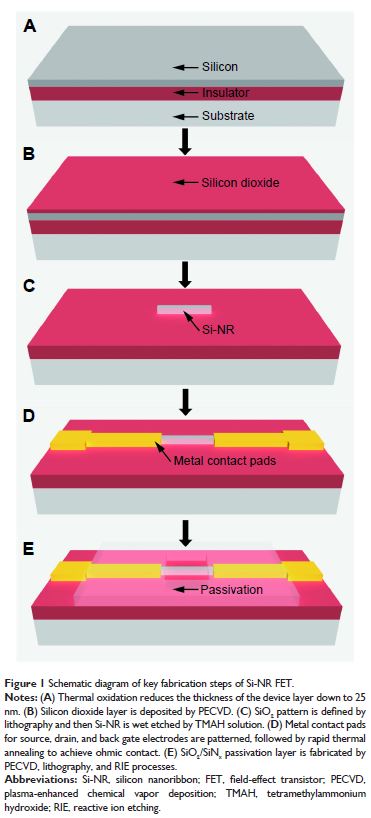
The silicon nanoribbon (Si-NR) transistor is fabricated on a Silicon-on-Insulator
(SOI) substrate by a top–down approach with complementary metal oxide
semiconductor (CMOS)-compatible technology. After the preparation, the surface
of Si-NR is functionalized with 3-aminopropyltriethoxysilane (APTES).
Glutaraldehyde is utilized to bind the amino terminals of APTES and antibody on
the surface. Finally, a microfluidic channel is integrated on the top of the
device, acting as a flowing channel for the carcinoembryonic antigen (CEA)
solution. The Si-NR FET is 120 nm in width and 25 nm in height, with ambipolar
electrical characteristics. A logarithmic relationship between the changing
ratio of the current and the CEA concentration is measured in the range of
0.1–100 ng/mL. The sensitivity of detection is measured as 10 pg/mL. The top–down
fabricated biochip shows feasibility in direct detecting of CEA with the
benefits of real-time, low cost, and high sensitivity as a promising biosensor
for tumor early diagnosis.
Keywords: silicon nanobiosensor, nanoribbon, field-effect transistor,
carcinoembryonic antigen, microfluidic channel