115195
论文已发表
注册即可获取德孚的最新动态
IF 收录期刊
- 3.6 Breast Cancer (Dove Med Press)
- 4.3 Clin Epidemiol
- 2.6 Cancer Manag Res
- 3.2 Infect Drug Resist
- 4.1 Clin Interv Aging
- 6.1 Drug Des Dev Ther
- 4.1 Int J Chronic Obstr
- 8.7 Int J Nanomed
- 2.5 Int J Women's Health
- 3.2 Neuropsych Dis Treat
- 2.4 OncoTargets Ther
- 2.6 Patient Prefer Adher
- 2.6 Ther Clin Risk Manag
- 3.1 J Pain Res
- 3.5 Diabet Metab Synd Ob
- 4.5 Psychol Res Behav Ma
- 3.4 Nat Sci Sleep
- 2.4 Pharmgenomics Pers Med
- 2.6 Risk Manag Healthc Policy
- 4.6 J Inflamm Res
- 2.3 Int J Gen Med
- 3.9 J Hepatocell Carcinoma
- 3.3 J Asthma Allergy
- 2.5 Clin Cosmet Investig Dermatol
- 3.0 J Multidiscip Healthc

将短版压力应对方式调查问卷 (CISS) 翻译成中文
Authors Li C, Liu Q, Hu T, Jin X
Received 14 March 2017
Accepted for publication 22 May 2017
Published 27 June 2017 Volume 2017:13 Pages 1669—1675
DOI https://doi.org/10.2147/NDT.S136950
Checked for plagiarism Yes
Review by Single-blind
Peer reviewers approved by Prof. Dr. Roumen Kirov
Peer reviewer comments 2
Editor who approved publication: Professor Wai Kwong Tang
Objectives: The Coping Inventory for Stressful Situations (CISS) is a measurement
tool for evaluating stress that has good psychometric properties. We
investigated the applicability of a short-form version of the CISS in a large
sample of Chinese university students.
Methods: Nine hundred and seventy-two Chinese university
students aged 18–30 years (mean =20.15, standard deviation =3.26) were
chosen as subjects, of whom 101 were randomly selected to be retested after a
2-week interval.
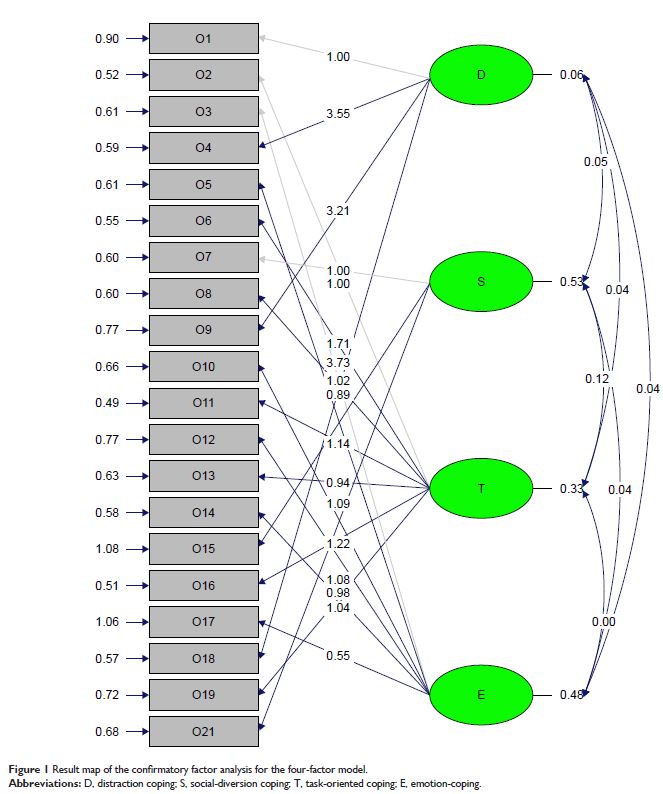
Results: The results of a confirmatory factor
analysis revealed that the root mean square error of approximation of a
four-factor model was 0.06, while the comparative fit index was 0.91, the
incremental fit index was 0.93, the non-normed fit index was 0.91, and the root
mean residual was 0.07. The Cronbach’s α coefficients for the task-oriented,
emotion-oriented, distraction, and social diversion coping subscales were 0.81,
0.74, 0.7, and 0.66, respectively. The 2-week test–retest reliability was 0.78,
0.74, 0.7, and 0.65 for the task-oriented, emotion-oriented, distraction, and
social diversion coping subscales, respectively. In the Chinese version of the
CISS short form, task-oriented coping was positively correlated with positive
affect and extraversion and negatively correlated with neuroticism; emotion-oriented
coping was negatively correlated with extraversion and positively correlated
with negative affect, anxiety, and neuroticism; distraction coping was
positively correlated with neuroticism, extroversion, anxiety, positive affect,
and negative affect and negatively correlated with psychoticism; and social
diversion coping was positively correlated with extroversion and positive
affect and negatively correlated with psychoticism.
Conclusion: The Chinese version of the CISS short form is
satisfactorily valid and reliable among Chinese university students.
Keywords: stress, coping, factor analysis,
reliability, validity, Chinese university students