115195
论文已发表
注册即可获取德孚的最新动态
IF 收录期刊
- 3.6 Breast Cancer (Dove Med Press)
- 4.3 Clin Epidemiol
- 2.6 Cancer Manag Res
- 3.2 Infect Drug Resist
- 4.1 Clin Interv Aging
- 6.1 Drug Des Dev Ther
- 4.1 Int J Chronic Obstr
- 8.7 Int J Nanomed
- 2.5 Int J Women's Health
- 3.2 Neuropsych Dis Treat
- 2.4 OncoTargets Ther
- 2.6 Patient Prefer Adher
- 2.6 Ther Clin Risk Manag
- 3.1 J Pain Res
- 3.5 Diabet Metab Synd Ob
- 4.5 Psychol Res Behav Ma
- 3.4 Nat Sci Sleep
- 2.4 Pharmgenomics Pers Med
- 2.6 Risk Manag Healthc Policy
- 4.6 J Inflamm Res
- 2.3 Int J Gen Med
- 3.9 J Hepatocell Carcinoma
- 3.3 J Asthma Allergy
- 2.5 Clin Cosmet Investig Dermatol
- 3.0 J Multidiscip Healthc

Current perspectives in the USA on the diagnosis and treatment of pelvic inflammatory disease in adolescents
Authors Risser WL, Risser JM, Risser AL
Received 19 December 2016
Accepted for publication 4 May 2017
Published 27 June 2017 Volume 2017:8 Pages 87—94
DOI https://doi.org/10.2147/AHMT.S115535
Checked for plagiarism Yes
Review by Single-blind
Peer reviewers approved by Dr Akshita Wason
Peer reviewer comments 3
Editor who approved publication: Professor Alastair Sutcliffe
Abstract: In this review, the epidemiology, diagnosis, and treatment of pelvic
inflammatory disease (PID) are discussed from a USA perspective and the
difficulties that USA adolescents face in recognizing and seeking care for PID
and other sexually transmitted infections (STIs) are emphasized. Females aged
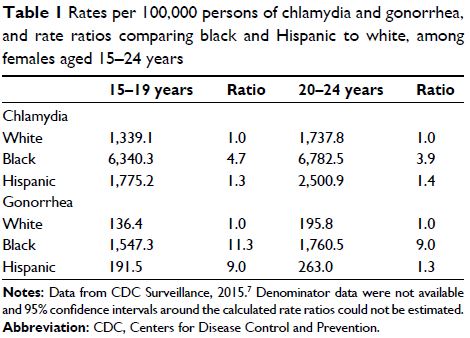
15–24 years have the highest incidence of cervical infection with Chlamydia trachomatis and Neisseria gonorrheae , the
principal causes of PID. PID is common in this age group. However, the
incidence of PID in the USA is not known, because it is not a reportable
disease, and because clinicians vary in the criteria used for the diagnosis.
The Centers for Disease Control and Prevention (CDC) recommended the following
diagnostic criteria that include lower abdominal or pelvic pain and at least
one of the following: adnexal tenderness or cervical motion tenderness or uterine
tenderness. Because PID can have serious sequelae, the criteria emphasize
sensitivity (few false-negatives) at the expense of specificity (some
false-positives). Patients who have PID are usually treated in the outpatient
setting, following the CDC’s Guidelines for the Treatment of Sexually
Transmitted Diseases 2015. They receive one dose of an intramuscular
cephalosporin, together with 2 weeks of oral doxy cycline, and sometimes oral
metronidazole. Improvement should usually be evident in 3 days. The USA does
not offer comprehensive sex education for adolescents in public or private
schools. Adolescents are unlikely to recognize the symptoms of PID and seek
medical treatment. Confidentiality is important to adolescents, and low cost or
free sources of confidential care are uncommon, making it unlikely that an
adolescent would seek care even if she suspected an STI. The CDC has concluded
that screening programs for chlamydia and gonorrhea infection help prevent PID;
however, the lack of appropriate sources of care makes adolescents’
participation in screening programs unlikely.
Keywords: pelvic
inflammatory disease, diagnosis, treatment, prevention, adolescence, Chlamydia trachomatis , Neisseria gonorrheae ,
bacterial vaginosis, sex education, intrauterine device, epidemiology