115195
论文已发表
注册即可获取德孚的最新动态
IF 收录期刊
- 3.6 Breast Cancer (Dove Med Press)
- 4.3 Clin Epidemiol
- 2.6 Cancer Manag Res
- 3.2 Infect Drug Resist
- 4.1 Clin Interv Aging
- 6.1 Drug Des Dev Ther
- 4.1 Int J Chronic Obstr
- 8.7 Int J Nanomed
- 2.5 Int J Women's Health
- 3.2 Neuropsych Dis Treat
- 2.4 OncoTargets Ther
- 2.6 Patient Prefer Adher
- 2.6 Ther Clin Risk Manag
- 3.1 J Pain Res
- 3.5 Diabet Metab Synd Ob
- 4.5 Psychol Res Behav Ma
- 3.4 Nat Sci Sleep
- 2.4 Pharmgenomics Pers Med
- 2.6 Risk Manag Healthc Policy
- 4.6 J Inflamm Res
- 2.3 Int J Gen Med
- 3.9 J Hepatocell Carcinoma
- 3.3 J Asthma Allergy
- 2.5 Clin Cosmet Investig Dermatol
- 3.0 J Multidiscip Healthc

短期和持续性急性肾损伤对高龄老年患者短期治疗结果的影响
Authors Li Q, Zhao M, Wang X
Received 21 February 2017
Accepted for publication 1 May 2017
Published 28 June 2017 Volume 2017:12 Pages 1013—1020
DOI https://doi.org/10.2147/CIA.S135241
Checked for plagiarism Yes
Review by Single-blind
Peer reviewers approved by Dr Akshita Wason
Peer reviewer comments 5
Editor who approved publication: Professor Zhi-Ying Wu
Objectives: Acute kidney injury (AKI) is a common complication in elderly patients
and is associated with poor outcomes. However, the effect of transient and
persistent geriatric AKI on short-term mortality is unclear. We aimed to study
the incidence, clinical characteristics, and prognostic impact of transient and
persistent AKI in such patients.
Methods: We retrospectively enrolled very elderly patients (≥75 years) from the
geriatric department of the Chinese PLA General Hospital between 2007 and 2015.
AKI was defined according to the 2012 Kidney Disease: Improving Global Outcomes
criteria. AKI patients were divided into transient or persistent AKI groups
based on their renal function at 3 days post-AKI. Renal function recovery was
defined as a return to the baseline serum creatinine (SCr) levels.
Results: In total, 668 geriatric patients (39.0%) experienced AKI, and 652
satisfied the inclusion criteria. Of these 652 patients, 270 (41.4%) had
transient AKI, and 382 (58.6%) had persistent AKI. The 90-day mortality was
5.9% in patients with transient AKI and 53.1% in patients with persistent AKI.
Multivariate analysis revealed that low hemoglobin levels (odds ratio [OR]
=0.989; 95% CI: 0.980–0.999; P =0.025), low mean aortic pressure
(OR =0.985; 95% CI: 0.971–1.000; P =0.043), peak SCr (OR =1.020; 95%
CI: 1.015–1.026; P <0.001) levels, high uric acid
(OR =1.002; 95% CI: 1.000–1.003; P =0.040) levels, high blood urea
nitrogen (OR =1.028; 95% CI: 1.000–1.056; P =0.047) levels,
and mechanical ventilation requirements (OR =1.610; 95% CI: 1.012–2.562; P =0.044) were
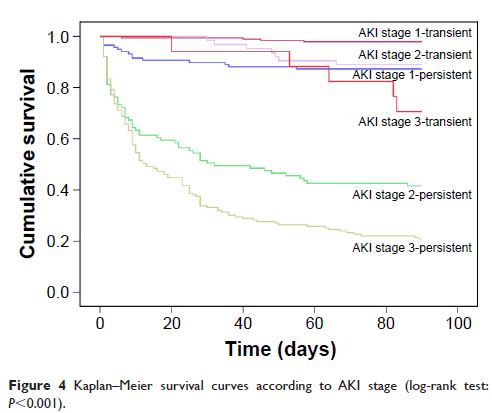
associated with persistent AKI. Persistent AKI (hazard ratio [HR] =5.741; 95%
CI: 3.356–9.822; P <0.001) and more severe AKI
stages (stage 2: HR =3.363; 95% CI: 1.973–5.732; P <0.001 and
stage 3: HR =4.741; 95% CI: 2.807–8.008; P <0.001) were associated with
90-day mortality.
Conclusion: AKI is common in very elderly patients, with transient renal injury
representing close to 42% of all cases of geriatric AKI. More frequent SCr
measurements may be helpful for the early diagnosis of transient geriatric AKI.
Persistent geriatric AKI is independently associated with a significantly
higher risk of 90-day mortality.
Keywords: acute kidney injury, very elderly, short-term mortality, transient and
persistent, risk factors