113173
论文已发表
注册即可获取德孚的最新动态
IF 收录期刊
- 3.4 Breast Cancer (Dove Med Press)
- 3.2 Clin Epidemiol
- 2.6 Cancer Manag Res
- 2.9 Infect Drug Resist
- 3.7 Clin Interv Aging
- 5.1 Drug Des Dev Ther
- 3.1 Int J Chronic Obstr
- 6.6 Int J Nanomed
- 2.6 Int J Women's Health
- 2.9 Neuropsych Dis Treat
- 2.8 OncoTargets Ther
- 2.0 Patient Prefer Adher
- 2.2 Ther Clin Risk Manag
- 2.5 J Pain Res
- 3.0 Diabet Metab Synd Ob
- 3.2 Psychol Res Behav Ma
- 3.4 Nat Sci Sleep
- 1.8 Pharmgenomics Pers Med
- 2.0 Risk Manag Healthc Policy
- 4.1 J Inflamm Res
- 2.0 Int J Gen Med
- 3.4 J Hepatocell Carcinoma
- 3.0 J Asthma Allergy
- 2.2 Clin Cosmet Investig Dermatol
- 2.4 J Multidiscip Healthc

对 E2F1 进行 MiR-98 靶向调节可增加白血病细胞 K562/A02 的化学敏感性
Authors Huang YD, Hong XL, Hu J, Lu Q
Received 5 November 2016
Accepted for publication 15 May 2017
Published 29 June 2017 Volume 2017:10 Pages 3233—3239
DOI https://doi.org/10.2147/OTT.S126819
Checked for plagiarism Yes
Review by Single-blind
Peer reviewers approved by Dr Ru Chen
Peer reviewer comments 3
Editor who approved publication: Dr Ingrid Espinoza
Background: miRNA is a microRNA that negatively regulates protein expression at
post-transcriptional or translational level. It is widely involved in the
pathogenesis of tumors. miR-98 belongs to the let-7 family, and its
overexpression can increase the sensitivity to drugs in solid cancer cells.
However, the function of miR-98 in leukemia is still unclear. In this study,
the effect of miR-98 on drug resistance and proliferation of leukemia cells
were investigated.
Methods: Real-time quantitative polymerase chain reaction analyzed the expression
difference between miR-98 and E2F1 in leukemia cell lines, K562 and K562/A02. The
downstream target gene of miR-98 was predicted by TargetScan; K562/A02 was
transiently transfected with miR-98 mimic to upregulate the expression of
miR-98; real-time quantitative polymerase chain reaction and Western blot were
used to analyze the expression alterations of E2F1; cell counting kit-8 was
used to evaluate the influence on K562/A02 proliferation and sensitivity to
chemotherapeutic drugs; meanwhile, Western blot was used to analyze the
expression of p21, Bax, matrix metalloproteinase 9 and ABCG2 proteins.
Results: E2F1 is one of the target genes of miR-98 proved by bioinformatics.
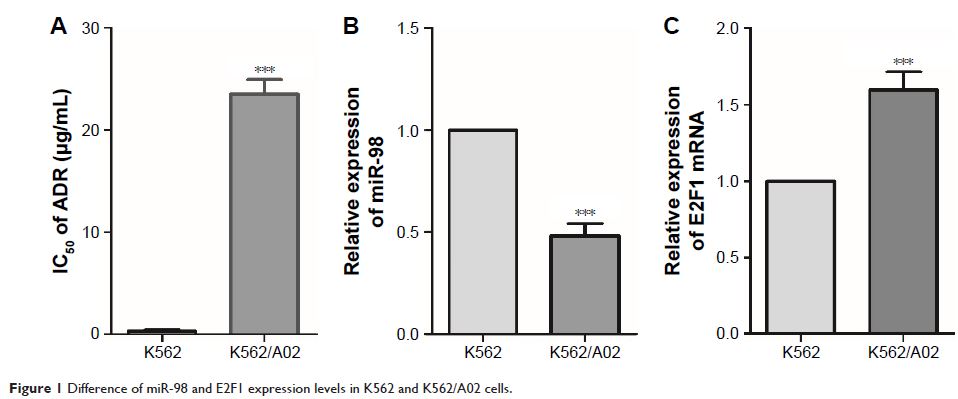
Compared with the K562, the level of miRNA-98 expression was decreased in
K562/A02, but the level of E2F1 expression was upregulated. Leukemia cell line
K562/A02 was transfected with miR-98 mimic to upregulate the expression of
miR-98, the expression of E2F1 was significantly decreased. After upregulating
the miR-98 expression in K562/A02, the proliferation was weakened, and the
sensitivity to chemotherapy was increased. Western blot showed that upregulated
miR-98 expression increased the levels of p21 and BAX proteins in K562/A02
cells, and decreased the levels of matrix metalloprotease 9 and ABCG2 proteins,
which were significantly different compared with those before miR-98 mimic
transfection.
Conclusion: In the leukemia drug-resistant cell line K562/A02, the targeted
upregulated expression of miR-98 could decrease the proliferation of leukemia
cells and improve the sensitivity to chemotherapeutics by inhibiting E2F1
expression. miR-98 might be a potential target for overcoming leukemia
multidrug resistance.
Keywords: miRNA-98, leukemia cells, E2F1, drug resistance, K562/A02