115195
论文已发表
注册即可获取德孚的最新动态
IF 收录期刊
- 3.6 Breast Cancer (Dove Med Press)
- 4.3 Clin Epidemiol
- 2.6 Cancer Manag Res
- 3.2 Infect Drug Resist
- 4.1 Clin Interv Aging
- 6.1 Drug Des Dev Ther
- 4.1 Int J Chronic Obstr
- 8.7 Int J Nanomed
- 2.5 Int J Women's Health
- 3.2 Neuropsych Dis Treat
- 2.4 OncoTargets Ther
- 2.6 Patient Prefer Adher
- 2.6 Ther Clin Risk Manag
- 3.1 J Pain Res
- 3.5 Diabet Metab Synd Ob
- 4.5 Psychol Res Behav Ma
- 3.4 Nat Sci Sleep
- 2.4 Pharmgenomics Pers Med
- 2.6 Risk Manag Healthc Policy
- 4.6 J Inflamm Res
- 2.3 Int J Gen Med
- 3.9 J Hepatocell Carcinoma
- 3.3 J Asthma Allergy
- 2.5 Clin Cosmet Investig Dermatol
- 3.0 J Multidiscip Healthc

研究在运用与事件相关的潜在技术处理利益冲突时同情和情感的组合影响
Authors He XL, Zhang N
Received 8 October 2016
Accepted for publication 20 April 2017
Published 29 June 2017 Volume 2017:13 Pages 1713—1721
DOI https://doi.org/10.2147/NDT.S124224
Checked for plagiarism Yes
Review by Single-blind
Peer reviewers approved by Prof. Dr. Roumen Kirov
Peer reviewer comments 4
Editor who approved publication: Professor Wai Kwong Tang
Objectives: Studies have found that
empathy is important in moral development and violence suppression, and emotion
also affects empathy. However, the combinatorial effect of emotion and empathy
on the processing of conflicts is not known.
Materials and methods: A total of 44 undergraduate students (23 in
low-empathy group and 21 in high-empathy group) were enrolled in this study.
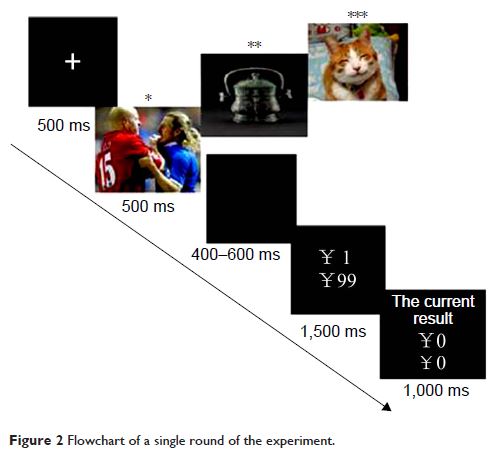
They were subjected to positive, negative, and neutral emotion evoking, as well
as conflicting or nonconflicting proposals. Event-related potential technology
was used to study the combinatorial effects of empathy and emotion on the
processing of conflict of interest.
Results: We found that under the influence of a positive
emotion, both low- and high-empathy groups exhibited lower rejection rates. In
the context of conflict, individuals in the high-empathy group showed fewer
refusals under positive emotion. In the low-empathy group, there was no
significant difference between responses to different emotions, but conflicting
proposals induced more negative medial frontal negativity than nonconflicting
proposals. Individuals in the low-empathy group showed different late positive
potentials when responding to different types of proposals under both neutral
and negative emotions, whereas those in the high-empathy group only showed
different late positive potentials responding to different types of proposals
under negative emotion.
Conclusion: Our results indicate that under positive emotion,
individuals with low empathy show less difference in processing either
conflicting or nonconflicting proposals, whereas under negative emotion,
individuals with high empathy show enhanced motivation toward nonconflicting
proposals.
Keywords: empathy,
conflicts of interest, emotion, event-related potential, late positive
potentials, medial frontal negativity