115195
论文已发表
注册即可获取德孚的最新动态
IF 收录期刊
- 3.6 Breast Cancer (Dove Med Press)
- 4.3 Clin Epidemiol
- 2.6 Cancer Manag Res
- 3.2 Infect Drug Resist
- 4.1 Clin Interv Aging
- 6.1 Drug Des Dev Ther
- 4.1 Int J Chronic Obstr
- 8.7 Int J Nanomed
- 2.5 Int J Women's Health
- 3.2 Neuropsych Dis Treat
- 2.4 OncoTargets Ther
- 2.6 Patient Prefer Adher
- 2.6 Ther Clin Risk Manag
- 3.1 J Pain Res
- 3.5 Diabet Metab Synd Ob
- 4.5 Psychol Res Behav Ma
- 3.4 Nat Sci Sleep
- 2.4 Pharmgenomics Pers Med
- 2.6 Risk Manag Healthc Policy
- 4.6 J Inflamm Res
- 2.3 Int J Gen Med
- 3.9 J Hepatocell Carcinoma
- 3.3 J Asthma Allergy
- 2.5 Clin Cosmet Investig Dermatol
- 3.0 J Multidiscip Healthc

对通过体外和体内不同方法合成和进行表面工程化的量子点的毒性进行平行比较研究
Authors Liu F, Ye W, Wang J, Song F, Cheng Y, Zhang B
Received 21 March 2017
Accepted for publication 7 June 2017
Published 19 July 2017 Volume 2017:12 Pages 5135—5148
DOI https://doi.org/10.2147/IJN.S137637
Checked for plagiarism Yes
Review by Single-blind
Peer reviewers approved by Dr Akshita Wason
Peer reviewer comments 4
Editor who approved publication: Dr Linlin Sun
Abstract: Quantum dots (QDs) have been considered to be promising probes for
biosensing, bioimaging, and diagnosis. However, their toxicity issues caused by
heavy metals in QDs remain to be addressed, in particular for their in vivo
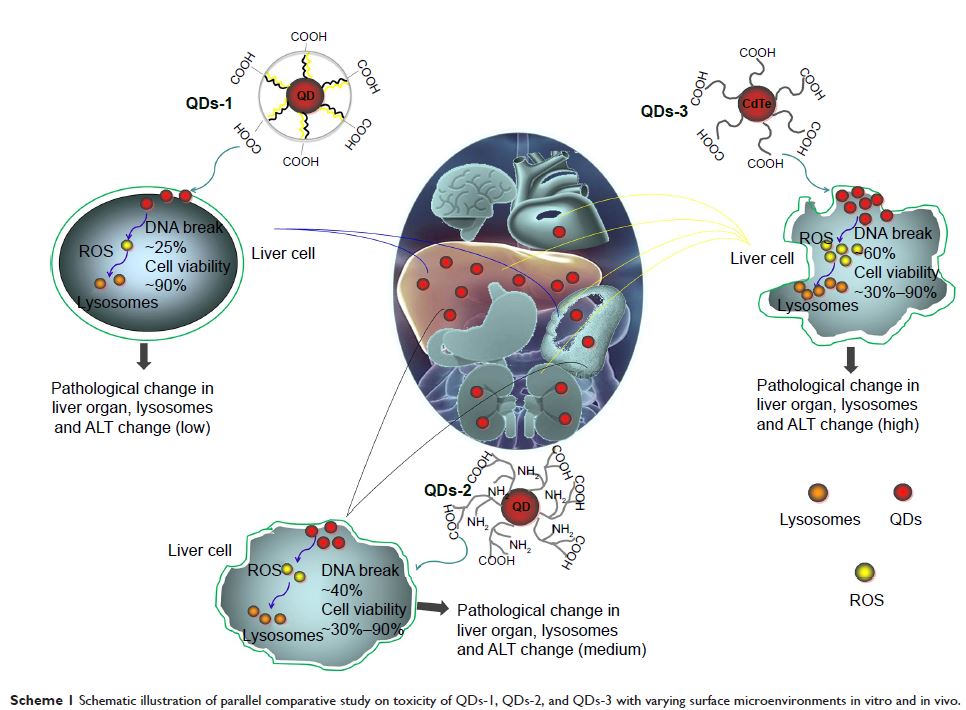
biomedical applications. In this study, a parallel comparative investigation in
vitro and in vivo is presented to disclose the impact of synthetic methods and
their following surface modifications on the toxicity of QDs. Cellular assays
after exposure to QDs were conducted including cell viability assessment, DNA
breakage study in a single cellular level, intracellular reactive oxygen
species (ROS) receptor measurement, and transmission electron microscopy to
evaluate their toxicity in vitro. Mice experiments after QD administration,
including analysis of hemobiological indices, pharmacokinetics, histological
examination, and body weight, were further carried out to evaluate their systematic
toxicity in vivo. Results show that QDs fabricated by the thermal decomposition
approach in organic phase and encapsulated by an amphiphilic polymer (denoted
as QDs-1) present the least toxicity in acute damage, compared with those of
QDs surface engineered by glutathione-mediated ligand exchange (denoted as
QDs-2), and the ones prepared by coprecipitation approach in aqueous phase with
mercaptopropionic acid capped (denoted as QDs-3). With the extension of the
investigation time of mice respectively injected with QDs, we found that the
damage caused by QDs to the organs can be gradually recovered. This parallel
comparative investigation suggests that synthetic methods and their resulting
surface microenvironment play vital roles in the acute toxicity profiles of
QDs. The present study provides updated insights into the fabrication and
surface engineering of QDs for their translational applications in
theranostics.
Keywords: comparative
investigation, amphiphilic polymer, glutathione, mercaptopropionic acid, DNA
breakage, surface microenvironment