115195
论文已发表
注册即可获取德孚的最新动态
IF 收录期刊
- 3.6 Breast Cancer (Dove Med Press)
- 4.3 Clin Epidemiol
- 2.6 Cancer Manag Res
- 3.2 Infect Drug Resist
- 4.1 Clin Interv Aging
- 6.1 Drug Des Dev Ther
- 4.1 Int J Chronic Obstr
- 8.7 Int J Nanomed
- 2.5 Int J Women's Health
- 3.2 Neuropsych Dis Treat
- 2.4 OncoTargets Ther
- 2.6 Patient Prefer Adher
- 2.6 Ther Clin Risk Manag
- 3.1 J Pain Res
- 3.5 Diabet Metab Synd Ob
- 4.5 Psychol Res Behav Ma
- 3.4 Nat Sci Sleep
- 2.4 Pharmgenomics Pers Med
- 2.6 Risk Manag Healthc Policy
- 4.6 J Inflamm Res
- 2.3 Int J Gen Med
- 3.9 J Hepatocell Carcinoma
- 3.3 J Asthma Allergy
- 2.5 Clin Cosmet Investig Dermatol
- 3.0 J Multidiscip Healthc

分泌型卷曲相关蛋白 (Secreted frizzled-related proteins) 的甲基化可预测非 M3 型急性骨髓性白血病的预后不良
Authors Guo H, Zhang T, Wen X, Zhou JD, Ma J, An C, Zhang W, Xu Z, Lin J, Qian J
Received 8 March 2017
Accepted for publication 31 May 2017
Published 20 July 2017 Volume 2017:10 Pages 3635—3644
DOI https://doi.org/10.2147/OTT.S136502
Checked for plagiarism Yes
Review by Single-blind
Peer reviewers approved by Dr Ashok Kumar Pandurangan
Peer reviewer comments 2
Editor who approved publication: Dr William Cho
Objective: Secreted frizzled-related proteins (SFRPs) as Wnt signaling antagonists
have been found to be dysregulated by promoter hypermethylation in several
cancers including acute myeloid leukemia (AML). This study aimed to investigate
the methylated status of SFRPs promoter region and its clinical relevance in
Chinese non-M3 AML patients.
Methods: SFRPs methylation in 139 primary non-M3 AML patients was
determined using methylation-specific real-time quantitative polymerase chain
reaction.
Results: The frequency of aberrant methylation was as follows: 30.2% for
SFRP1, 27.3% for SFRP2, 5.0% for SFRP4, and 1.4% for SFRP5. Hypermethylation of
at least one SFRP gene occurred in 51.8% (72/139) of non-M3 AML patient
samples, which was significantly higher compared to normal control (0/21) (P <0.001). Hypermethylation of
SFRP1 was potentially associated with N/K-RAS mutations
(P =0.043), and the frequency of
SFRPs methylation was higher in patients ≥50 years compared to those <50
years, especially for SFRP2 (P <0.05).
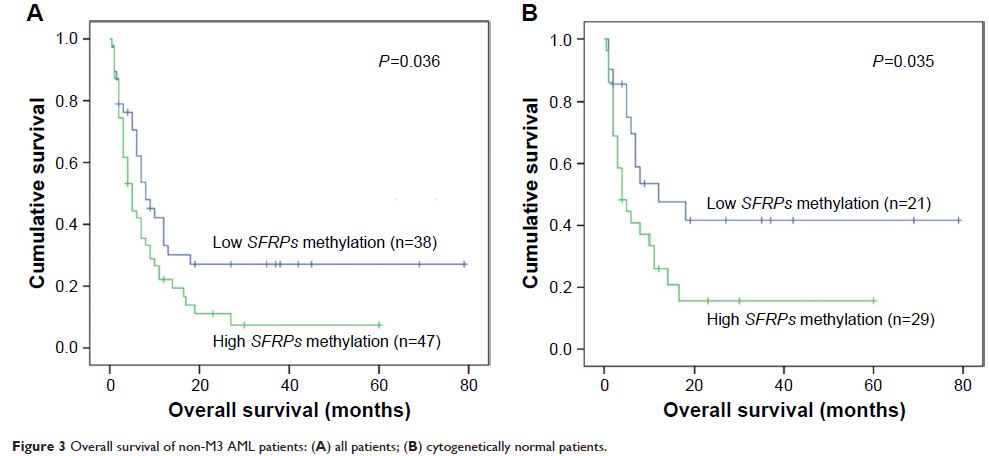
Furthermore, both whole cohort and cytogenetically normal (CN) patients with
high SFRPs-methylated group showed a shorter overall survival (OS) compared to
those with low group (P =0.036 and P =0.035, respectively). Moreover,
Cox regression multivariate analysis revealed that SFRPs hypermethylation acts
as an independent prognostic biomarker among both whole cohort (hazard ratio
=1.804, P =0.026) and CN (hazard
ratio =2.477, P =0.023) patients.
In leukemic cell line HL60 treated with 5-aza-2'-deoxycytidine, the alteration
of SFRP1/2 expression inversely correlated with change in SFRP1/2 methylation (r =-0.975, P =0.005 and r =-0.975, P =0.005, respectively). A tendency
of negative correlation was observed between SFRP1 expression and its promoter
methylation in AML patients (r =-0.334, P =0.038).
Conclusion: These findings suggested that hypermethylation of SFRP1/2 was a frequent
event and silenced SFRP1/2 expression in AML. Moreover, hypermethylation of
SFRPs promoter was an adverse risk factor for OS in Chinese non-M3 AML
patients.
Keywords: SFRPs, methylation, RQ-MSP, non-M3 AML, prognosis