115195
论文已发表
注册即可获取德孚的最新动态
IF 收录期刊
- 3.6 Breast Cancer (Dove Med Press)
- 4.3 Clin Epidemiol
- 2.6 Cancer Manag Res
- 3.2 Infect Drug Resist
- 4.1 Clin Interv Aging
- 6.1 Drug Des Dev Ther
- 4.1 Int J Chronic Obstr
- 8.7 Int J Nanomed
- 2.5 Int J Women's Health
- 3.2 Neuropsych Dis Treat
- 2.4 OncoTargets Ther
- 2.6 Patient Prefer Adher
- 2.6 Ther Clin Risk Manag
- 3.1 J Pain Res
- 3.5 Diabet Metab Synd Ob
- 4.5 Psychol Res Behav Ma
- 3.4 Nat Sci Sleep
- 2.4 Pharmgenomics Pers Med
- 2.6 Risk Manag Healthc Policy
- 4.6 J Inflamm Res
- 2.3 Int J Gen Med
- 3.9 J Hepatocell Carcinoma
- 3.3 J Asthma Allergy
- 2.5 Clin Cosmet Investig Dermatol
- 3.0 J Multidiscip Healthc

线粒体丝氨酸羟基甲基转移酶 2 的过度表达与预后不良相关,并可促进胶质瘤细胞增殖和侵袭
Authors Wu M, Wanggou S, Li X, Liu Q, Xie Y
Received 16 December 2016
Accepted for publication 9 March 2017
Published 27 July 2017 Volume 2017:10 Pages 3781—3788
DOI https://doi.org/10.2147/OTT.S130409
Checked for plagiarism Yes
Review by Single-blind
Peer reviewers approved by Dr Akshita Wason
Peer reviewer comments 3
Editor who approved publication: Dr William Cho
Abstract: Mitochondrial serine hydroxyl-methyltransferase 2 (SHMT2), participating
in the synthesis of mitochondrial thymidine monophosphate, has been reported to
drive glioma cell survival in ischemia. However, its clinical relevance in
gliomas remains unclear. In the current study, immunohistochemistry was
performed to examine subcellular localization and expression levels of SHMT2
protein in glioma and non-neoplastic brain tissue specimens. Then, the
associations of SHMT2 expression with various clinicopathological features and
patients’ prognosis were statistically evaluated. The roles of SHMT2 in the proliferation
and invasion of glioma cells after siRNA-SHMT2 vector transfection were also
detected by cell counting kit-8 and transwell assays, respectively. Results
showed that SHMT2 immunostaining was predominantly localized in the cellular
cytoplasm of tumor cells in glioma tissues but weakly in non-neoplastic brain
tissues. Statistically, SHMT2 protein expression was significantly higher in
glioma tissues than in non-neoplastic brain tissues (P <0.001). In addition, SHMT2
overexpression more frequently occurred in glioma patients with an advanced
grade of malignancy (P <0.001) and
poor prognosis (P =0.001). Notably, multivariate
analysis based on a Cox regression model identified SHMT2 expression as an
independent prognostic factor for glioma patients (P =0.01).
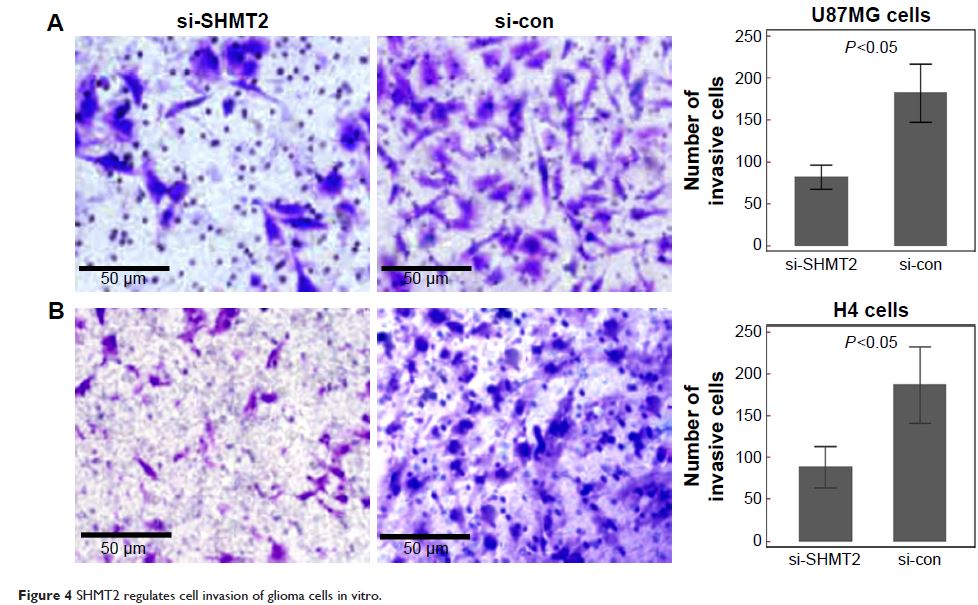
Functionally, SHMT2 knockdown efficiently suppressed the proliferation (P =0.02) and invasion (P <0.001) of glioma cells in
vitro. In conclusion, our findings suggest that SHMT2 may function as an
oncogene in glioma development and progression. Clinically, SHMT2 may serve as
a prognostic factor and as a potential therapeutic target for human gliomas.
Keywords: mitochondrial
serine hydroxyl-methyltransferase 2, glioma, prognosis, oncogene, cell
proliferation, cell invasion