115195
论文已发表
注册即可获取德孚的最新动态
IF 收录期刊
- 3.6 Breast Cancer (Dove Med Press)
- 4.3 Clin Epidemiol
- 2.6 Cancer Manag Res
- 3.2 Infect Drug Resist
- 4.1 Clin Interv Aging
- 6.1 Drug Des Dev Ther
- 4.1 Int J Chronic Obstr
- 8.7 Int J Nanomed
- 2.5 Int J Women's Health
- 3.2 Neuropsych Dis Treat
- 2.4 OncoTargets Ther
- 2.6 Patient Prefer Adher
- 2.6 Ther Clin Risk Manag
- 3.1 J Pain Res
- 3.5 Diabet Metab Synd Ob
- 4.5 Psychol Res Behav Ma
- 3.4 Nat Sci Sleep
- 2.4 Pharmgenomics Pers Med
- 2.6 Risk Manag Healthc Policy
- 4.6 J Inflamm Res
- 2.3 Int J Gen Med
- 3.9 J Hepatocell Carcinoma
- 3.3 J Asthma Allergy
- 2.5 Clin Cosmet Investig Dermatol
- 3.0 J Multidiscip Healthc

Texture-modified food and fluids in dementia and residential aged care facilities
Authors Painter V, Le Couteur DG, Waite LM
Received 27 April 2017
Accepted for publication 9 June 2017
Published 2 August 2017 Volume 2017:12 Pages 1193—1203
DOI https://doi.org/10.2147/CIA.S140581
Checked for plagiarism Yes
Review by Single-blind
Peer reviewers approved by Dr Akshita Wason
Peer reviewer comments 2
Editor who approved publication: Dr Richard Walker
Introduction: Dysphagia is common in people living with dementia and associated with
increased risk of aspiration pneumonia, dehydration, malnutrition, and death.
Treatment options are limited and the use of texture-modified food and fluids
(TMF) is a widespread clinical practice. This review aimed to evaluate the
evidence for TMF in dementia.
Methods: A literature search using terms “dysphagia,” “texture-modified
food and fluids,” “dementia,” and “aged care” was performed by using three
electronic databases from 1990 to March 2017. Studies were assessed for
suitability, then reviewed with data extracted, and grouped by categories of
outcome measures.
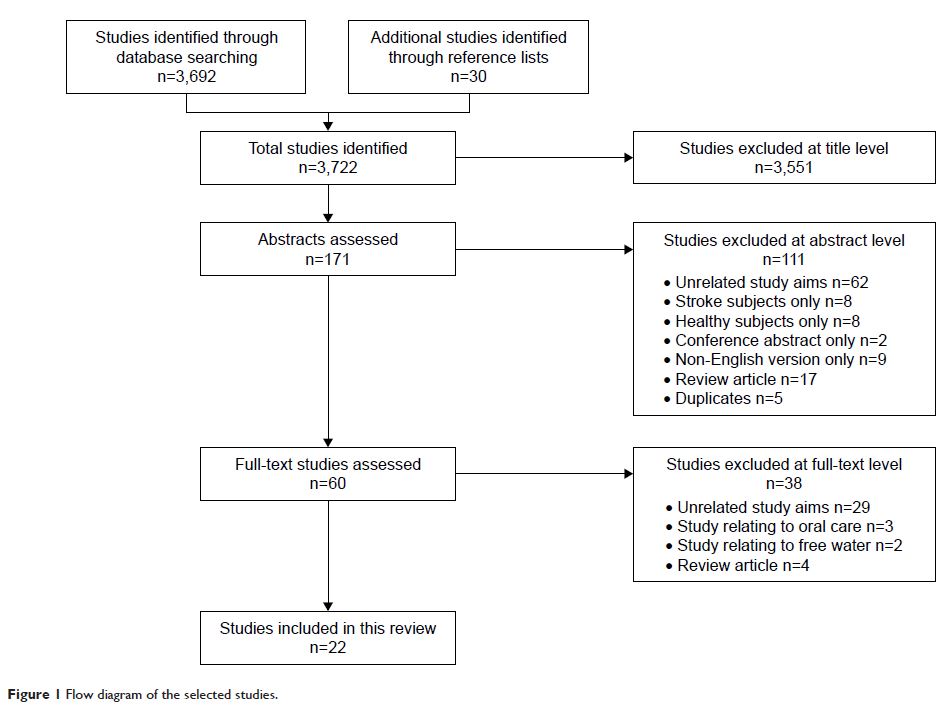
Results: A total of 3,722 publications were identified, and 22 studies met the
inclusion criteria. Studies were heterogeneous in design and methodology. There
were no publications examining dementia exclusively; however, many subjects
with dementia were included in studies of residential aged care facilities. TMF
reduced the risk of aspiration seen on videofluoroscopy but not clinical
aspiration and pneumonia. TMF was associated with lower daily energy and fluid
intake and variable adherence.
Conclusion: There is a lack of evidence for people living with dementia and in
residential care facilities that TMF improves clinical outcomes such as
aspiration pneumonia, nutrition, hydration, morbidity, and mortality. Adverse
effects including poorer energy and fluid intake were identified.
Keywords: modified diet, dysphagia, aspiration, aged care, nursing homes,
dehydration, nutrition