115195
论文已发表
注册即可获取德孚的最新动态
IF 收录期刊
- 3.6 Breast Cancer (Dove Med Press)
- 4.3 Clin Epidemiol
- 2.6 Cancer Manag Res
- 3.2 Infect Drug Resist
- 4.1 Clin Interv Aging
- 6.1 Drug Des Dev Ther
- 4.1 Int J Chronic Obstr
- 8.7 Int J Nanomed
- 2.5 Int J Women's Health
- 3.2 Neuropsych Dis Treat
- 2.4 OncoTargets Ther
- 2.6 Patient Prefer Adher
- 2.6 Ther Clin Risk Manag
- 3.1 J Pain Res
- 3.5 Diabet Metab Synd Ob
- 4.5 Psychol Res Behav Ma
- 3.4 Nat Sci Sleep
- 2.4 Pharmgenomics Pers Med
- 2.6 Risk Manag Healthc Policy
- 4.6 J Inflamm Res
- 2.3 Int J Gen Med
- 3.9 J Hepatocell Carcinoma
- 3.3 J Asthma Allergy
- 2.5 Clin Cosmet Investig Dermatol
- 3.0 J Multidiscip Healthc

在对内蒙古儿童和成人花粉诱发的季节性哮喘的诊断中,呼吸系统症状的预测价值
Authors Ma TT, Zhuang Y, Gong HY, Yii AC, Wang XY, Shi HZ
Received 30 March 2017
Accepted for publication 14 June 2017
Published 4 August 2017 Volume 2017:13 Pages 967—974
DOI https://doi.org/10.2147/TCRM.S138355
Checked for plagiarism Yes
Review by Single-blind
Peer reviewers approved by Dr Akshita Wason
Peer reviewer comments 2
Editor who approved publication: Professor Garry Walsh
Background: The diagnosis of asthma is made on the basis of variable respiratory
symptoms and supported by objective evidence of variable airflow limitation.
However, spirometry and bronchoprovocation tests may not be routinely available
in resource-scarce settings or in the context of large-scale epidemiological
studies. There is a gap in knowledge about the predictive value of respiratory
symptoms for the diagnosis of pollen-induced asthma.
Objective: The aim of this study was to investigate the predictive value of
self-reported respiratory symptoms for diagnosing pollen-induced asthma.
Patients and
methods: We recruited 1,161 patients
with respiratory symptoms who presented to the respiratory medicine outpatient
clinic of two central hospitals in Inner Mongolia during the pollen season of
July–September 2015. All patients were interviewed by a respiratory physician
and completed a questionnaire survey, lung function tests and skin prick tests
for common inhaled allergens.
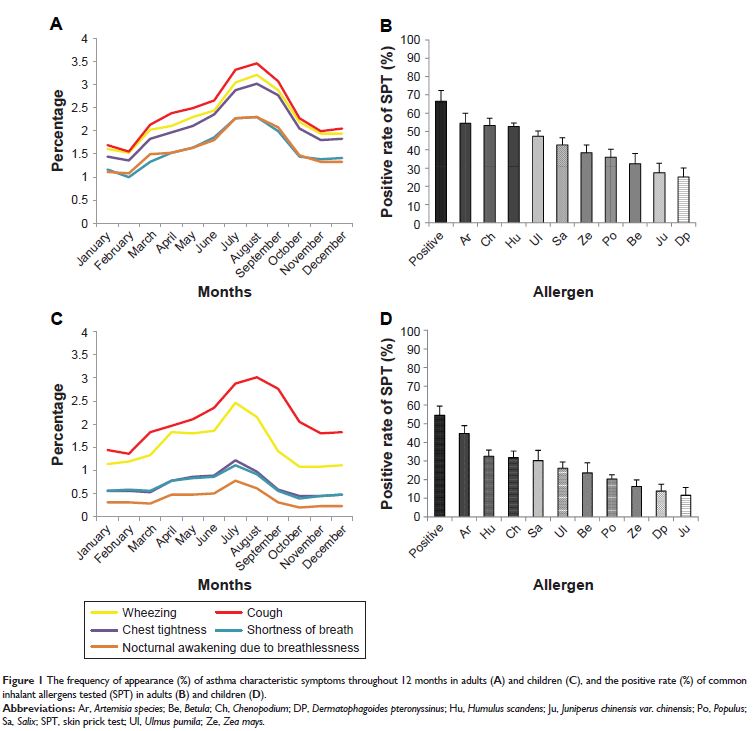
Results: A total of 392 patients (33.8%) were diagnosed with asthma and 292
(25.2%, 160 adults, 132 children) with pollen-induced asthma. Respiratory
symptoms of cough, wheezing, dyspnea, chest pain and nocturnal awakenings due
to breathlessness were all associated with increased odds of being diagnosed
with pollen-induced asthma, with cough being the most common symptom in both
adults and children, giving a sensitivity of 90.6% in adults and 88.6% in
children. Wheezing was the most specific symptom (78% and 89.5% in adults and
children, respectively) compared to other symptoms. Overall, the positive
predictive value of respiratory symptoms was poor for diagnosing pollen-induced
asthma, with the exception of wheezing in children which had a high positive
predictive value of 72.7%.
Conclusion: Cough was the predominant symptom in adults and children with
pollen-induced asthma. Wheezing was a reliable predictor of pollen-induced
asthma in children. In adults, respiratory symptoms were not sufficiently
reliable for diagnosing pollen-induced asthma.
Keywords: pollen-induced asthma, asthma symptoms, wheezing, cough, shortness
of breath