115195
论文已发表
注册即可获取德孚的最新动态
IF 收录期刊
- 3.6 Breast Cancer (Dove Med Press)
- 4.3 Clin Epidemiol
- 2.6 Cancer Manag Res
- 3.2 Infect Drug Resist
- 4.1 Clin Interv Aging
- 6.1 Drug Des Dev Ther
- 4.1 Int J Chronic Obstr
- 8.7 Int J Nanomed
- 2.5 Int J Women's Health
- 3.2 Neuropsych Dis Treat
- 2.4 OncoTargets Ther
- 2.6 Patient Prefer Adher
- 2.6 Ther Clin Risk Manag
- 3.1 J Pain Res
- 3.5 Diabet Metab Synd Ob
- 4.5 Psychol Res Behav Ma
- 3.4 Nat Sci Sleep
- 2.4 Pharmgenomics Pers Med
- 2.6 Risk Manag Healthc Policy
- 4.6 J Inflamm Res
- 2.3 Int J Gen Med
- 3.9 J Hepatocell Carcinoma
- 3.3 J Asthma Allergy
- 2.5 Clin Cosmet Investig Dermatol
- 3.0 J Multidiscip Healthc

肝素 - 泊洛沙姆 (Poloxamer) 的三维结构胶束改善了 17β-雌二醇对宫内粘连大鼠模型子宫内膜再生的治疗作用
Authors Zhang S, Xia W, Xu J, Xu H, Lu C, Zhao Y, Wu X
Received 16 March 2017
Accepted for publication 23 May 2017
Published 7 August 2017 Volume 2017:12 Pages 5643—5657
DOI https://doi.org/10.2147/IJN.S137237
Checked for plagiarism Yes
Review by Single-blind
Peer reviewers approved by Dr Alexander Kharlamov
Peer reviewer comments 2
Editor who approved publication: Dr Linlin Sun
Abstract: Intrauterine adhesions (IUA) frequently occur after infectious or
mechanical injury to the endometrium, which may lead to infertility and/or
pregnancy complications. There are few effective treatments due to the complex
function of endometrium and shortage of native materials. 17β-estradiol (E2) is commonly used as an ancillary treatment in IUA
patients, but it is limited by its poor solubility in aqueous solutions and low
concentrations at the injured sites. In this research, a mini-endometrial
curette was used to injure the rat’s endometrium to form an IUA model.
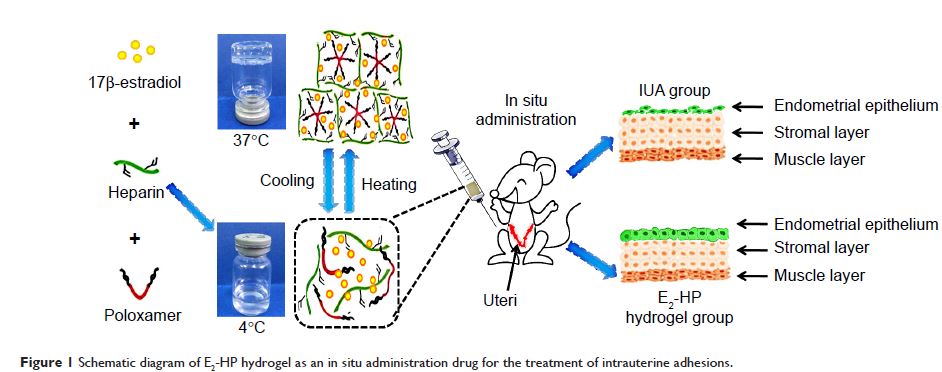
17β-estradiol was encapsulated into the micelles of heparin-poloxamer and a
thermosensitive hydrogel (E2-HP hydrogel) was
formed. This sustained releasing system was applied to restore the structure
and function of the injured uterus. E2-HP hydrogel was
constructed and relevant characteristics including gelation temperature and
micromorphology were evaluated. Sustained release of 17β-estradiol from HP
hydrogel was performed both in vitro and in vivo. Ultrasonography measurement
and pathologic characteristics on the IUA rats were performed to evaluate the
therapeutic effect of E2-HP hydrogel. Endoplasmic
reticulum (ER) stress-related apoptosis was analyzed to explore the possible
mechanisms in IUA recovery. E2-HP hydrogel
showed a prolonged release of E2 at the
targeting region and more effective endometrium regeneration in IUA rats.
Significant improvements in both gland numbers and fibrosis area were observed
in the E2-HP hydrogel group. We also demonstrated that E2-HP hydrogel in the recovery of IUA was closely
related to the suppression of ER stress signals via the activation of
downstream signals, PI3K/Akt and ERK1/2. HP hydrogel might be an effective
approach to deliver E2 into the injured
endometrium. Therapeutic strategies targeting ER stress using E2-HP hydrogel might be a promising solution for the
treatment of women with intrauterine adhesions.
Keywords: intrauterine
adhesions, 17β-estradiol, heparin-poloxamer hydrogel, endometrium regeneration,
endoplasmic reticulum stress