115195
论文已发表
注册即可获取德孚的最新动态
IF 收录期刊
- 3.6 Breast Cancer (Dove Med Press)
- 4.3 Clin Epidemiol
- 2.6 Cancer Manag Res
- 3.2 Infect Drug Resist
- 4.1 Clin Interv Aging
- 6.1 Drug Des Dev Ther
- 4.1 Int J Chronic Obstr
- 8.7 Int J Nanomed
- 2.5 Int J Women's Health
- 3.2 Neuropsych Dis Treat
- 2.4 OncoTargets Ther
- 2.6 Patient Prefer Adher
- 2.6 Ther Clin Risk Manag
- 3.1 J Pain Res
- 3.5 Diabet Metab Synd Ob
- 4.5 Psychol Res Behav Ma
- 3.4 Nat Sci Sleep
- 2.4 Pharmgenomics Pers Med
- 2.6 Risk Manag Healthc Policy
- 4.6 J Inflamm Res
- 2.3 Int J Gen Med
- 3.9 J Hepatocell Carcinoma
- 3.3 J Asthma Allergy
- 2.5 Clin Cosmet Investig Dermatol
- 3.0 J Multidiscip Healthc

自我效能和社会支持对中国类风湿关节炎患者的抑郁和焦虑症状的减缓作用
Authors Liu L, Xu N, Wang L
Received 16 March 2017
Accepted for publication 14 July 2017
Published 9 August 2017 Volume 2017:13 Pages 2141—2150
DOI https://doi.org/10.2147/NDT.S137233
Checked for plagiarism Yes
Review by Single-blind
Peer reviewers approved by Prof. Dr. Roumen Kirov
Peer reviewer comments 3
Editor who approved publication: Professor Wai Kwong Tang
Purpose: Rheumatoid arthritis (RA) is significantly associated with depression
and anxiety. Social support and self-efficacy are the coping resources of
psychological distress. However, little research is available on the
interaction of social support and self-efficacy in RA patients. This study
aimed to identify the prevalence of depressive and anxiety symptoms and to
examine whether or not self-efficacy moderates the associations of social
support with depressive and anxiety symptoms in Chinese RA patients.
Methods: A multicenter, cross-sectional study was conducted in northeast of China
from December 2014 to January 2016. A total of 297 RA patients completed the
Center for Epidemiologic Studies Depression Scale, Zung Self-Rating Anxiety
Scale, Multidimensional Scale of Perceived Social Support and General
Self-Efficacy Scale. The associations of social support, self-efficacy and
social support × self-efficacy interaction with depressive and
anxiety symptoms were examined by hierarchical regression analysis.
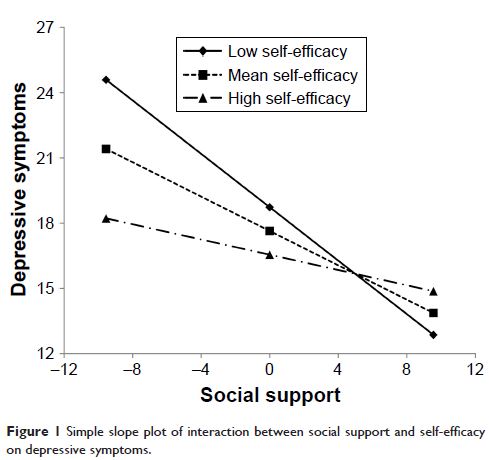
If the interaction was statistically significant, simple slope
analysis was conducted.
Results: The prevalence of depressive symptoms was 58.2%, while 47.5% RA patients
had anxiety symptoms. Social support and social
support × self-efficacy interaction were significantly associated
with depressive symptoms. Social support, self-efficacy and their interaction
were significantly associated with anxiety symptoms. The association between
social support and depressive symptoms was gradually reduced in the low (1
standard deviation [SD] below the mean, B =–0.614, β =–0.876, P <0.001), mean (B =–0.395, β =–0.563, P <0.001) and high (1 SD
above the mean, B =–0.176, β =–0.251, P =0.002) groups of self-efficacy.
For anxiety symptoms, the association was also gradually reduced in the low (B =–0.527, β =–0.774, P <0.001), mean (B =–0.288, β =–423, P <0.001) and high (B =–0.049, β =–0.071, P =0.447) groups of self-efficacy.
Conclusion: There was a high prevalence of depressive and anxiety symptoms in
Chinese RA patients. Self-efficacy could attenuate the associations of social
support with depressive and anxiety symptoms. Adequate social support and
self-efficacy intervention should be provided to alleviate psychological
distress.
Keywords: self-efficacy, social support, psychological distress, moderating role,
rheumatoid arthritis