115195
论文已发表
注册即可获取德孚的最新动态
IF 收录期刊
- 3.6 Breast Cancer (Dove Med Press)
- 4.3 Clin Epidemiol
- 2.6 Cancer Manag Res
- 3.2 Infect Drug Resist
- 4.1 Clin Interv Aging
- 6.1 Drug Des Dev Ther
- 4.1 Int J Chronic Obstr
- 8.7 Int J Nanomed
- 2.5 Int J Women's Health
- 3.2 Neuropsych Dis Treat
- 2.4 OncoTargets Ther
- 2.6 Patient Prefer Adher
- 2.6 Ther Clin Risk Manag
- 3.1 J Pain Res
- 3.5 Diabet Metab Synd Ob
- 4.5 Psychol Res Behav Ma
- 3.4 Nat Sci Sleep
- 2.4 Pharmgenomics Pers Med
- 2.6 Risk Manag Healthc Policy
- 4.6 J Inflamm Res
- 2.3 Int J Gen Med
- 3.9 J Hepatocell Carcinoma
- 3.3 J Asthma Allergy
- 2.5 Clin Cosmet Investig Dermatol
- 3.0 J Multidiscip Healthc

用于消融汉族低危分化型甲状腺癌患者甲状腺切除后残留的放射性碘活性的高低比较
Authors Lv RB, Wang QG, Liu C, Liu F, Zhao Q, Han JG, Ren DL, Liu B, Li CL
Received 19 February 2017
Accepted for publication 5 July 2017
Published 14 August 2017 Volume 2017:10 Pages 4051—4057
DOI https://doi.org/10.2147/OTT.S135145
Checked for plagiarism Yes
Review by Single-blind
Peer reviewers approved by Dr Akshita Wason
Peer reviewer comments 5
Editor who approved publication: Dr XuYu Yang
Aim: The aim of this study was to compare the efficacy and adverse effects
of radioiodine (131I) therapy between two groups
of patients with low-risk differentiated thyroid cancer (DTC) who received 30
mCi or 100 mCi radioiodine for ablation of the thyroid remnant after total
thyroidectomy.
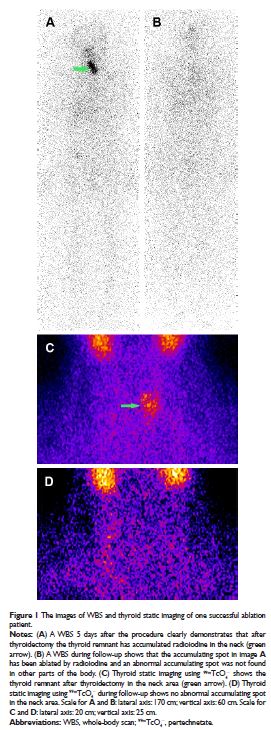
Methods: The study cohort was 173 patients, 85 of whom
were given 30 mCi of radioiodine and the others were given 100 mCi of
radioiodine. Follow-up involved neck ultrasonography, measurement of serum
levels of thyroglobulin and whole-body scans to evaluate the response of
radioiodine treatment. All patients were assessed for adverse effects.
Results: Of the 173 patients, 170 (98.3%) patients
finally achieved successful ablation. The prevalence of successful ablation was
77.6% in the low-dose group versus 71.5% in the high-dose group after the first
dose administration (P =0.36), 79% in the
low-dose group versus 88% in the high-dose group after the second dose
administration (P =0.416), and 97.6% in the
low-dose group versus 98.9% in the high-dose group after the final ablation (P =0.54). We found no significant
differences between the two groups. No patient had an adverse effect with a
severity grade >2 and the prevalence of adverse effects in the high-dose
group was higher than that in the low-dose group, especially for nausea, neck
pain, and sore throat.
Conclusion: These data suggest that a low dose of radioiodine is
as effective as a high dose of radioiodine for ablation of the thyroid remnant
after total thyroidectomy for low-risk DTC. Moreover, low-dose radioiodine
therapy is associated with a lower prevalence of adverse events.
Keywords: differentiated
thyroid cancer, radioiodine, radiotherapy, thyroglobulin