115195
论文已发表
注册即可获取德孚的最新动态
IF 收录期刊
- 3.6 Breast Cancer (Dove Med Press)
- 4.3 Clin Epidemiol
- 2.6 Cancer Manag Res
- 3.2 Infect Drug Resist
- 4.1 Clin Interv Aging
- 6.1 Drug Des Dev Ther
- 4.1 Int J Chronic Obstr
- 8.7 Int J Nanomed
- 2.5 Int J Women's Health
- 3.2 Neuropsych Dis Treat
- 2.4 OncoTargets Ther
- 2.6 Patient Prefer Adher
- 2.6 Ther Clin Risk Manag
- 3.1 J Pain Res
- 3.5 Diabet Metab Synd Ob
- 4.5 Psychol Res Behav Ma
- 3.4 Nat Sci Sleep
- 2.4 Pharmgenomics Pers Med
- 2.6 Risk Manag Healthc Policy
- 4.6 J Inflamm Res
- 2.3 Int J Gen Med
- 3.9 J Hepatocell Carcinoma
- 3.3 J Asthma Allergy
- 2.5 Clin Cosmet Investig Dermatol
- 3.0 J Multidiscip Healthc

原发性输尿管小细胞癌患者的临床病理特征、治疗和治疗效果:病例系列和文献系统综述
Authors Zhong W, Lin R, Zhang L, Jin C, Li X, He Q, Gong K, He Z, Zhou L
Received 4 April 2017
Accepted for publication 6 July 2017
Published 17 August 2017 Volume 2017:10 Pages 4105—4111
DOI https://doi.org/10.2147/OTT.S138769
Checked for plagiarism Yes
Review by Single-blind
Peer reviewers approved by Dr Colin Mak
Peer reviewer comments 2
Editor who approved publication: Dr Jianmin Xu
Purpose: The aim of this case series was to review the standard diagnosis
and treatment procedures of primary small cell carcinoma (SCC) in our
institution and discuss the clinicopathologic characteristics, treatments and
outcomes of patients with primary ureteral SCC.
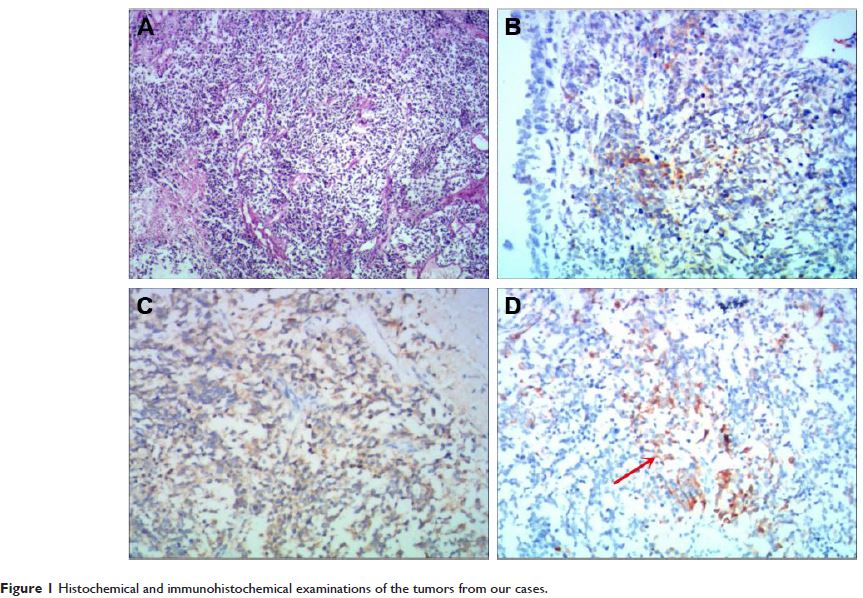
Patients and methods: Patients diagnosed with ureteral SCC in Peking
University First Hospital, Beijing, China, from January 2007 to December 2016
were included. In addition, we performed a systematic literature review, in
October 2016, on case reports and case series of ureteral SCC. The
clinicopathologic characteristics, treatments and outcomes of this rare disease
were analyzed.
Results: A total of 32 patients were included in our
analysis (4 cases from our institution and 28 cases from the literature). Most
patients (71.0%) were male with an average age of 66.6 years (range
48–80 years). The most common symptoms were hematuria (n=14, 48.3%) and
flank pain (n=14, 48.3%). All patients underwent surgery, with 12 (37.5%)
patients undergoing multimodality therapy. Regional or distant recurrences
developed in 11 patients, among which only 1 patient had bladder recurrence.
The overall median survival of the patients was 17 months, with 1- and
3-year survival rates of 51.9% and 30.3%, respectively. In a univariate
analysis, female (P =0.009), pure SCC (P =0.03) and advanced T stage (P =0.04) were associated with worse
overall survival.
Conclusion: Ureteral SCCs are extremely rare neoplasms with
aggressive natural history and poor prognosis. T stage, tumor components and
gender may be important factors influencing prognosis. A multimodality
treatment is recommended for management. However, further studies are needed to
improve the treatment strategy.
Keywords: carcinoma,
neuroendocrine, small cell, ureteral carcinoma, systematic review