117333
论文已发表
注册即可获取德孚的最新动态
IF 收录期刊
- 3.6 Breast Cancer (Dove Med Press)
- 4.3 Clin Epidemiol
- 2.6 Cancer Manag Res
- 3.2 Infect Drug Resist
- 4.1 Clin Interv Aging
- 6.1 Drug Des Dev Ther
- 4.1 Int J Chronic Obstr
- 8.7 Int J Nanomed
- 2.5 Int J Women's Health
- 3.2 Neuropsych Dis Treat
- 2.4 OncoTargets Ther
- 2.6 Patient Prefer Adher
- 2.6 Ther Clin Risk Manag
- 3.1 J Pain Res
- 3.5 Diabet Metab Synd Ob
- 4.5 Psychol Res Behav Ma
- 3.4 Nat Sci Sleep
- 2.4 Pharmgenomics Pers Med
- 2.6 Risk Manag Healthc Policy
- 4.6 J Inflamm Res
- 2.3 Int J Gen Med
- 3.9 J Hepatocell Carcinoma
- 3.3 J Asthma Allergy
- 2.5 Clin Cosmet Investig Dermatol
- 3.0 J Multidiscip Healthc

藻酸盐寡糖 (Alginate oligosaccharide) 通过抑制硝化和氧化应激和内质网应激介导的细胞凋亡来减轻心肌再灌注损伤
Authors Guo JJ, Xu FQ, Li YH, Li J, Liu X, Wang XF, Hu LG, An Y
Received 18 May 2017
Accepted for publication 18 July 2017
Published 18 August 2017 Volume 2017:11 Pages 2387—2397
DOI https://doi.org/10.2147/DDDT.S142118
Checked for plagiarism Yes
Review by Single-blind
Peer reviewers approved by Dr Lucy Goodman
Peer reviewer comments 2
Editor who approved publication: Dr Anastasios Lymperopoulos
Abstract: Alginate
oligosaccharide (AOS) has recently demonstrated the ability to protect against
acute doxorubicin cardiotoxicity and neurodegenerative disorders by inhibiting
oxidative stress and endoplasmic reticulum (ER) stress-mediated apoptosis,
which are both involved in myocardial ischemia/reperfusion (I/R) injury. In the
present study, we investigated whether pretreatment with AOS protects against
myocardial I/R injury in mice and explored potential cardioprotective
mechanisms. AOS pretreatment significantly decreased the infarct size, reduced
the cardiac troponin-I concentration, and ameliorated the cardiac dysfunction.
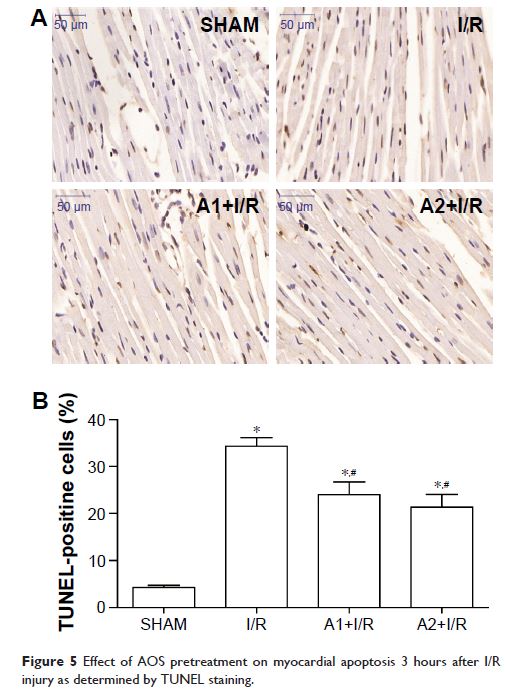
Accompanied with the reduced cardiac injury, AOS pretreatment clearly decreased
I/R-induced myocardial apoptosis. With regard to mechanism, AOS pretreatment
markedly attenuated nitrative/oxidative stress, as evidenced by decreases in
3-nitrotyrosine content and superoxide generation, and downregulated inducible
nitric oxide synthase, NADPH oxidase2, and 4-hydroxynonenal. Moreover, AOS
pretreatment decreased myocardial apoptosis by inhibiting the ER
stress-mediated apoptosis pathway, which is reflected by the downregulation of
C/EBP homologous protein, glucose-regulated protein 78, caspase-12, and
Bcl-2-associated X protein, and by the upregulation of the anti-apoptotic
protein B-cell lymphoma-2. Collectively, these findings demonstrate that AOS
renders the heart resistant to I/R injury, at least in part, by inhibiting
nitrative/oxidative stress and ER stress-mediated apoptosis.
Keywords: alginate oligosaccharide, myocardial ischemia/reperfusion injury,
nitrative/oxidative stress, endoplasmic reticulum, cardioprotection