117333
论文已发表
注册即可获取德孚的最新动态
IF 收录期刊
- 3.6 Breast Cancer (Dove Med Press)
- 4.3 Clin Epidemiol
- 2.6 Cancer Manag Res
- 3.2 Infect Drug Resist
- 4.1 Clin Interv Aging
- 6.1 Drug Des Dev Ther
- 4.1 Int J Chronic Obstr
- 8.7 Int J Nanomed
- 2.5 Int J Women's Health
- 3.2 Neuropsych Dis Treat
- 2.4 OncoTargets Ther
- 2.6 Patient Prefer Adher
- 2.6 Ther Clin Risk Manag
- 3.1 J Pain Res
- 3.5 Diabet Metab Synd Ob
- 4.5 Psychol Res Behav Ma
- 3.4 Nat Sci Sleep
- 2.4 Pharmgenomics Pers Med
- 2.6 Risk Manag Healthc Policy
- 4.6 J Inflamm Res
- 2.3 Int J Gen Med
- 3.9 J Hepatocell Carcinoma
- 3.3 J Asthma Allergy
- 2.5 Clin Cosmet Investig Dermatol
- 3.0 J Multidiscip Healthc

Ki-67 免疫组化表达在胃癌中的临床病理和预后意义:一个系统综述和荟萃分析
Authors Liu G, Xiong DS, Zeng JJ, Chen BR, Huang ZJ
Received 3 June 2017
Accepted for publication 1 August 2017
Published 1 September 2017 Volume 2017:10 Pages 4321—4328
DOI https://doi.org/10.2147/OTT.S143089
Checked for plagiarism Yes
Review by Single-blind
Peer reviewers approved by Dr Colin Mak
Peer reviewer comments 2
Editor who approved publication: Dr Carlos Vigil Gonzales
Abstract: The prognostic significance
of Ki-67 in patients with gastric cancer (GC) remains controversial. The aim of
our meta-analysis is to evaluate its association with clinicopathological
characteristics and prognostic value in patients with GC. PubMed, EMBASE, and
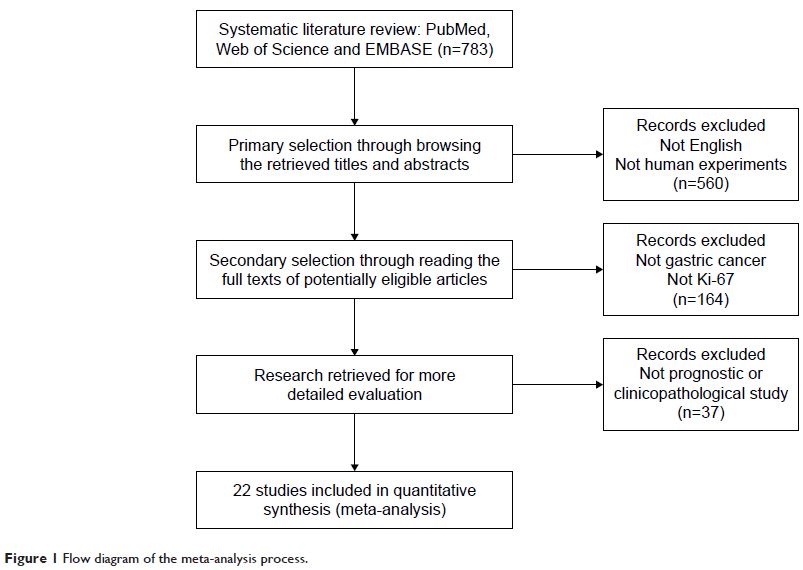
Web of Science were systematically searched up to May 2017. Twenty-two studies
including 3,825 patients with GC were analyzed. The meta-analysis indicated
that the incidence difference of Ki-67 expression in GC patients was
significant when comparing the older group to younger group (odds ratio [OR]
=1.44, 95% confidence interval [CI] 1.19, 1.75), lymph node positive group to
negative group (OR =1.49, 95% CI 1.20, 1.84), the large size tumor group to the
small size tumor group (OR =1.27, 95% CI 1.24, 1.68) and the TNM stage III+IV
group to TNM stage I+II group (OR =2.28, 95% CI 1.66, 3.12). However, no
statistical differences existed in gender. The detection of Ki-67 significantly
correlated with the overall survival of patients (hazard ratio =1.51, 95% CI
1.31, 1.72). Our study suggested that Ki-67 overexpression was associated with
poor prognosis in GC patients. Ki-67 positive rates may be associated with age,
lymph node metastasis, tumor size, and TNM staging system in GC patients.
Keywords: Ki-67, gastric
cancer, meta-analysis, prognostic