115195
论文已发表
注册即可获取德孚的最新动态
IF 收录期刊
- 3.6 Breast Cancer (Dove Med Press)
- 4.3 Clin Epidemiol
- 2.6 Cancer Manag Res
- 3.2 Infect Drug Resist
- 4.1 Clin Interv Aging
- 6.1 Drug Des Dev Ther
- 4.1 Int J Chronic Obstr
- 8.7 Int J Nanomed
- 2.5 Int J Women's Health
- 3.2 Neuropsych Dis Treat
- 2.4 OncoTargets Ther
- 2.6 Patient Prefer Adher
- 2.6 Ther Clin Risk Manag
- 3.1 J Pain Res
- 3.5 Diabet Metab Synd Ob
- 4.5 Psychol Res Behav Ma
- 3.4 Nat Sci Sleep
- 2.4 Pharmgenomics Pers Med
- 2.6 Risk Manag Healthc Policy
- 4.6 J Inflamm Res
- 2.3 Int J Gen Med
- 3.9 J Hepatocell Carcinoma
- 3.3 J Asthma Allergy
- 2.5 Clin Cosmet Investig Dermatol
- 3.0 J Multidiscip Healthc

CdTe 量子点的使用剂量和时间对小鼠肝肾抗氧化能力的影响
Authors Wang J, Sun H, Meng P, Wang M, Tian M, Xiong Y, Zhang X, Huang P
Received 17 May 2017
Accepted for publication 8 August 2017
Published 1 September 2017 Volume 2017:12 Pages 6425—6435
DOI https://doi.org/10.2147/IJN.S142008
Checked for plagiarism Yes
Review by Single-blind
Peer reviewers approved by Dr Akshita Wason
Peer reviewer comments 2
Editor who approved publication: Dr Linlin Sun
Abstract: Although quantum dot (QD)-induced toxicity occurs due to free
radicals, generation of oxidative stress mediated by reactive oxygen species
(ROS) formation is considered an important mechanism. However, free radical
mechanisms are essentially difficult to elucidate at the molecular level
because most biologically relevant free radicals are highly reactive and
short-lived, making them difficult to directly detect, especially in vivo.
Antioxidants play an important role in preventing or, in most cases, limiting
the damage caused by ROS. Healthy people and animals possess many endogenous
antioxidative substances that scavenge free radicals in vivo to maintain the
redox balance and genome integrity. The antioxidant capacity of an organism is
highly important but seldom studied. In this study, the dose and time effects
of CdTe QDs on the antioxidant capacities of the liver and kidneys were
investigated in mice using the electron paramagnetic resonance (EPR)
spin-trapping technique. We found that the liver and kidneys of healthy mice
contain specific antioxidant capacities that scavenge ·OH and ·O2-. Furthermore,
oxidative stress markers (superoxide dismutase [SOD], catalase [CAT],
glutathione peroxidase [GPx], glutathione [GSH] and malondialdehyde [MDA]) were
examined. In dose course studies, the free radical scavenging efficiencies of
the liver and kidneys were found to gradually decrease with increasing
concentration of CdTe QD exposure. The activities and levels of SOD, CAT, GPx
and MDA were observed to increase in treated groups, whereas those of GSH were
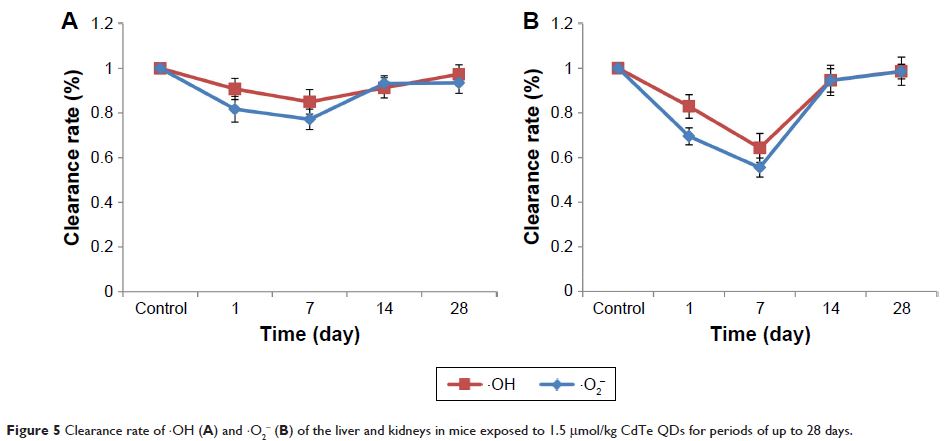
reduced. The time course studies revealed that the QD-induced antioxidant
efficiency reduction was time dependent with GSH decrease and could recover
after a period of time. These experimental results offer new information on QD toxicity
in vivo. Specifically, CdTe QDs can deplete GSH to reduce the elimination
ability of the liver and kidneys for ·OH and ·O2-, thus inducing oxidative damage to tissues.
Keywords: quantum dot,
antioxidative capacity, free radical elimination, hydroxyl radical, superoxide
anion radical, spin-trapping