115195
论文已发表
注册即可获取德孚的最新动态
IF 收录期刊
- 3.6 Breast Cancer (Dove Med Press)
- 4.3 Clin Epidemiol
- 2.6 Cancer Manag Res
- 3.2 Infect Drug Resist
- 4.1 Clin Interv Aging
- 6.1 Drug Des Dev Ther
- 4.1 Int J Chronic Obstr
- 8.7 Int J Nanomed
- 2.5 Int J Women's Health
- 3.2 Neuropsych Dis Treat
- 2.4 OncoTargets Ther
- 2.6 Patient Prefer Adher
- 2.6 Ther Clin Risk Manag
- 3.1 J Pain Res
- 3.5 Diabet Metab Synd Ob
- 4.5 Psychol Res Behav Ma
- 3.4 Nat Sci Sleep
- 2.4 Pharmgenomics Pers Med
- 2.6 Risk Manag Healthc Policy
- 4.6 J Inflamm Res
- 2.3 Int J Gen Med
- 3.9 J Hepatocell Carcinoma
- 3.3 J Asthma Allergy
- 2.5 Clin Cosmet Investig Dermatol
- 3.0 J Multidiscip Healthc

层叠纳米颗粒同时加载吉西他滨 (Gemcitabine) 和铂 (IV) 前药用于对肺癌进行协同性的联合治疗
Authors Zhang R, Ru Y, Gao Y, Li J, Mao S
Received 1 June 2017
Accepted for publication 2 August 2017
Published 5 September 2017 Volume 2017:11 Pages 2631—2642
DOI https://doi.org/10.2147/DDDT.S143047
Checked for plagiarism Yes
Review by Single-blind
Peer reviewers approved by Dr Ashok Kumar Pandurangan
Peer reviewer comments 3
Editor who approved publication: Dr Sukesh Voruganti
Purpose: Cisplatin
plus gemcitabine (GEM) is a standard regimen for the first-line treatment of
advanced non-small cell lung cancer. The aim of this study was to prepare
biocompatible and biodegradable polymeric prodrugs and construct nanoparticles
(NPs) with layer-by-layer (LbL) technique.
Methods: Platinum (Pt) (IV) complex with a carboxyl group was conjugated to
the amino group of chitosan (CH), resulting in a CH-Pt conjugation with
positive charge. GEM with amino group was conjugated to the carboxyl group of
hyaluronic acid (HA), resulting in a HA-GEM conjugation with negative charge.
Novel LbL NPs consisting of the CH-Pt core and the HA-GEM layer, named as
HA-GEM/CH-Pt NPs, were constructed. The physicochemical properties of the
HA-GEM/CH-Pt NPs were investigated. In vitro cytotoxicity against human
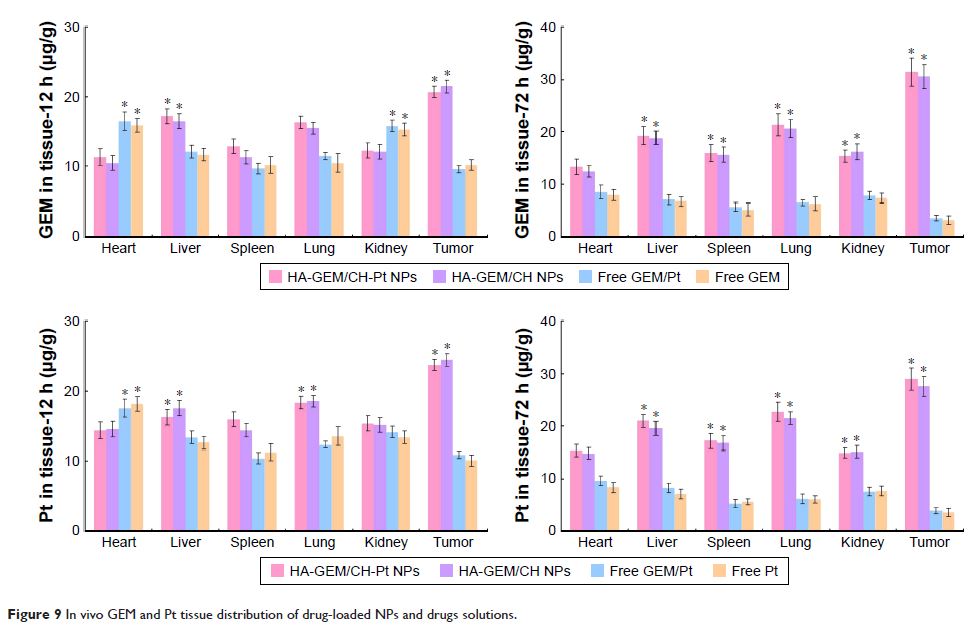
non-small lung cancer cells (NCl-H460 cells) was investigated, and in vivo
antitumor efficiency was evaluated on mice bearing NCl-H460 cells xenografts.
Results: HA-GEM/CH-Pt NPs have a size of about 187 nm, a zeta potential
value of -21 mV and high drug encapsulation efficiency of 90%. The drug release
of HA-GEM/CH-Pt NPs exhibited a sustained behavior. HA-GEM/CH-Pt NPs could
significantly enhance in vitro cytotoxicity and in vivo antitumor effect
against lung cancer animal model compared to the single-drug-loaded NPs and
free drug solutions.
Conclusion: The results demonstrated that the HA-GEM/CH-Pt NPs might be a promising
system for the synergetic treatment of lung carcinoma.
Keywords: lung cancer, combination chemotherapy, cisplatin, gemcitabine,
layer-by-layer technology