115195
论文已发表
注册即可获取德孚的最新动态
IF 收录期刊
- 3.6 Breast Cancer (Dove Med Press)
- 4.3 Clin Epidemiol
- 2.6 Cancer Manag Res
- 3.2 Infect Drug Resist
- 4.1 Clin Interv Aging
- 6.1 Drug Des Dev Ther
- 4.1 Int J Chronic Obstr
- 8.7 Int J Nanomed
- 2.5 Int J Women's Health
- 3.2 Neuropsych Dis Treat
- 2.4 OncoTargets Ther
- 2.6 Patient Prefer Adher
- 2.6 Ther Clin Risk Manag
- 3.1 J Pain Res
- 3.5 Diabet Metab Synd Ob
- 4.5 Psychol Res Behav Ma
- 3.4 Nat Sci Sleep
- 2.4 Pharmgenomics Pers Med
- 2.6 Risk Manag Healthc Policy
- 4.6 J Inflamm Res
- 2.3 Int J Gen Med
- 3.9 J Hepatocell Carcinoma
- 3.3 J Asthma Allergy
- 2.5 Clin Cosmet Investig Dermatol
- 3.0 J Multidiscip Healthc

伊立替康 (Irinotecan) 和 5-氟尿嘧啶共负载的透明质酸修饰的层叠纳米颗粒用于胃癌靶向治疗
Authors Gao Z, Li Z, Yan J, Wang P
Received 1 May 2017
Accepted for publication 30 June 2017
Published 5 September 2017 Volume 2017:11 Pages 2595—2604
DOI https://doi.org/10.2147/DDDT.S140797
Checked for plagiarism Yes
Review by Single-blind
Peer reviewers approved by Dr Amy Norman
Peer reviewer comments 2
Editor who approved publication: Professor Jianbo Sun
Abstract: For targeted gastric carcinoma therapy, hyaluronic acid
(HA)-modified layer-by-layer nanoparticles (NPs) are applied for improving
anticancer treatment efficacy and reducing toxicity and side effects. The aim
of this study was to develop HA-modified NPs for the co-loading of irinotecan
(IRN) and 5-fluorouracil (5-FU). A novel polymer–chitosan (CH)–HA hybrid
formulation (HA–CH–IRN/5-FU NPs) consisting of poly(D,L-lactide-co -glycolide) (PLGA) and IRN as
the core, CH and 5-FU as a shell on the core and HA as the outmost layer was
prepared. Its morphology, average size, zeta potential and drug encapsulation
ability were evaluated. Human gastric carcinoma cells (MGC803 cells) and
cancer-bearing mice were used for the testing of in vitro cytotoxicity and
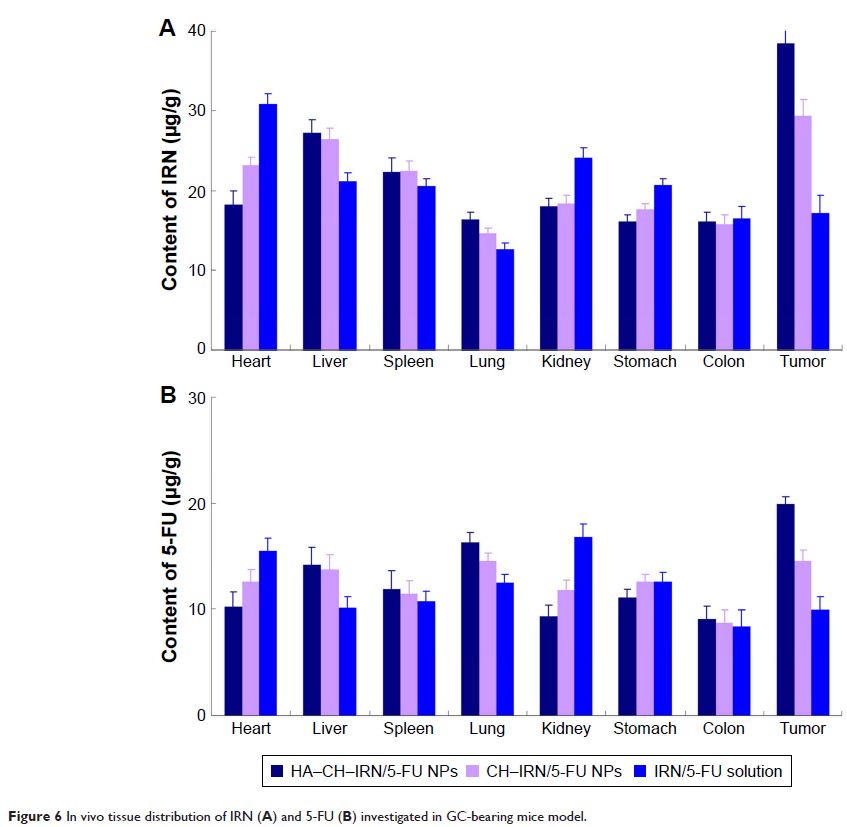
in vivo antitumor efficiency of NPs. HA–CH–IRN/5-FU NPs displayed enhanced
antitumor activity in vitro and in vivo than non-modified NPs, single
drug-loaded NPs and drugs solutions. The results demonstrate that HA–CH–IRN/5-FU
NPs can achieve impressive antitumor activity and the novel targeted drug
delivery system offers a promising strategy for the treatment of gastric
cancer.
Keywords: gastric
carcinoma, irinotecan, 5-fluorouracil, hyaluronic acid, layer-by-layer nanoparticles