115195
论文已发表
注册即可获取德孚的最新动态
IF 收录期刊
- 3.6 Breast Cancer (Dove Med Press)
- 4.3 Clin Epidemiol
- 2.6 Cancer Manag Res
- 3.2 Infect Drug Resist
- 4.1 Clin Interv Aging
- 6.1 Drug Des Dev Ther
- 4.1 Int J Chronic Obstr
- 8.7 Int J Nanomed
- 2.5 Int J Women's Health
- 3.2 Neuropsych Dis Treat
- 2.4 OncoTargets Ther
- 2.6 Patient Prefer Adher
- 2.6 Ther Clin Risk Manag
- 3.1 J Pain Res
- 3.5 Diabet Metab Synd Ob
- 4.5 Psychol Res Behav Ma
- 3.4 Nat Sci Sleep
- 2.4 Pharmgenomics Pers Med
- 2.6 Risk Manag Healthc Policy
- 4.6 J Inflamm Res
- 2.3 Int J Gen Med
- 3.9 J Hepatocell Carcinoma
- 3.3 J Asthma Allergy
- 2.5 Clin Cosmet Investig Dermatol
- 3.0 J Multidiscip Healthc

木兰酚 (Magnolol) 对念珠菌属菌株 (Candida spp.) 的体外抗菌活性
Authors Zhou PR, Fu JY, Hua H, Liu XS
Received 15 July 2017
Accepted for publication 17 August 2017
Published 6 September 2017 Volume 2017:11 Pages 2653—2661
DOI https://doi.org/10.2147/DDDT.S146529
Checked for plagiarism Yes
Review by Single-blind
Peer reviewers approved by Dr Akshita Wason
Peer reviewer comments 2
Editor who approved publication: Dr Anastasios Lymperopoulos
Abstract: Candida spp. cause various infections involving the skin, mucosa, deep
tissues, and even life-threatening candidemia. They are regarded as an
important pathogen of nosocomial bloodstream infection, with a high mortality
rate. As a result of prolonged exposure to azoles, the therapeutic failure
associated with azoles resistance has become a serious challenge in clinical
situations. Therefore, novel, alternative antifungals are required urgently. In
the present study, the CLSI M-27A broth microdilution method and the
2,3-Bis-(2-methoxy-4-nitro-5-sulfophenyl)-2H-tetrazolium-5-carboxanilide (XTT)
reduction assay were used to evaluate the antifungal effects of magnolol
against various standard Candida strains
in planktonic mode and biofilm formation, respectively. The antifungal activity
of magnolol was demonstrated in planktonic C.
albicans and non-albicans Candida species,
especially fluconazole-resistant Candida krusei ,
with the minimum inhibitory concentrations ranging from 10 to 40 µg/mL. The
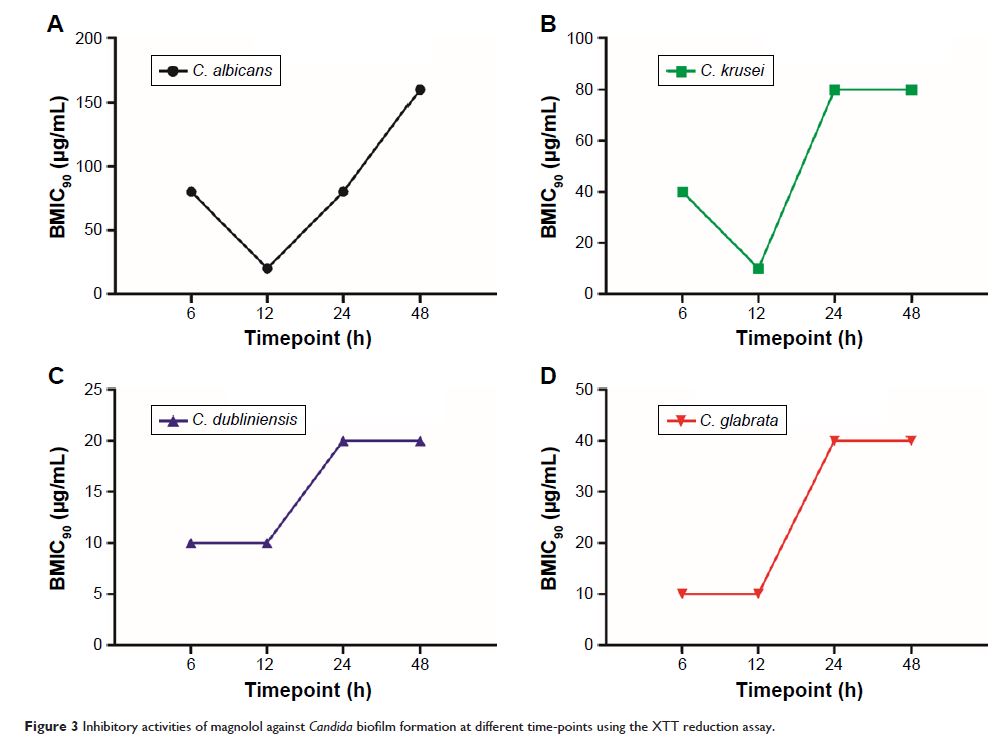
BMIC90 (minimum concentration with 90% Candida biofilm inhibited)
values of magnolol ranged from 20 to 160 µg/mL, whereas the BMIC90 values of fluconazole were more than 128
µg/mL. As an alternative and broad-spectrum antifungal agent, magnolol might be
of benefit to the treatment of refractory Candida infection.
Keywords: magnolol,
inhibition, Candida spp., biofilm